China Pushes Back Against US Over Iran and Cuba in UN Speech
 |
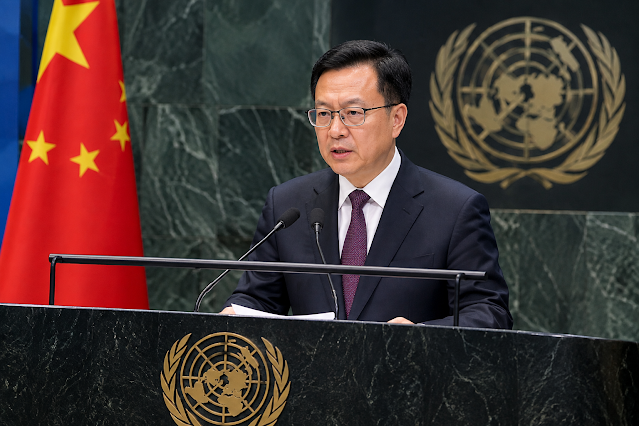
| China’s representative delivers remarks at the United Nations in New York. |
United Nations – China used its address to the United Nations General Assembly on Saturday to push back against U.S. policies toward Iran and Cuba, calling for respect for national sovereignty and opposing unilateral military action.
Chinese Vice President Han Zheng, speaking at the UN General Assembly, did not directly name the United States. However, his remarks addressed several issues at the center of Washington’s current foreign policy, including the conflict involving Iran and pressure on Cuba.
China calls for respect for Gulf sovereignty
Han said the sovereignty and security of Middle Eastern countries, including states in the Gulf, should be respected.
He also called for disputes to be settled through dialogue and consultation and opposed unilateral military actions that violate the UN Charter or bypass authorization from the UN Security Council.
The comments came as the United States remains involved in an ongoing conflict with Iran. The Iran conflict has also affected regional security and international energy and shipping routes, including the strategically important Strait of Hormuz.
China has previously called for the Strait to be reopened and for Iran and the United States to return to negotiations. Chinese Foreign Minister Wang Yi made a similar appeal during talks with Iranian Foreign Minister Abbas Araghchi earlier this month.
Beijing also raises Cuba
Han also addressed the situation in Cuba, urging the “relevant country” to stop using the threat of force against Cuba and to lift the blockade and sanctions imposed on the island.
The remarks came days after U.S. President Donald Trump used his own UN General Assembly speech to say that Cuba’s communist government was under intense pressure and that he expected political change on the island.
The Cuban delegation walked out of the UN chamber during Trump’s remarks on Cuba, according to Reuters.
China’s statement therefore placed Cuba alongside Iran as part of a broader argument against unilateral pressure and military action.
Different messages at the UN
Han’s speech contrasted with Trump’s UN address earlier in the week.
Trump defended U.S. military action against Iran and called on Tehran to reopen the Strait of Hormuz and return to negotiations. He also spoke forcefully about Cuba and said his administration was seeking fundamental change there.
China, by contrast, emphasized dialogue, respect for sovereignty and adherence to the UN Charter.
Han also called on major countries to take responsibility for international peace and security and said global trade and industrial supply chains should remain stable and unobstructed.
China links Iran tensions to wider regional stability
Beijing’s position comes as China seeks to present diplomacy as the preferred way to resolve the Iran conflict.
Earlier in September, Chinese Foreign Minister Wang Yi told Iran’s Foreign Minister Abbas Araghchi that China opposed the use of force and supported rebuilding a negotiating mechanism between Washington and Tehran.
Wang also urged all sides to take steps to reopen the Strait of Hormuz and protect the safe passage of international waterways and global energy supplies.
China has therefore continued to call for negotiations while also stressing the importance of regional sovereignty and international trade.
Broader message on international affairs
Han’s UN address also touched on the Palestinian issue and Ukraine.
On Gaza and the West Bank, he called for governance based on the principle of Palestinians governing Palestine and urged progress toward a two-state solution.
On Ukraine, he said China would continue to play what he described as a constructive role toward a political settlement.
The speech highlighted Beijing’s broader diplomatic position: opposing unilateral military action, supporting dialogue and emphasizing the role of the UN and international law in resolving conflicts.
What the speech means
China’s UN intervention comes at a sensitive moment in relations between Beijing and Washington. Just days earlier, Chinese President Xi Jinping and Trump held talks in Washington, followed by a state dinner and other meetings.
Despite those high-level diplomatic contacts, Beijing’s UN message showed that the two countries continue to hold significantly different positions on several major international issues.
For Iran, China is calling for negotiations and the reopening of international waterways. On Cuba, Beijing is opposing U.S. pressure and calling for an end to the blockade and sanctions.
Han’s remarks did not announce any new Chinese military or economic measure. Instead, the speech focused on diplomacy, sovereignty, the UN Charter and opposition to unilateral military action.
Key Facts
• China’s Vice President Han Zheng addressed the UN General Assembly on September 26, 2026.
• He did not directly name the United States in his remarks on Iran and Cuba.
• China said the sovereignty and security of Gulf countries should be respected.
• Beijing opposed unilateral military action that violates the UN Charter or bypasses the Security Council.
• China called for the U.S. blockade and sanctions on Cuba to be lifted.
• Han also called for dialogue on international conflicts and supported a two-state solution for Palestine.
• China has separately urged Iran and the United States to return to negotiations and reopen the Strait of Hormuz.
Sources: Reuters, Anadolu Agency, UN records and China’s Ministry of Foreign Affairs.