
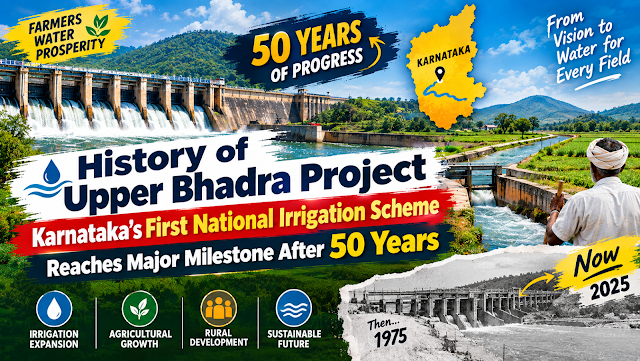
History of Upper Bhadra Project: Karnataka’s First National Irrigation Scheme Reaches Major Milestone After 50 Years

BENGALURU: Marking a monumental milestone in India’s water infrastructure history, Karnataka’s ambitious Upper Bhadra Project has achieved a historic breakthrough. On September 6, 2026, the state successfully initiated a trial run, releasing 3 TMC of water from the Bhadra reservoir into the Chitradurga Branch Canal. This operational initiation has effectively ended a five-decade-long grueling wait for the residents of central Karnataka’s drought-prone semi-arid zones.
Complete History: From 1969 to 2026
The structural planning of the Upper Bhadra Irrigation project spans across several political eras and environmental transitions:
• The Genesis (1969): The earliest conceptual proposal for this mega irrigation network was envisioned way back in 1969 by the then Chief Minister of Karnataka, S. Nijalingappa, to deliver surface water to the chronically dry districts of the state.
• The Planning Era (2001-2003): For nearly three decades, the design remained in conceptual phases. A concrete masterplan was finally drafted in 2001, which led to the approval of Stage-I by the S.M. Krishna administration in 2003 with an initial budget allocation.
• Ground Implementation (2008): The physical construction and actual ground excavation on the project officially commenced on October 15, 2008. However, the development faced massive delays due to statutory forest clearances and land acquisition logjams.
• National Status (2022): The Union Government of India formally approved the historic declaration of making it Karnataka’s first-ever project to receive ‘National Project Status’, securing substantial central funding assistance.
• Current Status (September 2026): With the successful launch of the recent water trials, Major and Medium Irrigation authorities have confirmed that Phase-1 of the project will be fully finished by the end of 2026, resolving massive agricultural distress.
Financial Value and Operational Structure
Constructed at a re-revised dynamic cost level of over ₹21,500 crores, this massive lift irrigation scheme operates on a specialized two-stage mechanism designed to lift water from the Tunga and Bhadra rivers. The primary core objective focuses on recharging dried-up groundwater tables, supplying clean drinking water, filling 367 minor irrigation tanks, and directly providing micro-irrigation facilities across 2.25 lakh hectares of parched agricultural fields spread across Chikkamagaluru, Chitradurga, Tumakuru, and Davanagere districts.