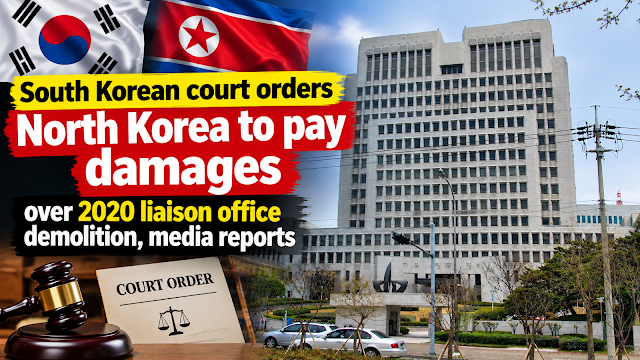
South Korea Orders North Korea to Pay: Seoul Court Slaps $32.5 Million Damages Over 2020 Liaison Office Blasts
 |
| Seoul Central Court Orders North Korea to Compensate for Blowing Up Joint Diplomatic Facility ( photo credit: Indrajit explore) |
In an unprecedented legal victory for global diplomacy, a South Korean court (Seoul Central District Court) issued a historic ruling on Wednesday (September 16, 2026), officially ordering the North Korean state to pay 44.6 billion won (approximately $32.5 million or ₹270 crore) in damages.
The significant monetary compensation is designated for the physical destruction of the joint Inter-Korean Liaison Office in 2020. This verdict marks the first time a South Korean civil court has ever upheld a sovereign damages claim filed directly against the state of North Korea.
Recapping the Explosive 2020 Kaesong Building Demolition
To ensure your news website provides accurate historical context to its readers, here are the core facts behind this cross-border dispute:
• The Sanctuary of Peace: Established originally in 2018 in the North Korean border city of Kaesong, the joint liaison office acted as an essential diplomatic hub where officials from both nations could engage in face-to-face negotiations to reduce military friction.
• The Sudden Detonation: In June 2020, severe tensions flared up after South Korean civic activists sent anti-regime propaganda leaflets across the border via helium balloons. Outraged by this action, the North Korean military completely blew up the multi-story liaison building on June 16, 2020.
• The Ministry’s Lawsuit: In response to the attack, South Korea’s Unification Ministry officially filed a property damages lawsuit in June 2023, seeking 10.25 billion won for the destroyed office and 34.45 billion won for a severely impacted adjacent administrative support facility.
A Banned In-Absentia Hearing: Can Seoul Enforce the Fine?
The Seoul court thoroughly validated the South Korean government’s claims, though the actual enforcement of the massive fine faces severe practical bottlenecks:
• In-Absentia Proceeding: Because North Korean state entities naturally refused to send legal representation to the capital, the entire trial was legally concluded through public litigation notices without any active input from Pyongyang.
• No Asset Seizure Channels: Prominent international law experts and state media analysts confirm that the South Korean government holds no practical enforcement mechanism to physically compel the North Korean regime to pay this fine.
• Accumulating Compound Interest: To reinforce the ruling, the presiding judge ordered that a 5% baseline interest rate applies from the 2020 incident date, escalating to a strict 12% annual interest penalty until total compensation is legally delivered.
The Long-Term Matrix of Inter-Korean Relations (Conclusion)
South Korea’s Unification Ministry released an immediate statement following the verdict, stating that they respect the court’s objective judgment and remain open to peaceful diplomatic channels. However, this legal escalation lands at a time when relations between the two nuclear neighbors are at an all-time low. North Korean Supreme Leader Kim Jong Un has officially designated South Korea as the country’s “principal enemy state” and permanently dismantled all communication lines. While this civil ruling remains largely symbolic, it legally solidifies South Korea’s sovereign claims on the international stage against state-sponsored aggression.