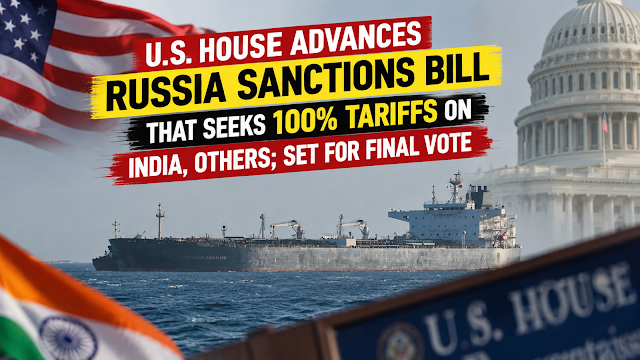
US Tariff Threat on India: House Advances Russia Sanctions Bill Seeking 100% Duties Over Energy Trade

A highly critical development has emerged from Washington that could significantly impact global commerce and India-US bilateral trade relations. The U.S. House of Representatives has cleared a major procedural hurdle, advancing a sweeping sanctions bill that could authorize the U.S. administration to impose aggressive 100% import tariffs on countries continuing to trade with Russia.
The package, formally known as the ‘Lindsey O. Graham Sanctioning Russia and Iran Act of 2026’, cleared a tight procedural vote by a 214-211 margin on Tuesday evening (September 15, 2026). The vote succeeded after two Democratic lawmakers broke ranks with their party leadership to align with House Republicans. The bill is now firmly set for a final House floor vote.
Why is Washington Targeting India with a 100% Secondary Tariff Threat?
The primary driver behind this aggressive legislative push is the United States’ ongoing strategy to choke off Moscow’s financial flows, which Washington asserts are directly funding the conflict against Ukraine.
• The Core Trigger: Following the eruption of the geopolitical crisis in Europe, New Delhi stepped up its acquisition of deeply discounted Russian seaborne crude oil to stabilize its domestic energy costs. This has resulted in Russia making up roughly half of India’s total crude import mix.
• Tariff Powers: If the bill successfully crosses the final legislative votes and is signed into law, it will grant statutory authority to the U.S. President to impose punitive tariffs ranging up to 100% on goods originating from major Russian trading partners.
• Ten Nations Explicitly Named: An official amendment introduced by House lawmakers seeks to explicitly list 10 specific countries as eligible for these secondary tariffs. The target list prominently features India and China, alongside Türkiye, the UAE, Singapore, Hungary, Slovakia, Azerbaijan, Kazakhstan, and the Kyrgyz Republic.
Intense Political Drama and Internal Fractures in the U.S. Congress
The path toward advancing this heavy sanctions package has exposed notable policy rifts within the American legislative bodies:
• Senate Foundation: This development follows an overwhelming 86-11 bipartisan victory for the core bill in the U.S. Senate last month.
• The Legislative Resistance: In the House, the bill faced sharp resistance from some lawmakers. Notably, the ranking member of the House Foreign Affairs Committee staunchly opposed the legislation, arguing that it hands over unchecked, sweeping trade weaponization powers to the President without proper democratic guardrails.
• Defeated Exemptions: Competing amendments were filed behind closed doors to either completely eliminate Section 113 (the tariff provision) or strike India from the designated penalty list. However, the House Rules Committee officially rejected those modification attempts, keeping the tariff vulnerabilities fully active in the final draft.
The Looming Impact on the Indian Economy (Conclusion)
If this sweeping bill secures its final passage through the House and receives the presidential signature, it could trigger massive structural complications for India’s high-value export sectors—including engineering goods, pharmaceuticals, textiles, and chemicals.
New Delhi has consistently defended its sovereign energy policy, reiterating that its crude oil trade is governed entirely by national energy security and consumer affordability considerations rather than geopolitical alignments. With the critical final vote arriving on Wednesday (September 16), international economic observers are keeping a very close watch on Washington.