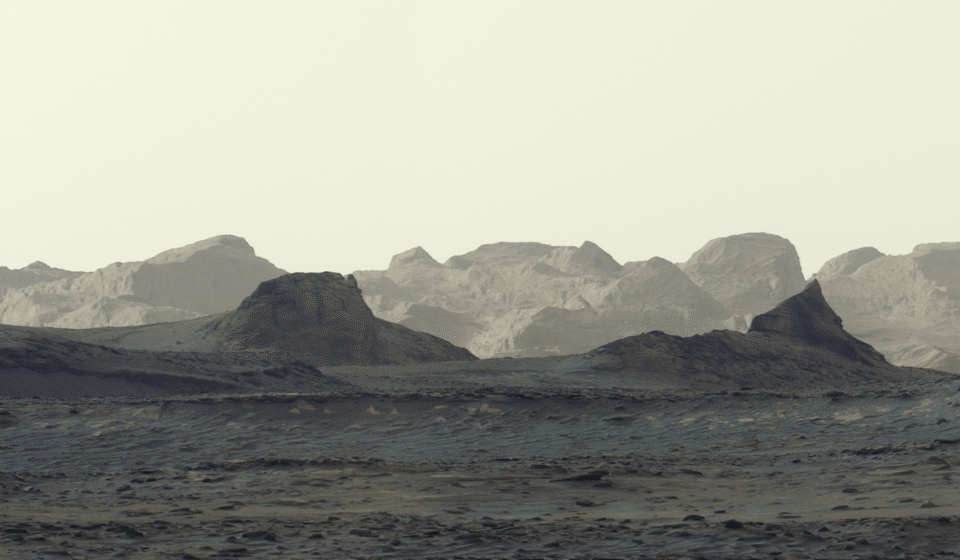

NASA’s Curiosity rover has captured a striking view of dawn on Mars, revealing unusual wind-carved rock formations on the slopes of Mount Sharp under the planet’s early morning light.
The newly released panorama shows distant cliffs known as yardangs, which stand out against the Martian horizon as sunlight begins illuminating the landscape. NASA said the image provides one of the clearest views yet of these distinctive geological formations.
Curiosity Captures Martian Dawn
The panorama was captured by Curiosity’s Mastcam on August 11, 2026, the rover’s 4,982nd Martian day, or sol. The images were taken at around 8:30 a.m. local Mars time and later stitched together to create the wider panorama.
NASA said the image was processed without the usual white balancing used for many Curiosity photographs. That decision preserved the appearance of the early morning scene, including distinctive blue tones in the foreground and the warm colors of the Martian landscape.
The result provides a dramatic look at the transition between darkness and daylight on the Red Planet.
Mysterious Yardangs Draw Scientists’ Attention
The most prominent features in the image are the jagged rock formations known as yardangs. These structures were shaped by wind over extremely long periods and form part of a distinctive geological layer on Mount Sharp.
The yardang layer stretches for approximately 10 miles (16 kilometers) across the northwestern section of Mount Sharp, a mountain that rises about 3 miles (5 kilometers) above the floor of Gale Crater.
Scientists are particularly interested in the layer because its appearance differs from surrounding rocks. NASA said its color, tilted layers and unusual position have raised questions about how it formed.
One possibility is that the material could be linked to ancient volcanic ash, although scientists have not yet determined its exact origin.
What the Rocks Reveal About Ancient Mars
Curiosity has been exploring Mount Sharp since beginning its ascent in 2014. The mountain contains layers of rock that preserve evidence of different periods in Mars’ geological history.
Scientists studying these layers have found evidence that Gale Crater once contained lakes and streams billions of years ago. Over time, the water disappeared, leaving behind minerals associated with a much drier Martian environment.
Studying formations such as the yardangs could help scientists understand how Mars changed from a wetter environment in its distant past to the cold and dry planet seen today.
The research may also help scientists assess whether ancient Mars once had environmental conditions suitable for microbial life.
Curiosity Reaches a Major Milestone
The new image comes shortly after Curiosity reached another milestone during its climb of Mount Sharp.
NASA said the rover has gained about 0.6 miles (1 kilometer) in elevation since beginning its ascent from the floor of Gale Crater. This represents the greatest elevation gain achieved by a rover on Mars.
Curiosity is currently in the second year of its fifth extended mission. The rover is expected to continue travelling through geological layers containing sulfates and carbonates before eventually reaching the yardang layer.
NASA scientists hope Curiosity will reach the base of the yardangs sometime in 2027, potentially allowing the rover to study the formations from much closer.
A New Look at the Red Planet
The latest panorama offers more than a visually striking view of a Martian sunrise. It also gives scientists another opportunity to study the geological history preserved on Mount Sharp.
As Curiosity continues its climb, researchers hope that close-up observations of the unusual rock formations will help answer questions about their origin and the environmental changes that shaped Mars over billions of years.
The rover’s continuing exploration, along with NASA’s other Mars missions, is helping scientists build a clearer picture of the Red Planet’s ancient climate, geology and potential habitability.
Source attribution: NASA/JPL-Caltech/MSSS