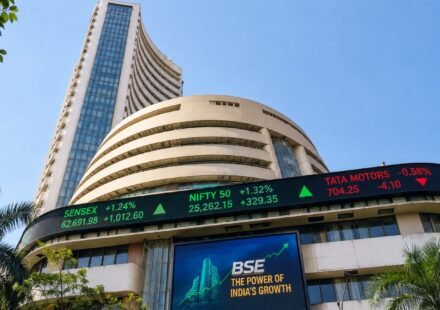
Stock Market Today: GIFT Nifty in Focus as Investors Track Global Cues and Q2 Earnings

Indian stock market investors are preparing for another closely watched trading session on Friday, October 16, 2026, with GIFT Nifty, global market movements and second-quarter earnings from major companies likely to influence sentiment. LTIMindtree, DLF and Punjab National Bank (PNB) are among the stocks in focus.
The market outlook follows a strong rally on Dalal Street on Thursday. The BSE Sensex advanced 1,533.72 points, or approximately 2.10%, to close at 74,315.61, while the NSE Nifty 50 gained 374.65 points, or 1.66%, to finish at 22,997.35.
The gains came as investors assessed global technology-sector volatility, expectations surrounding US interest rates and the possibility of renewed foreign investment in Indian equities.
GIFT Nifty and Global Markets: Key Signals
GIFT Nifty is an important indicator that traders monitor before the Indian stock market opens. Its movement can provide an early indication of market sentiment, although it does not guarantee how the Nifty 50 will perform during the session.
Investors are also watching Asian markets, including South Korea's KOSPI, alongside movements in US equities. Global markets have experienced volatility as concerns about elevated valuations in artificial intelligence-related companies and persistent inflation have affected investor confidence.
On Thursday, US markets ended higher. The Dow Jones Industrial Average rose 1.08%, the S&P 500 gained 0.33% and the Nasdaq Composite advanced 0.08%.
However, the broader international outlook remains uncertain. Investors are weighing the possibility of further US interest-rate increases against corporate earnings and changing expectations for technology-sector growth.
Sensex and Nifty Rebound Sharply
The Indian benchmarks recorded their strongest single-day performance in four months on Thursday, supported by buying in major stocks, including financial and information technology companies.
The Nifty 50 ended at 22,997.35, bringing it close to the 23,000 mark. The Sensex closed at 74,315.61 after gaining more than 1,500 points.
Information technology shares attracted attention amid quarterly earnings announcements and changing investor expectations about the global technology sector. Banking stocks also contributed to the broader recovery.
Despite the gains in benchmark indices, performance across the wider market was mixed. Small-cap and mid-cap stocks did not participate as strongly in the rally, highlighting the importance of examining individual sectors and shares rather than relying only on headline index movements.
LTIMindtree Shares in Focus
LTIMindtree will be closely watched as investors assess its second-quarter financial performance and management commentary.
Market participants are likely to examine revenue growth, operating margins, deal wins, demand from international clients and the company's outlook for the information technology services business.
Investors will also monitor how the company discusses spending by clients in key markets, particularly the United States and Europe. Changes in technology budgets, currency movements and demand for digital transformation services can affect the company's performance.
The broader IT sector has attracted attention following recent results from major Indian technology companies. However, individual share movements will depend on company-specific financial results, guidance and market expectations.
DLF Q2 Results on Investors' Radar
Real estate developer DLF is another major company in focus on October 16, with its second-quarter results scheduled for attention.
Investors will assess revenue, net profit, operating performance, new bookings and cash flows to evaluate the company's financial position.
The residential property market, premium housing demand, project launches and the pace of new sales are important factors for real estate companies. Investors may also examine the company's commentary on its project pipeline and the outlook for the property sector.
DLF's results could influence sentiment towards real estate shares, although the reaction will depend on the financial numbers and how they compare with market expectations.
Punjab National Bank: Banking Stock in Focus
Punjab National Bank is also on the market's watchlist as investors track its quarterly performance and developments in the banking sector.
Key indicators include net profit, net interest income, net interest margin, loan growth, deposit mobilisation and asset quality. Investors will also look for updates on bad loans, credit costs and provisions.
The performance of public-sector banks remains sensitive to credit demand, funding costs and the broader economic environment. Any company-specific earnings surprise or change in management guidance could affect the stock's movement.
Banking shares will also be influenced by expectations for interest rates, liquidity conditions and the outlook for lending activity.
Inflation and Interest Rates Remain Major Risks
Persistent US inflation remains an important concern for global financial markets. Stronger-than-expected inflation can increase expectations that the Federal Reserve may keep interest rates higher for longer or consider further tightening.
Higher US interest rates can influence global capital flows, currency movements and investor appetite for emerging-market equities, including Indian shares.
Investors will therefore monitor economic data and central-bank signals alongside domestic earnings announcements.
Foreign institutional investor activity is another factor to watch. Changes in overseas investment flows can influence large-cap shares and benchmark indices, while domestic institutional buying may provide support during periods of volatility.
What Investors Should Watch Today
The key factors likely to influence the Indian market on October 16 include:
• GIFT Nifty: Its latest movement ahead of the NSE opening.
• Global cues: Developments in Asian markets and the previous US trading session.
• Quarterly earnings: Results and commentary from LTIMindtree, DLF and Punjab National Bank.
• US inflation and interest rates: Their potential impact on global risk appetite.
• Institutional flows: Buying and selling by foreign and domestic investors.
• Sector performance: Trends in IT, banking, real estate and other heavyweight sectors.
Outlook
The strong gains recorded on Thursday have improved the recent closing picture for Indian benchmark indices, but they do not establish the direction of the next session.
Traders will be watching whether buying momentum continues and whether the Nifty 50 can sustain its position near 23,000. Corporate earnings, global market volatility and interest-rate expectations could all contribute to intraday swings.
Investors should verify live prices and official company announcements before making decisions. Market movements remain uncertain, and this report is intended for news and information purposes rather than investment advice.

Gold Prices Today: What 10 Grams of 22K and 24K Gold Cost in 5 Major Indian Cities
Gold prices remain in focus on Thursday, October 15, as buyers compare 22-carat and 24-carat rates across India’s major cities. With gold trading at elevated levels, even small price differences can affect the cost of jewellery purchases.
Rates vary by city, jeweller and purity. Buyers should also remember that the final price of jewellery can include GST, making charges and other applicable costs.
Gold Rate Today in Major Indian Cities
The following indicative rates were reported by Gadgets 360 for October 15. Confirm the latest local rate before purchasing, as retail prices and updates may differ between sources.
City 24K Gold (per 10g) 22K Gold (per 10g)
Mumbai ₹1,48,260 ₹1,35,900
Delhi ₹1,48,410 ₹1,36,050
Chennai ₹1,48,310 ₹1,35,950
Kolkata ₹1,48,260 ₹1,35,900
Bengaluru ₹1,48,310. ₹1,35,950
What Is the Difference Between 22K and 24K Gold?
24-carat gold: It is the higher-purity form of gold, generally used for bullion, coins and investment products. Its purity is typically around 99.9%.
22-carat gold: It contains approximately 91.6% gold, with the remainder made up of other metals. It is commonly used for jewellery because the added metals make it more durable.
The difference in purity means 24K gold generally costs more than 22K gold by weight.
Why Do Gold Rates Differ Between Cities?
Gold prices can vary across Indian cities because of transportation costs, local demand, jeweller margins and other regional factors. International gold prices, the rupee’s exchange rate, import-related costs and changes in investor demand can also influence domestic rates.
The displayed gold rate may not include all taxes and jewellery-making expenses. As a result, two jewellers in the same city may quote different final prices.
What Should Buyers Check Before Purchasing Gold?
Before buying gold jewellery, consumers should:
• Confirm the day’s 22K or 24K rate with the jeweller.
• Check the purity and hallmarking details.
• Ask for a clear breakdown of the gold price, making charges and GST.
• Compare the final bill rather than relying only on the advertised rate.
• Keep the invoice and relevant product documentation.
Gold prices can change during the trading day. Buyers should therefore confirm the current rate before completing a transaction.
Stock Market Today: GIFT Nifty Signals Weak Opening for Sensex, Nifty 50; Wipro, Nestlé and Tech Mahindra in Focus
Indian equity markets are expected to face a cautious start on Thursday, October 15, as weakness across global technology stocks, rising crude oil prices and concerns about US inflation weigh on investor sentiment. The Sensex and Nifty 50 will also be influenced by fresh quarterly earnings from major companies, including Wipro, Nestlé India and Tech Mahindra.
GIFT Nifty is an important indicator of the market’s potential opening direction. However, its latest live reading should be checked before publication, as futures prices can change quickly before the Indian market opens.
The previous session ended lower. On Wednesday, October 14, the Nifty 50 declined 99 points, or 0.44%, to close at 22,622.70, while the BSE Sensex fell 0.34% to 72,781.89. Higher oil prices and continued foreign investor outflows weighed on sentiment.
1. GIFT Nifty and Global Market Cues
Investors will monitor GIFT Nifty for clues about the opening direction of domestic benchmarks. A weaker futures signal can indicate a lower start, but it does not guarantee how the market will trade throughout the session.
Global markets are facing pressure after US inflation data came in hotter than expected. Asian shares fell on Thursday, led by sharp losses in South Korea and weakness in Japan. Technology and artificial-intelligence-linked stocks were among the sectors under pressure.
The direction of global technology shares is particularly relevant for Indian IT companies, which generate a substantial portion of their revenue from overseas clients.
2. US Inflation and Federal Reserve Policy
Fresh concerns about US inflation have raised questions about the future path of interest rates. Higher rates can increase borrowing costs and put pressure on equity valuations, particularly in sectors where share prices depend heavily on expectations of future growth.
Reuters reported that the stronger US inflation reading increased market expectations of another Federal Reserve rate increase. Investors will watch further economic data and comments from central-bank officials for clues about monetary policy.
For Indian markets, changes in US bond yields, the dollar and global risk appetite can influence foreign portfolio investment and currency movements.
3. Crude Oil Prices Remain a Key Risk
Crude oil remains another important factor for Indian equities. Higher oil prices can increase India's import bill and add pressure to inflation, corporate costs and the current-account balance.
Energy supply concerns have pushed oil prices higher amid renewed tensions around the Strait of Hormuz, according to Reuters.
Investors will monitor energy prices closely because sustained increases could affect sectors such as aviation, paints, chemicals, logistics and oil-dependent manufacturing.
4. Wipro Q2 Results in Focus
Wipro is scheduled to announce its September-quarter results on October 15. Investors will look at revenue growth, operating margins, demand conditions and management's outlook for the coming quarter.
Analysts have highlighted weak demand, pricing pressure and the potential impact of artificial intelligence on traditional IT services as factors to watch. The company's guidance for the next quarter could be particularly important in shaping market expectations.
The results may also influence sentiment towards other listed Indian IT companies.
5. Nestlé India and Tech Mahindra Earnings
Nestlé India is also scheduled to report its Q2 FY2027 results on Thursday. Investors will focus on sales growth, demand, product volumes, margins and the impact of input costs.
Brokerage previews have pointed to the possibility of improved revenue growth, supported by consumer demand and distribution strength, although actual results may differ from estimates.
Tech Mahindra is another major company on the earnings calendar. Investors will examine its revenue performance, profitability, deal wins and commentary on demand from global clients. Its results could provide additional information about the recovery prospects of the IT services sector.
What Should Investors Watch Today?
Market participants will track several developments during Thursday's session:
• GIFT Nifty's latest movement before the opening bell.
• Asian market performance and overnight US trading.
• Crude oil prices and developments affecting global energy supplies.
• Wipro, Nestlé India and Tech Mahindra's quarterly results.
• Foreign institutional investor activity and the movement of the rupee.
• Company guidance and broader market breadth after Wednesday's decline.
A weak opening does not necessarily mean that the market will remain lower throughout the day. Corporate earnings, global cues and intraday buying or selling can change the direction of both benchmark indices.
Market takeaway: Thursday's trading is likely to be shaped by a combination of global risk sentiment and domestic earnings. Investors should verify live market data and company announcements before making trading decisions.

Mukesh Ambani’s Jio Sets IPO Price Band at ₹1,065–₹1,119; India’s Biggest Share Sale Ahead
Jio Platforms, the digital and telecom business of Mukesh Ambani-led Reliance Industries, has set the price band for its initial public offering (IPO) at ₹1,065 to ₹1,119 per share. The offering is expected to become India’s largest-ever IPO, potentially raising approximately ₹30,213 crore at the upper end of the price range.
According to the company’s filing, the IPO will open for public subscription on October 21 and close on October 23, 2026. Bidding for anchor investors is scheduled for October 19, ahead of the public issue.
At the upper end of the price band, Jio Platforms would have an estimated valuation of approximately ₹10.3 lakh crore, or around $108 billion.
Jio IPO: Key Dates and Details
The proposed offering comprises up to 27 crore fresh equity shares with a face value of ₹10 each. The issue is expected to surpass Hyundai Motor India’s October 2024 offering, which raised approximately ₹27,870 crore.
The key details are:
• Price band: ₹1,065–₹1,119 per share
• IPO opening date: October 21, 2026
• IPO closing date: October 23, 2026
• Anchor investor bidding: October 19, 2026
• Expected fundraising: Approximately ₹30,213 crore
• Estimated valuation: Around ₹10.3 lakh crore at the upper end
The final amount raised will depend on the issue price and the number of shares allotted.
Where Will the IPO Money Go?
Jio Platforms plans to use a substantial portion of the proceeds to repay borrowings of its telecom subsidiary, Reliance Jio Infocomm. The company’s prospectus indicates that up to ₹27,500 crore could be allocated for this purpose, with the remaining proceeds intended for general corporate purposes.
Reducing the subsidiary’s debt could help strengthen its financial position and support its future business requirements. The actual impact will depend on the final proceeds and the company’s financial performance after the issue.
Meta and Google Among Jio’s Major Investors
Jio Platforms attracted major global investors in 2020, including Meta and Google, as the business expanded its digital services and telecom operations.
The upcoming IPO will give public-market investors an opportunity to buy shares in a business that operates across telecommunications, broadband, cloud computing, entertainment and other digital services.
Reliance Industries remains the controlling shareholder. The public offering will also provide investors with a market-based valuation of Jio Platforms, subject to demand and trading conditions.
Jio’s Position in India’s Telecom Market
Since its commercial launch in 2016, Reliance Jio has reshaped India’s telecom market through low-cost data plans, expanded network coverage and investments in digital services.
Jio has grown into the country’s largest telecom operator, with more than 524 million subscribers reported as of March 2026. Its scale gives the company a significant position in India’s mobile data and digital-services markets.
The company’s next phase of growth will depend on factors including subscriber additions, average revenue per user, network investment, competition and the expansion of its digital businesses.
What Should Investors Watch?
Investors will assess Jio’s valuation, financial performance, debt-repayment plans and growth prospects before deciding whether to subscribe. The price band alone does not determine whether the shares are attractively valued or how they will perform after listing.
Market conditions, demand during the subscription period and the company’s final allotment and listing details will be important factors to monitor. Investors should read the official offer documents and consider their own financial circumstances before applying.

India’s Exports to China Surge 40%, Yet Trade Deficit Crosses $100 Billion
India’s exports to China are growing rapidly, but the country’s trade deficit with its neighbouring economic giant has continued to widen, crossing $100 billion in the first nine months of 2026. The latest figures highlight a persistent imbalance: India is selling more goods to China than a year ago, but it is still importing far more than it exports.
According to data released by China’s General Administration of Customs, India’s trade deficit with China reached $105.93 billion between January and September 2026, up 20.7% from the same period last year.
Key Numbers: India–China Trade in 2026
• Trade deficit: $105.93 billion in January–September 2026
• Indian exports to China: $19.26 billion, up 40.7%
• Chinese exports to India: $125.19 billion, up 23.3%
• Total bilateral trade: $144.45 billion, up 25.4%
The figures show that stronger Indian exports have not been sufficient to close the gap between the two countries’ trade flows.
Why Is the Trade Deficit Still Growing?
The central reason is the difference in the value of goods India buys from China and the value of goods it sells there.
Indian businesses rely on Chinese supplies of electronics, machinery, chemicals and components used in manufacturing. These imports support production across several industries, including sectors that make finished goods for the Indian market and for export.
As industrial activity and demand for equipment increase, imports can rise even when Indian exports are performing well. The result is a larger trade deficit if import growth in value terms outpaces export growth.
India’s Exports Are Growing—but From a Smaller Base
The 40.7% rise in Indian exports to China is significant. However, exports reached $19.26 billion during the first nine months of 2026, compared with Chinese exports to India of $125.19 billion.
India’s shipments to China include products such as ores, fuels, seafood and agricultural goods. The composition of trade matters: India’s exports and China’s exports serve different roles in their respective economies, and the two sides do not exchange goods in equal amounts or at comparable values.
Even a strong percentage increase in Indian exports may therefore have a limited effect on the overall deficit when the starting export value is much smaller.
A Longer-Term Challenge for Indian Industry
The latest figures follow a record trade deficit in India’s 2025–26 financial year. According to figures cited by PTI, India’s exports to China rose 36.66% to $19.47 billion, while imports increased 16% to $131.63 billion. The resulting deficit reached $112.6 billion, compared with $99.2 billion in 2024–25.
The difference between the calendar-year figures published by Chinese customs and India’s April–March financial-year data is important when comparing totals. The reporting periods are not identical.
Reducing the imbalance would require more than a temporary increase in exports. It would involve expanding the range and competitiveness of Indian products that can enter the Chinese market, strengthening domestic manufacturing where feasible, and improving access for sectors in which Indian businesses see export opportunities.
Market Access Remains a Key Issue
India has repeatedly sought better access to China for products and services in areas including information technology, pharmaceuticals and agricultural goods. However, export opportunities depend on market rules, regulatory approvals, commercial demand and the ability of Indian producers to compete on price and quality.
The two countries have also discussed structural trade imbalances and supply-chain issues as part of broader efforts to manage their economic relationship. Progress in these areas could influence future trade flows, but the latest figures alone do not establish whether the deficit will narrow.
What the Numbers Mean
India’s rising exports to China indicate stronger sales in the period covered by the data. At the same time, the $105.93 billion deficit shows that the overall relationship remains heavily tilted towards imports from China.
The key question is not simply whether India can sell more to China, but whether export growth can become broad and sustained enough to narrow the gap while Indian manufacturers continue to depend on imported inputs.
For now, the latest data point to a clear contrast: Indian exports are growing quickly, but the value of imports from China remains more than six times as large.
Stock Market Today: Sensex, Nifty Eye Opening Cues as GIFT Nifty, Canara Bank and BHEL Take Centre Stage
Indian equity markets are set for another closely watched session on Wednesday, October 14, as investors assess global market signals, quarterly earnings announcements and movements in crude oil prices. The headline points to a potentially weaker opening for the Sensex and Nifty 50, although the opening direction should be confirmed using the latest GIFT Nifty data before the market begins trading.
The focus is also on Canara Bank, which is scheduled to consider its September-quarter results, while investors will monitor developments involving Bharat Heavy Electricals Limited (BHEL) and other companies reporting or drawing attention during the second-quarter earnings season.
Sensex and Nifty 50: What Happened in the Previous Session?
Indian benchmark indices staged a strong recovery on Tuesday. The BSE Sensex climbed 1,109.10 points, or 1.54%, to close at 73,033.78, while the NSE Nifty 50 gained 358.60 points, or 1.60%, to settle at 22,721.95.
The rally was supported by buying in information technology shares after quarterly results from HCL Technologies and Tata Consultancy Services drew investor attention. Comments from Finance Minister Nirmala Sitharaman regarding discussions around capital-gains and securities transaction taxes also contributed to market sentiment.
However, one strong session does not necessarily establish a sustained recovery. Investors will look for follow-through buying and fresh corporate earnings signals to assess whether the rebound can continue.
GIFT Nifty and Asian Markets in Focus
GIFT Nifty futures are an important early indicator for the Indian market because they trade outside regular domestic cash-market hours. Traders commonly use their movement to gauge the likely opening tone for the Nifty 50.
A lower GIFT Nifty reading can point to a weaker start, but it does not guarantee that Indian benchmarks will open lower or remain under pressure throughout the session. Global equity movements, currency changes, oil prices and domestic institutional flows can all alter the direction after the opening bell.
Asian markets are another key indicator. Weakness in regional technology stocks or renewed concerns about global inflation could weigh on sentiment, while a recovery in overseas equities may offer support.
Canara Bank Q2 Results: Key Details to Watch
Canara Bank is scheduled to consider its financial results for the quarter ended September 30, 2026, at a board meeting on October 14. The results will provide investors with an updated picture of the public-sector lender’s performance during the second quarter of FY2026–27.
Investors are likely to examine several indicators:
• Net interest income: The difference between interest earned on loans and investments and interest paid on deposits and borrowings.
• Net profit: Whether earnings growth is supported by core operations.
• Asset quality: Changes in gross and net non-performing assets.
• Provisions and credit costs: The amount set aside for potential loan losses.
• Deposit and loan growth: Trends in funding, lending and margins.
The actual figures should be taken from the bank’s official results announcement after publication. Expectations or pre-results estimates should not be treated as confirmed financial performance.
BHEL and Other Stocks on Investors’ Radar
Bharat Heavy Electricals Limited (BHEL), a state-owned engineering and power-equipment manufacturer, may attract attention as investors track corporate announcements and the wider earnings season.
For BHEL, market participants typically monitor order inflows, project execution, revenue growth, operating margins and working-capital requirements. Any company-specific announcement should be checked against its official stock-exchange disclosures before being presented as a fresh development.
Investors may also track other companies scheduled to announce results or disclose material business updates. In an earnings-driven market, individual shares can move sharply even when the broader indices remain relatively stable.
Crude Oil, Inflation and the Rupee
Oil prices remain an important risk factor for India because the country imports a substantial share of its crude requirements. Higher oil prices can increase the import bill and put pressure on inflation, the rupee and corporate costs.
Investors are also assessing the implications of recent inflation data and Reserve Bank of India measures aimed at easing pressure on the currency. A weaker rupee can benefit some exporters but raise costs for companies dependent on imported inputs.
Developments in the Middle East could influence oil prices and broader risk sentiment. Any sharp movement in crude or the rupee may affect sectors differently, including aviation, oil marketing, energy, paints and information technology.
What Investors Should Watch Today
The main factors likely to shape Wednesday’s session are the latest GIFT Nifty signal, trends across Asian markets, crude oil prices, rupee movement, foreign-investor activity and company-specific earnings announcements.
A weaker opening, if confirmed, would not by itself establish the direction for the entire trading day. Investors should distinguish between opening indicators and confirmed market prices once trading begins.
Market disclaimer: This article is for informational purposes only and is not investment advice or a recommendation to buy or sell any security. Stock prices can be volatile, and investors should assess their own financial circumstances and risk tolerance.
Gold Rate Today, October 14: 24K and 22K Prices in Mumbai, Delhi, Chennai, Kolkata and Bengaluru; Global Gold Near $4,158
Gold prices remained under pressure in international markets as investors awaited key US inflation data and comments from Federal Reserve officials that could influence the outlook for interest rates. Domestic buyers are also tracking 24-carat and 22-carat gold prices across major Indian cities on Wednesday, October 14.
According to market data published by Gadgets 360, the indicative national gold rates were ₹1,47,620 per 10 grams for 24-carat gold and ₹1,35,220 for 22-carat gold. However, city-level listings can differ by source, and jewellery prices may vary depending on local taxes, dealer premiums and other charges.
Gold Rate Today in India: 24K and 22K Prices
The following indicative city prices were listed by Gadgets 360 for major Indian markets.
City 24K Gold (10g) 22K Gold(10g)
Mumbai ₹1,49,290 ₹1,36,850
Delhi ₹1,49,440 ₹1,37,000
Chennai ₹1,49,290 ₹1,36,850
Kolkata ₹1,49,290 ₹1,36,850
Bengaluru ₹1,49,340 ₹1,36,900
Important: These are indicative published rates, not guaranteed jeweller quotations. The same source separately lists a nationwide reference price, so readers should confirm the applicable rate with a local jeweller before buying. Prices generally exclude GST, making charges and other applicable levies.
International Gold Price Today
International spot gold fell 0.3% to approximately $4,157.90 per troy ounce on Tuesday, according to Reuters market reporting. US gold futures for December delivery settled around $4,177.30 per ounce.
These figures refer to the reported Tuesday session and should not be mistaken for a live Wednesday quote. International prices fluctuate during trading hours.
For comparison, one troy ounce equals approximately 31.1 grams. At a spot price of $4,157.90 per ounce, the metal’s quoted value works out to roughly $133.70 per gram, before currency conversion, import costs, taxes and local premiums.
Why Are Gold Prices Under Pressure?
Investors are watching US Consumer Price Index data due Wednesday and Producer Price Index figures scheduled for Thursday. These reports may influence expectations for the Federal Reserve’s interest-rate policy.
Gold does not pay interest, so higher interest rates can make interest-bearing assets more attractive relative to the precious metal. However, inflation concerns, geopolitical tensions and demand for safe-haven assets can also support gold prices.
The US dollar and Treasury yields are additional factors that traders monitor. Changes in either can influence the cost of gold for international buyers and affect market sentiment.
What Determines Gold Rates in India?
Indian gold prices are influenced by several domestic and international factors:
• International spot prices: Global bullion movements provide a key reference for domestic rates.
• Rupee-dollar exchange rate: A weaker rupee can increase the rupee cost of imported gold.
• Import costs and taxes: Duties and applicable taxes affect the final domestic price.
• Local demand and premiums: Jewellery demand, dealer margins and city-level costs can cause price differences.
• Purity: 24K gold is generally purer than 22K gold, which is commonly used for jewellery.
What Should Gold Buyers Check Before Purchasing?
Before buying gold jewellery or coins, consumers should compare the latest local rate, confirm purity and hallmarking, and request a detailed bill showing the gold value, making charges and applicable taxes.
A daily price table is useful for comparison, but it does not guarantee that every jeweller will sell at the same rate. Buyers should also distinguish between the international spot price and the final retail price in India.

RBI Governor Says Forex Curbs Aim to Curb Speculation, Links Interest Rates to Financial Stability
Reserve Bank of India (RBI) Governor Sanjay Malhotra has said the central bank’s latest foreign-exchange measures are designed to curb speculative activity and ensure orderly movement in the rupee, while emphasising that monetary policy and financial stability are closely connected.
In an interview with Moneycontrol reported on Tuesday, Malhotra said the measures were intended to ensure that the foreign-exchange market serves genuine hedging requirements rather than speculative positions. He also stressed that the restrictions should not be interpreted as capital controls.
The RBI has introduced a series of measures since October 10 as the Indian rupee faced renewed pressure against the US dollar. The steps include changes to foreign-exchange derivative rules, a cash reserve requirement for certain transactions and a special facility for oil companies’ dollar purchases.
Why Has the RBI Tightened Forex Rules?
The rupee recently approached the 97-per-dollar level amid pressure from dollar demand, elevated crude oil prices and foreign capital outflows. The currency’s weakness has increased concerns about imported inflation and the cost of overseas payments.
The RBI has reduced the limit for certain foreign-exchange derivative transactions that can be undertaken without establishing an underlying exposure from $100 million to $5 million. It has also restricted the rebooking of cancelled rupee derivative contracts.
In addition, the central bank introduced a Foreign Exchange Risk Reserve requirement. Under the announced rules, authorised dealers must maintain a cash reserve equivalent to 20% of the rupee value of qualifying rupee-linked foreign-exchange derivative transactions exceeding $2 million, subject to the applicable provisions.
The measures are intended to discourage excessive speculative positions and make sure currency derivatives are used for legitimate hedging needs. However, market participants have sought clarity over how some requirements apply to banks’ own transactions and interbank trading.
RBI Says Measures Are Not Capital Controls
Malhotra said the new rules should not be viewed as an attempt to restrict capital flows. According to Moneycontrol, he reiterated that foreign portfolio investors can continue to invest in Indian equities, debt and corporate bonds, as well as move funds into and out of the country, subject to applicable rules.
The governor also said the RBI does not target a particular exchange-rate level. Instead, the central bank seeks orderly conditions in the foreign-exchange market and is prepared to take further steps if necessary.
The distinction matters because measures aimed at limiting speculative currency trading are different from broad restrictions on the movement of investment capital.
Why Interest Rates and Financial Stability Are Linked
Malhotra acknowledged that monetary policy is not generally used as the primary instrument for managing financial stability, but said the two cannot be treated as entirely separate.
He explained that price stability depends in part on a stable financial system, which allows monetary policy to work effectively across the economy. Financial instability can disrupt the transmission of interest-rate decisions to lending, borrowing and spending.
The comments come after the RBI raised its benchmark repo rate by 25 basis points earlier in October, marking its first increase in nearly four years. The rate decision and the new foreign-exchange measures are distinct policy actions, although both come amid concerns about currency pressure and broader economic stability.
What Happens Next?
The RBI’s immediate challenge is to reduce excessive volatility without disrupting legitimate currency transactions. While tighter rules may discourage speculative dollar buying, they cannot eliminate genuine demand for foreign currency arising from imports, overseas payments, hedging and capital flows.
Reuters reported that the new rules initially caused uncertainty among some banks, with several lenders temporarily holding back from quoting dollar-rupee forward contracts as they sought clarity on margin requirements.
The rupee’s future movement will therefore depend not only on regulatory action but also on underlying demand for dollars, crude oil prices, international financial conditions and investment flows.
For businesses and investors, the key issue will be whether the measures restore orderly trading while allowing companies to hedge genuine currency risks. The RBI has indicated that it will continue monitoring the market and take further action if required.

Apple Unveils $299 HomeView Hub in Major Push to Expand Its Smart Home Ecosystem
Apple has unveiled its new $299 HomeView smart home hub, expanding its product lineup as the company seeks to make its ecosystem a bigger part of everyday life at home.
Announced on October 13, HomeView combines a touchscreen display, speaker, video calling and smart home controls in a single device. Apple says the product is designed to serve as a shared household screen while providing personalised experiences for individual family members.
The launch forms part of Apple's wider smart home strategy, which also includes updated Apple TV hardware, a new HomePod mini and connected home accessories developed with partner companies.
According to Apple's official announcement, pre-orders for HomeView opened on October 13 in several markets, including India, the United States, the United Kingdom, Canada, Australia and New Zealand. Availability is scheduled to begin on November 13.
HomeView Price and Key Features
HomeView starts at $299 in the United States. Apple is offering a tabletop version and a wall-mounted model at the same starting price.
The device features a 7-inch Liquid Retina display attached to a speaker base. Its design allows the screen to tilt for more comfortable viewing on a desk, kitchen counter or bedside table. The wall-mounted version is intended for spaces such as hallways and entryways.
Key features include:
• 7-inch display: Shows personal information, photos, controls and other content.
• Siri AI: Enables voice-based interaction and smart home commands.
• Face recognition: Personalises the experience for different household members.
• FaceTime: Supports video calls with compatible Apple devices and services.
• Entertainment: Plays music and displays photos and other supported content.
• Smart home dashboard: Lets users control compatible lights, thermostats, locks and cameras.
Apple says HomeView can recognise individual users and display relevant personal content, including information from supported apps such as Calendar, Messages and Reminders when paired with a compatible Apple Intelligence-enabled device.
How HomeView Controls a Smart Home
HomeView is designed to bring compatible smart home devices together in one interface. Users can ask Siri to adjust lights, change thermostat settings, control door locks and access supported camera feeds.
Apple says its Home Camera interface can display up to nine live video feeds simultaneously. With compatible cameras and a supported iCloud+ subscription, users can also receive security notifications and access features such as recognition of familiar people, pets, packages and vehicles.
These functions depend on compatible accessories, software and subscriptions where required. They are not automatically available with every third-party smart home product.
The device is intended to work within Apple's existing Home ecosystem, allowing customers to manage supported connected accessories without relying on separate control screens for every device.
Privacy and Personalised Experiences
One of HomeView's central features is its ability to distinguish between household members. Apple says the device can recognise users by their faces and adapt the screen to show personal content.
That approach could make a shared device more convenient for families, but it also makes privacy settings important. Users should review which personal information is accessible on a shared display and understand how connected cameras, microphones and accounts are configured.
Apple says HomeView was designed with privacy and security in mind. Those assurances describe the company's stated approach; real-world security also depends on device settings, account protection, software updates and the connected accessories a household uses.
Apple Faces Competition From Amazon and Google
HomeView enters a market where Amazon and Google already sell smart displays and voice-controlled home devices.
Amazon's Echo Show range combines screens, Alexa voice assistance and connected-home controls, while Google's Nest Hub products offer a display-based interface for Google Home services.
Apple's approach is to integrate HomeView with its existing hardware, software and services. That could appeal to households already using iPhones and other Apple products, particularly those interested in FaceTime, personal information and HomeKit-compatible accessories.
However, Apple's success will depend on factors including the usefulness of Siri, compatibility with third-party products, pricing and how easily customers can configure their smart homes.
India Availability and Additional Costs
Apple lists India among the markets where HomeView pre-orders began on October 13, with availability scheduled for November 13. The announced $299 price is the US price; Indian retail pricing, taxes and final local configuration should be checked through Apple's India store or authorised sellers.
The wall-mounted version can also require a separately purchased mount. Apple lists compatible mounting options at additional cost, so the total setup price may exceed the device's base price.
What the Launch Means for Apple's Smart Home Plans
HomeView represents a more direct move by Apple into the smart display category, bringing entertainment, communications and home automation together in a dedicated screen.
The wider product announcement suggests Apple is seeking to make its home ecosystem more connected through a combination of displays, speakers, streaming hardware and accessories.
Whether HomeView gains traction will depend on how well its features work in everyday use and whether customers see enough value in Apple's integrated approach to choose it over competing smart home platforms.

US Stock Market Today: AI Fears Pressure Tech Stocks as Wall Street Watches Bank Earnings and Inflation Data
US stock market futures were mixed on Tuesday as investors assessed fresh corporate earnings, renewed concerns about competition in the artificial intelligence industry and the outlook for inflation and interest rates.
Technology stocks remained under pressure following reports of progress by Chinese memory-chip maker ChangXin Memory Technologies (CXMT). Investors are weighing whether increasing competition in memory chips could affect the growth prospects and pricing power of established US semiconductor companies.
At the same time, the start of the third-quarter earnings season has brought major banks and other large companies into focus. Their results and outlooks could provide clues about consumer demand, credit conditions and the strength of corporate profits.
According to Investopedia’s premarket report, Dow futures were recently up around 0.9%, while S&P 500 futures slipped approximately 0.1% and Nasdaq futures declined around 0.7%. These are premarket indications, not the final performance of the indexes.
Previous Session: Dow Rose While S&P 500 and Nasdaq Fell
Wall Street finished Monday, October 12, with mixed results. The Dow Jones Industrial Average advanced, while the S&P 500 and Nasdaq Composite edged lower.
The closing figures reported by the Associated Press were:
• Dow Jones Industrial Average: Up 195.60 points, or 0.4%, to 51,850.55.
• S&P 500: Down 4.30 points, or 0.1%, to 7,807.24.
• Nasdaq Composite: Down 120.27 points, or 0.4%, to 27,245.90.
• Russell 2000: Down 12.50 points, or 0.4%, to 2,794.48.
The mixed session kept the major indexes near the record levels reached the previous week. However, weakness in technology shares showed that investors remained selective even as the broader market stayed close to its highs.
AI Competition Puts Semiconductor Stocks Under Pressure
Developments in China’s semiconductor industry are one of the main technology-sector stories investors are following this week.
Reports about CXMT’s progress in memory-chip production have raised questions about the competitive position of established suppliers. Memory chips are widely used in data centres, computers, smartphones and AI infrastructure.
Companies linked to AI hardware have benefited from strong demand for computing capacity, but their shares can also be sensitive to concerns about valuations, competition and future profit margins.
Reuters reported that Micron Technology fell 3.8% in Tuesday’s global-market trading, while Nvidia declined 0.8%. Those figures reflect the reported trading at the time of Reuters’ report and should not be treated as final US closing prices for Tuesday.
Investors will be watching whether pressure on semiconductor shares spreads to other technology companies or remains concentrated in selected chipmakers.
Major Bank Earnings Take Centre Stage
Investors are also assessing results from some of the largest US financial institutions as the third-quarter reporting season gathers momentum.
JPMorgan Chase, Goldman Sachs, Wells Fargo and Citigroup are among the banks reporting results around the start of the week. Their earnings can offer insight into lending, consumer finances, investment banking activity and the health of the wider economy.
Early reports showed mixed reactions. Investopedia reported that Goldman Sachs shares rose in premarket trading following its results, while JPMorgan Chase and Wells Fargo shares faced pressure in the market update it reviewed.
Bank earnings are particularly important when investors are trying to determine whether economic growth can support corporate profits while borrowing costs remain elevated.
Oil Prices and Inflation Remain Key Risks
Energy prices are another factor shaping market sentiment. Brent crude settled at $106.65 a barrel on Monday, up 1.8%, according to the Associated Press. Reuters subsequently reported a decline in oil prices during Tuesday’s global trading.
Higher oil prices can increase transport and production costs and put upward pressure on inflation. That can complicate the Federal Reserve’s decisions on interest rates, particularly if price increases persist beyond the energy sector.
Investors are also awaiting fresh US inflation data and retail-sales figures due later in the week. These releases could influence expectations for the direction of monetary policy.
Treasury yields remain important for equity valuations because higher yields can make bonds more attractive relative to stocks and increase the discount rate applied to future corporate earnings.
What Investors Will Watch Next
Several developments could shape the next move in US equities:
• Bank earnings: Whether major financial institutions report stronger or weaker results than expected.
• Inflation data: Whether price pressures appear to be easing or remain persistent.
• AI and semiconductor competition: Whether concerns about Chinese chip production continue to weigh on technology stocks.
• Oil prices: Whether energy costs ease or add to inflation concerns.
• Treasury yields: Whether bond-market moves change expectations for interest rates and stock valuations.
The market’s direction will depend on how investors balance corporate earnings against concerns about technology competition, inflation and borrowing costs.
Market status: This report uses the latest available premarket information and the previous session’s confirmed closing figures. Tuesday’s final Dow, S&P 500 and Nasdaq closing levels were not yet available when this article was prepared.