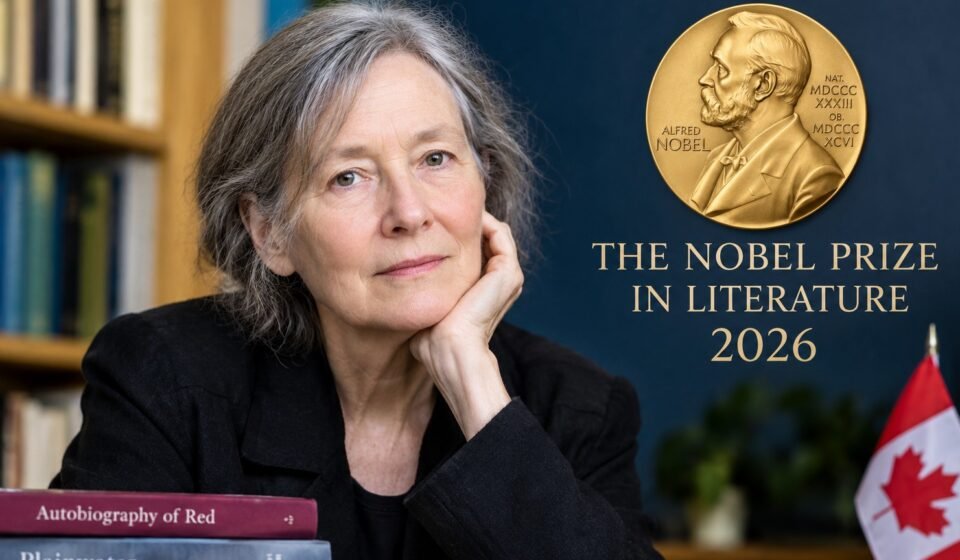

Canadian poet, essayist and writer Anne Carson has won the 2026 Nobel Prize in Literature, becoming this year’s recipient of one of the world’s most prestigious literary honours. The Swedish Academy announced the award in Stockholm on Thursday, October 8.
The Swedish Academy praised Carson for her bold and inventive body of work, particularly the way she engages with classical traditions while creating new forms for contemporary literature. The award carries a prize of 12 million Swedish kronor, roughly $1.2 million.
A distinctive literary voice
Carson, 76, was born in Toronto, Canada, and has developed a reputation for crossing traditional boundaries between poetry, prose, essays, translation and performance.
Her writing frequently draws inspiration from ancient Greek literature, but she approaches classical material through unconventional structures and modern perspectives. Her work has included verse novels, poetry collections, literary criticism and translations of classical Greek authors.
The Swedish Academy highlighted the connection between Carson’s interest in language and her poetic creativity. Her work often examines how words evolve and how old stories can acquire new meanings when placed in different literary and cultural settings.
Among her best-known works
One of Carson’s best-known books is “Autobiography of Red,” a 1998 verse novel inspired by the ancient Greek poet Stesichorus and the mythological figure Geryon.
Another notable work, “Norma Jeane Baker of Troy,” combines the story of Helen of Troy from Euripides’ Helen with the life and image of Marilyn Monroe. The work demonstrates Carson’s distinctive approach of connecting ancient literature with modern cultural figures.
Her earlier work “Eros the Bittersweet” explored love and desire through ancient Greek literature and established many of the themes that would continue throughout her career.
Carson has also translated works by classical Greek writers, including Sappho, Sophocles and Euripides. Her translations are known for taking creative approaches rather than simply reproducing the original texts in conventional modern language.
Carson was surprised by the announcement
According to the Swedish Academy, Carson was in Iceland when officials contacted her about the Nobel award. Ingrid Carlberg, permanent secretary of the Swedish Academy, said Carson was surprised and had little time to speak with the academy after being informed.
Carson has held Icelandic citizenship since 2022 and has spent time living in the country with her husband.
A major recognition for contemporary literature
Carson’s Nobel win places her among a long list of major literary figures who have received the award since the Nobel Prizes began in 1901.
The 2026 honour also follows Hungarian author László Krasznahorkai, who won the 2025 Nobel Prize in Literature.
Carson’s selection underscores the Swedish Academy’s continuing recognition of literary work that crosses established genres and connects historical traditions with contemporary forms.
Her career has consistently combined scholarship and creative writing, particularly through her engagement with ancient Greek texts. The Nobel recognition now brings that distinctive literary approach to an even wider international audience.