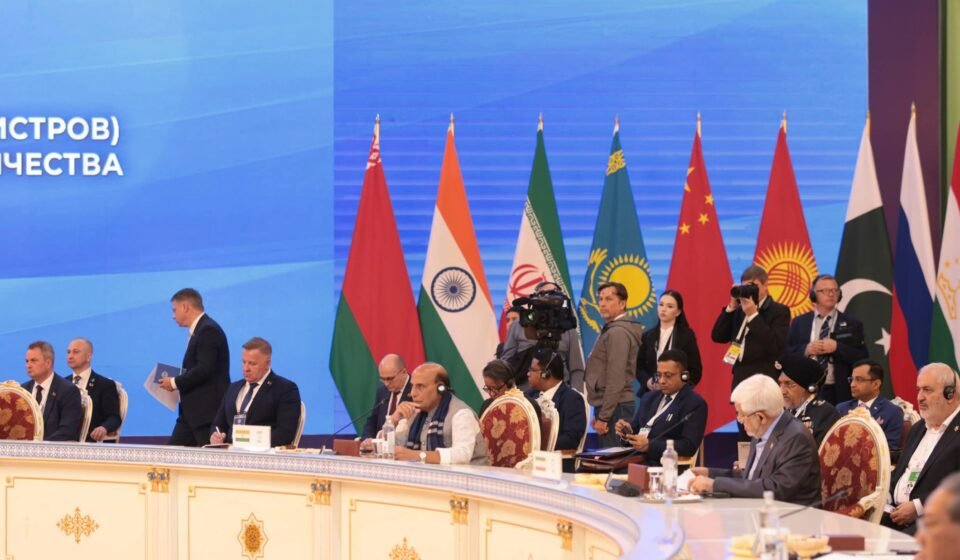

Indian Defence Minister Rajnath Singh has arrived in Dushanbe, the capital of Tajikistan, to represent India at the 25th meeting of the Council of Heads of Government of the Shanghai Cooperation Organisation (SCO). The high-level gathering is focused on regional cooperation, economic development, investment, connectivity and cultural exchanges among member countries.
Singh’s visit comes as India continues to engage with the SCO on practical cooperation involving trade, technology, infrastructure and people-to-people links. His presence also provides an opportunity for discussions with officials from participating countries on shared regional priorities.
The meeting is scheduled for October 19–20, 2026, with leaders and representatives reviewing ongoing initiatives and considering the organisation’s financial and institutional functioning.
Rajnath Singh Holds Talks With Tajikistan’s Defence Minister
Following his arrival in Dushanbe on Monday evening, Singh met Tajikistan’s Defence Minister, Emomali Sobirzoda. The two sides discussed ways to strengthen their bilateral partnership.
The meeting reflects the continuing engagement between India and Tajikistan, which maintain diplomatic ties and cooperate on regional security and other areas of mutual interest. Tajikistan’s location in Central Asia also gives it strategic relevance in discussions involving regional stability and connectivity.
India has maintained engagement with Central Asian countries through diplomatic exchanges, security cooperation and economic initiatives. Such contacts provide opportunities to discuss common concerns and identify areas where cooperation can be expanded.
No specific new defence agreement was confirmed in the available public reporting on Singh’s arrival and his initial meeting with his Tajik counterpart.
SCO Meeting Focuses on Trade, Investment and Connectivity
The 25th meeting of the Council of Heads of Government is expected to review cooperation across several areas, including trade, the economy, investment, innovation and cultural-humanitarian exchanges.
Connectivity remains an important issue for the organisation because transport links, supply chains and access to markets influence trade between member states. Better connections can help businesses reduce logistical costs and make cross-border economic activity more efficient.
The discussions are also expected to cover the progress of existing cooperation initiatives and decisions concerning the SCO’s financial and institutional operations.
For India, the meeting offers a multilateral platform to exchange views with other member countries and pursue cooperation that delivers practical benefits. Its participation is part of a wider effort to remain engaged with Eurasian countries on economic, technological and diplomatic issues.
India Highlights Innovation and Digital Public Infrastructure
India has identified start-ups, innovation and digital public infrastructure as areas through which it can contribute to regional cooperation.
Digital public infrastructure includes systems that support services such as digital identity, payments and the delivery of public services. India has developed experience in these fields and has promoted exchanges with other countries interested in digital solutions.
Innovation and investment are also relevant to the SCO’s economic agenda. Cooperation in these areas could support business links, technology exchanges and opportunities for companies across participating markets.
However, the meeting’s stated priorities should not be confused with confirmed agreements. The outcomes will depend on discussions among member countries and any decisions formally announced by the organisation.
Rajnath Singh Meets Tajikistan’s Prime Minister
During the SCO gathering on Tuesday, Singh also met Tajikistan’s Prime Minister, Qohir Rosulzoda. The meeting highlighted longstanding civilisational connections and people-to-people links between India and Tajikistan.
Such exchanges are important because bilateral relations extend beyond government-to-government contact. Educational, cultural and professional interactions can help strengthen mutual understanding and provide a foundation for wider cooperation.
Singh also met Iran’s First Vice President, Mohammad Reza Aref, on the sidelines of the meeting. The engagement brought another regional partner into the series of discussions taking place in Dushanbe.
The meetings provide opportunities for direct exchanges between Indian representatives and officials from countries with interests in regional trade, security and connectivity. Any specific agreements or policy commitments, however, need to be assessed on the basis of official announcements.
Why the SCO Matters to India
The Shanghai Cooperation Organisation provides a forum for its members to discuss regional security, economic development and cooperation. Its membership brings together countries with different political systems and economic priorities, making sustained dialogue important even where national interests do not always align.
India’s participation allows it to communicate its priorities directly and explore areas of common interest with other members. Trade, supply-chain resilience, investment and digital cooperation are among the issues that can influence the organisation’s practical work.
For New Delhi, engagement through the SCO complements its bilateral relationships with individual countries. Meetings on the sidelines can also provide opportunities to discuss matters that may not be addressed in detail during formal sessions.
The Dushanbe meeting is therefore significant as a diplomatic opportunity rather than proof that major new agreements have already been reached. Its broader value will depend on whether discussions lead to concrete cooperation and follow-up action.
What Happens Next?
The immediate focus is on the meeting’s discussions and the decisions taken by participating governments. Areas to watch include progress on economic cooperation, investment, connectivity and the organisation’s institutional functioning.
For India, Singh’s participation provides an opportunity to reinforce its engagement with the SCO and maintain contact with regional partners. His meetings with Tajikistan’s defence minister and prime minister, along with Iran’s first vice president, add a bilateral dimension to the visit.
The significance of the gathering will ultimately be measured by its outcomes and the extent to which member countries implement the initiatives discussed in Dushanbe.