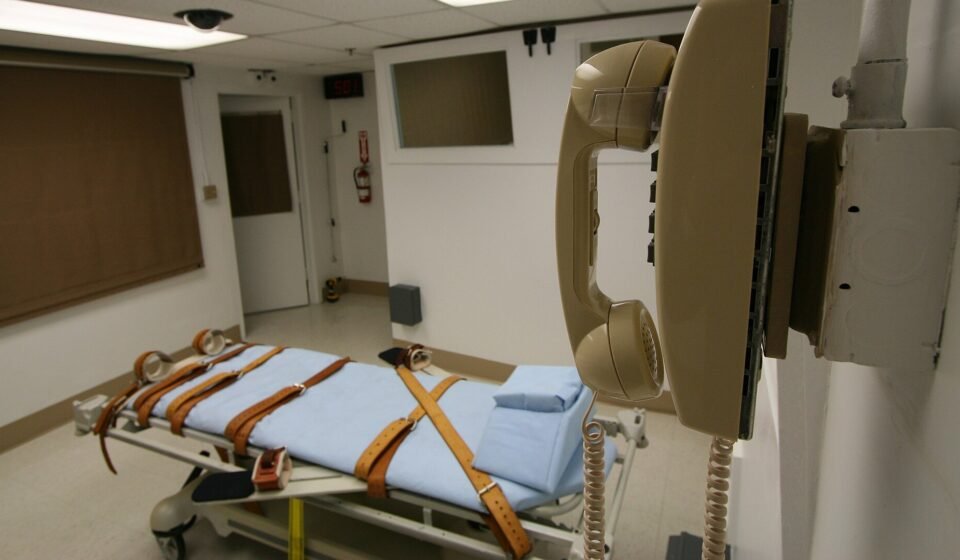

The United States is facing an unusually rare day in its use of capital punishment, with three executions scheduled for Thursday, November 5, 2026, across Indiana, Florida and Alabama. The cases involve three men convicted of separate murders, and all three states plan to carry out the death sentences through lethal injection.
The scheduled executions have brought renewed attention to America’s death penalty system, including questions about the fairness of trials, the treatment of prisoners on death row and the methods used by authorities to carry out capital punishment.
The three prisoners are Jeffrey Weisheit in Indiana, Jesse Guardado in Florida and Michael Taylor in Alabama. If all three executions proceed as planned, it will be the second occasion in 2026 on which three people are scheduled to be executed in the United States on the same day. A similar situation occurred on August 13.
Although executions are generally scheduled independently by individual states, the coincidence has highlighted the increased pace of capital punishment in the country.
Indiana: Jeffrey Weisheit’s execution scheduled
Indiana is scheduled to execute 50-year-old Jeffrey Weisheit for the deaths of two children, Alyssa Lynch, 8, and Caleb Lynch, 5, in a house fire near Evansville in 2010.
Weisheit was convicted of setting the fire at the home of his girlfriend’s children. The prosecution linked the killings to the deteriorating relationship between Weisheit and the children’s mother.
His lawyers made several attempts to stop the execution. They argued that a history of head injuries and mental health problems had not received sufficient attention during his trial and sentencing. The defence also sought additional medical examinations, including brain scans, to support its arguments.
Weisheit acknowledged his crimes at a public hearing in October but asked for the opportunity to remain alive and use his time in prison to help others. His legal team also raised concerns about Indiana’s supply of the drug intended for lethal injection.
Governor Mike Braun rejected the request to reduce the sentence to life imprisonment and said the execution would proceed. The state’s Department of Correction has maintained that it is prepared to carry out the court-ordered sentence.
The case has also drawn attention because of concerns raised by lawyers about the state’s procurement of pentobarbital, the drug used in Indiana’s execution protocol.
Florida: Jesse Guardado faces execution
Florida is scheduled to execute 64-year-old Jesse Guardado for the 2004 killing of Jackie Malone, a 75-year-old woman.
Guardado was convicted in connection with the fatal stabbing and beating of Malone inside her Walton County home. According to the case record described in reports, he confessed and pleaded guilty. The prosecution said valuables and money were stolen from the residence following the killing.
If carried out, Guardado’s execution would be Florida’s 19th in 2026, matching the state’s annual record set in 2025. Florida has become the most active state in the country in carrying out executions during this period.
Governor Ron DeSantis has repeatedly defended the state’s use of capital punishment, arguing that victims’ families have waited years for justice. Florida’s execution rate has also become a central part of the wider national discussion about the growing use of the death penalty.
Guardado’s case has attracted additional attention because of his reported history at the former Dozier School for Boys, a state-run reform institution associated with allegations of abuse and mistreatment. Death penalty opponents have raised questions about the background of people who passed through the institution and later faced execution.
Alabama: Michael Taylor’s case raises questions over execution method
The third scheduled execution is that of 54-year-old Michael Taylor in Alabama. He was convicted for the 1991 killings of Ivan Moore, 83, and Lucille Moore, 79, during a robbery at their home in Gadsden.
Prosecutors said Taylor was 19 when he attacked the couple with a metal bar and took their belongings, including their vehicle. He was later arrested in Birmingham, according to reports on the case.
Taylor’s execution has faced opposition from people who believe his age at the time of the crime should be considered in the clemency process. Advocates have argued that his youth and level of maturity at the time should be taken into account when assessing whether the death sentence should be carried out.
Alabama Governor Kay Ivey declined to grant clemency.
There is also a legal dispute over the method of execution. Taylor had previously selected nitrogen gas as his preferred execution method. However, after a judge ruled that the state’s nitrogen gas procedure was unconstitutional, officials moved towards lethal injection.
Taylor’s lawyers challenged the change, arguing that the state should not replace the method he had selected without addressing the legal concerns. A judge rejected the challenge, allowing preparations for lethal injection to continue.
Death penalty debate intensifies across the US
The three scheduled executions come at a time when capital punishment is receiving renewed scrutiny in the United States. Recent execution-related controversies, including a failed attempt in Tennessee involving Christa Pike, have raised questions about the safety and reliability of lethal injection procedures.
Indiana’s legal dispute over its execution drug supply has added another dimension to the debate. Critics argue that states must demonstrate that their procedures comply with constitutional protections against cruel and unusual punishment. Officials who support capital punishment maintain that courts have reviewed the cases and that lawful sentences should be carried out.
The number of executions in the country has also increased. Florida’s high execution rate has played a major role in the national total, while a relatively small group of states continues to account for most executions.
The fact that three executions are scheduled for one day does not mean the states are coordinating their actions. Each case follows its own legal process, execution warrant and timetable. However, the unusual overlap has brought attention to the broader direction of capital punishment in America.
The outcome of Thursday’s scheduled proceedings will also be closely watched by death penalty advocates, victims’ families, legal observers and civil rights organisations.
For now, the central issue is whether all three states will proceed with the scheduled sentences or whether any last-minute court intervention will change the timetable. The cases underline how the death penalty debate in the United States continues to involve competing questions of justice, legal procedure, public accountability and the rights of prisoners.