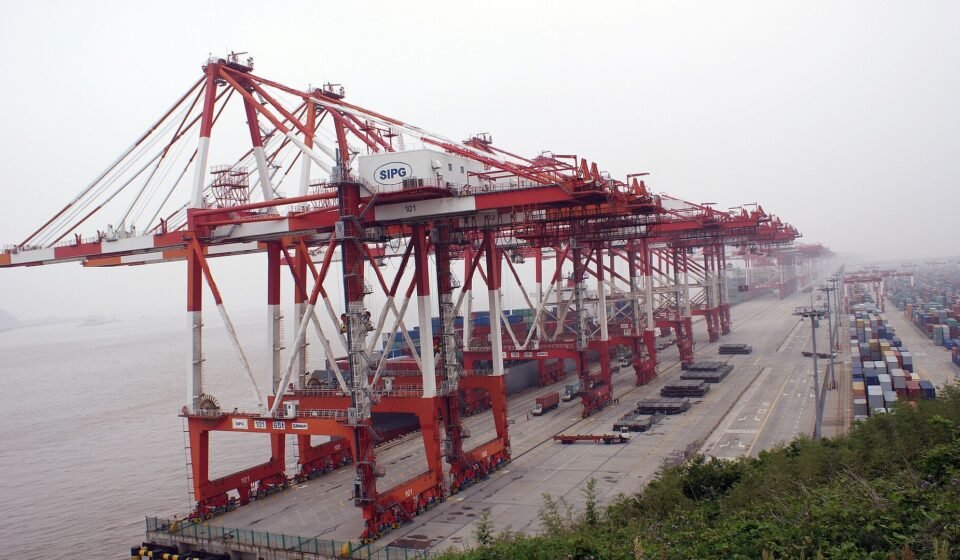

China’s trade surplus has crossed the $1 trillion mark for a second consecutive year, highlighting the growing strength of its export sector even as the country’s domestic economy continues to face challenges. A sharp rise in overseas shipments, particularly technology-related products and automobiles, has helped China maintain its position as one of the world’s largest manufacturing and exporting powers.
China recorded a trade surplus of approximately $1.04 trillion between January and October 2026. The milestone was reached a month earlier than in the previous year, showing how strongly overseas demand has supported Chinese businesses.
The latest figures also revealed that exports increased by 35.2 per cent in October compared with the same month last year. The growth was stronger than many market expectations and followed a 36.3 per cent increase in September.
The development puts China on course to exceed its full-year trade surplus record of around $1.2 trillion, established in 2025.
Technology demand drives export growth
One of the biggest factors behind China’s export performance is rising international demand for products connected with technology and artificial intelligence.
The global expansion of AI infrastructure has increased demand for electronic components, semiconductor-related products, data-centre equipment and other technology goods. Chinese manufacturers have benefited from this investment cycle by supplying a wide range of products used in modern industrial and digital systems.
Automobiles have also contributed to the country’s export strength. Chinese carmakers are increasingly looking towards international markets as competition at home intensifies and domestic vehicle sales remain under pressure.
The growth of overseas sales has helped manufacturers maintain production and generate revenue despite slower spending by Chinese consumers.
China’s large industrial base, established supply chains and ability to produce goods at competitive prices have helped companies respond quickly to demand from different regions.
Imports also record strong growth
Although exports attracted much of the attention, China’s imports also increased significantly in October.
Imports rose 41.6 per cent compared with the same period a year earlier, accelerating from the 31 per cent growth recorded in September. The increase was also higher than economists had expected.
Stronger imports indicate that purchases from overseas suppliers have increased, including goods and materials needed by Chinese industries. Higher energy and commodity prices have also influenced the value of international trade.
Despite the strong export performance, the faster growth in imports reduced China’s monthly trade surplus.
The surplus for October stood at approximately $105.3 billion, compared with $133.5 billion in September. This shows that the country’s overall trade balance can narrow even when exports continue to expand rapidly.
However, the accumulated surplus for the first ten months remained above $1 trillion, reflecting the scale of China’s export advantage during 2026.
Weak domestic demand remains a challenge
The record trade surplus also highlights an important imbalance in China’s economy. While factories are sending large quantities of goods overseas, domestic consumption has not recovered strongly enough to provide an equally powerful source of demand.
Household spending remains cautious, with concerns about employment, income security and the property market affecting consumer confidence.
China’s prolonged property sector slowdown has weakened household wealth and created uncertainty for businesses and families. This has made it more difficult for domestic demand to absorb the country’s expanding industrial production.
As a result, manufacturers have increasingly relied on overseas customers to sell their products and maintain factory activity.
This export dependence has supported economic growth, but it also creates risks. If international demand weakens, Chinese manufacturers could face excess inventories, lower prices and pressure on profits.
Growing trade tensions with major economies
China’s expanding trade surplus is likely to increase concerns among its major trading partners, particularly the United States and European Union.
Several governments have argued that large volumes of Chinese goods entering their markets could put pressure on domestic manufacturers. They are concerned about competition in industries such as electric vehicles, batteries, electronics and industrial equipment.
The European Union has already taken steps to restrict some Chinese vehicle imports and is considering how to protect its manufacturing sector from growing competitive pressure.
The United States has also maintained trade barriers and tariffs on several Chinese products, although both countries have extended a temporary trade truce to reduce immediate tensions.
A widening trade imbalance could make future negotiations more difficult. Countries facing large deficits with China may seek additional tariffs, import restrictions or other measures to protect their industries.
For Chinese exporters, these developments could create uncertainty about market access and future business opportunities.
Artificial intelligence could shape the next phase
The global AI investment cycle has become an important source of demand for Chinese technology exports. Spending on data centres, computing infrastructure and electronic equipment has supported shipments during 2026.
However, this source of growth also carries uncertainty.
If investment in AI infrastructure slows, demand for certain components and technology products could weaken. That could affect export prices, production plans and the revenue of companies that have expanded their businesses around international technology demand.
Automobile exporters also face challenges, including changing trade rules, competition from international manufacturers and differences in consumer demand across markets.
The strength of China’s exports in the coming months will therefore depend on global economic conditions, technology investment and the ability of Chinese businesses to expand into new markets.
A record that brings both opportunity and pressure
China’s $1.04 trillion trade surplus demonstrates the competitiveness and scale of its manufacturing sector. Strong demand for technology products and automobiles has helped the country maintain export momentum despite domestic economic difficulties.
At the same time, the figures underline the challenges facing Beijing. A stronger export sector cannot permanently replace balanced domestic consumption, while growing trade surpluses may encourage other countries to introduce further restrictions.
China has said it wants more balanced global trade rather than simply expanding its surplus. Turning that goal into reality will require stronger domestic demand and a more sustainable relationship between production, consumption and international markets.
For now, the latest figures show that China’s export engine remains powerful. Whether that momentum can continue without creating deeper trade tensions will be one of the key economic questions for the months ahead.