Pakistan’s First Astronaut Set for Historic China Space Mission: What Shenzhou-24 Will Achieve

Pakistan is preparing to enter a new phase of human space exploration as astronaut Muhammad Zeeshan Ali gets ready to travel to China’s Tiangong space station aboard the Shenzhou-24 spacecraft. The mission, scheduled for November 25, 2026, will mark the first time a Pakistani national joins a crewed mission to China’s orbital laboratory.
Beyond the historic milestone, the flight will give Pakistani researchers an opportunity to participate in scientific work conducted in microgravity. Ali will join two Chinese astronauts for a short-duration visit, with the mission forming part of a wider partnership between the two countries in space research and astronaut training.
Key Highlights
• Muhammad Zeeshan Ali is scheduled to become the first Pakistani astronaut to visit China’s Tiangong space station.
• Shenzhou-24 is scheduled to launch on November 25 aboard a Long March-2F rocket.
• Ali will work as a payload specialist and is expected to spend around one week aboard the station.
• Four Pakistan-linked biotechnology experiments are part of the scientific cooperation behind the mission.
A Pakistani astronaut joins China’s crew
China has selected three astronauts for the Shenzhou-24 flight. Mission commander Tang Hongbo and flight engineer Wu Yi will travel with Pakistan’s Muhammad Zeeshan Ali, who will serve as the payload specialist.
The assignment makes Ali the first foreign astronaut selected to visit Tiangong as part of China’s crewed space programme. It also represents a significant step for Pakistan, which has developed space capabilities through satellite technology and research but has not previously sent a national on an orbital crewed mission.
The two Chinese crew members bring different levels of flight experience. Tang has already travelled to space on the Shenzhou-12 and Shenzhou-17 missions. The new flight is expected to make him the first astronaut to visit Tiangong three times. Wu, from China’s third group of astronauts, is preparing for his first spaceflight.
Launch preparations at Jiuquan
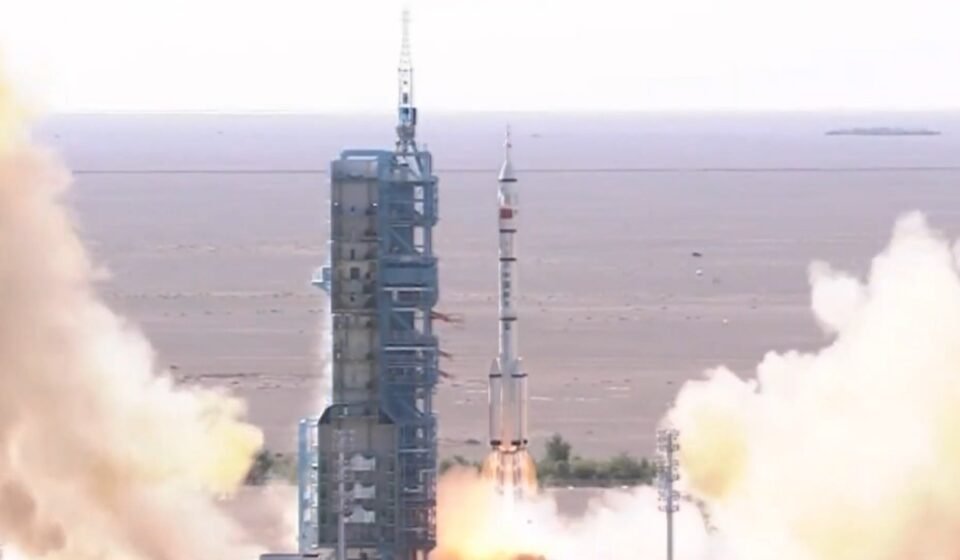
The spacecraft is scheduled to depart from the Jiuquan Satellite Launch Center in northwestern China at 8:18 a.m. Beijing time on November 25. A Long March-2F rocket will carry the crew into orbit.
Pre-launch preparations have included checks of the spacecraft, rocket and space station systems, along with rehearsals involving the astronauts and ground teams. The launch schedule remains subject to the final technical and operational conditions.
After reaching its planned orbit, Shenzhou-24 is expected to approach and dock with Tiangong. The incoming crew will then take part in station handover activities with astronauts already living aboard the orbital complex.
The scientific work planned for Ali
Ali’s role will focus on scientific payloads rather than commanding the spacecraft. His responsibilities are expected to include installing experiment samples and equipment, following research procedures and carrying out scheduled tests in orbit.
Four Pakistani biotechnology experiments have been selected for work connected with the mission. Chinese institutions chose these projects from more than 300 proposals submitted to Pakistan’s Space and Upper Atmosphere Research Commission by universities across the country.
The research areas are linked to food security and climate change. One area involves photosynthetic microorganisms, which can be studied to understand how biological systems respond to the unusual conditions of space.
Microgravity offers researchers an environment that cannot be reproduced in the same way in ordinary laboratories on Earth. Experiments conducted in orbit can help scientists examine biological and material processes under different physical conditions. The results may contribute to future research, although their practical applications will depend on what the experiments demonstrate.
The four Pakistan-linked projects form part of a much wider research programme. China has planned around 90 scientific experiments and technology tests for the mission, covering areas such as space life sciences, materials, fluid physics, combustion science and space medicine.
How Pakistan reached this opportunity
The mission follows a formal cooperation agreement signed in February 2025 between Pakistan’s Space and Upper Atmosphere Research Commission and the China Manned Space Agency. The agreement established a framework for selecting and training Pakistani astronauts for participation in Chinese space station missions.
Two Pakistani candidates, Muhammad Zeeshan Ali and Khurram Daud, were selected after a screening process and sent to China for training. Ali has now been confirmed as the astronaut for Shenzhou-24, while Daud serves as the backup candidate.
Preparation for a spaceflight involves more than learning how to operate spacecraft equipment. Astronauts must understand station procedures, scientific tasks, emergency responses and the responsibilities of working in a confined environment with an international crew.
Ali’s training has therefore included technical operations and coordination with Chinese personnel. Familiarity with operational commands and scientific procedures is especially important because even a short visit requires precise execution of planned activities.
A short visit during a major crew rotation
Ali is expected to remain aboard Tiangong for approximately one week. His return journey is planned aboard the Shenzhou-23 spacecraft, rather than on the vehicle that carries him to the station.
This arrangement is connected to the station’s crew rotation. Shenzhou-23 has been supporting an existing crew at Tiangong, and the arrival of Shenzhou-24 will allow a handover between the outgoing and incoming teams.
One member of the Shenzhou-23 crew, Zhu Yangzhu, is expected to remain in orbit for a year-long residency experiment. The extended stay is intended to provide experience and research data relevant to the challenges of longer human space missions.
For Ali, the shorter flight offers an opportunity to complete assigned experiments and experience life aboard an operational space station without undertaking a full six-month crew rotation.
Why Tiangong matters to China’s space programme
Tiangong is central to China’s independent human spaceflight programme. The station became operational in its current basic configuration in 2022 and provides a permanent platform for crew rotations, scientific research and technology testing.
China has invested heavily in developing launch vehicles, spacecraft and orbital infrastructure. Its long-term ambitions also include sending astronauts to the Moon before 2030. Experience gained through station operations, astronaut training and long-duration research can support some of the technical knowledge required for more demanding missions.
The decision to include a Pakistani astronaut also gives China an opportunity to demonstrate international cooperation through its own crewed space programme. It creates a practical route for a partner country to participate in research conducted aboard Tiangong.
Strategic & Future Implications
For Pakistan, the value of Shenzhou-24 will depend on what the country builds after the flight. The selection of an astronaut is a major achievement, but sustained progress requires investment in university research, biotechnology facilities, scientific training and the ability to analyse experimental results. The four selected projects could provide a starting point for stronger cooperation between Pakistani researchers and Chinese institutions.
The mission also gives China a visible example of international participation in its space station programme. If the partnership produces useful scientific results and leads to further astronaut exchanges, it could create opportunities for other countries to join future research activities. For now, Ali’s scheduled flight is an important first step: its lasting significance will be measured not only by the journey to orbit, but also by the scientific work and cooperation that follow.