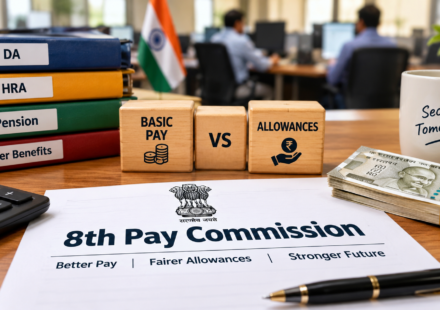
8th Pay Commission: Higher Basic Pay or Bigger Allowances? What Could Offer Government Employees Greater Financial Security

Central government employees and pensioners are closely watching the 8th Central Pay Commission as discussions continue over future salaries, pensions and allowances. One important question is whether a larger increase in basic pay or improved allowances would provide greater financial security over the long term.
The answer will depend on the final pay structure recommended by the commission and approved by the government. Basic pay and allowances serve different purposes, and changes to each can affect employees' monthly income, retirement benefits and ability to manage rising living costs.
The commission has been gathering views from employee associations, pensioners and other stakeholders. Its recommendations have not yet been finalised, so salary figures and fitment factors circulating online should be treated as estimates rather than confirmed increases.
Why a higher basic pay could make a difference
Basic pay is the foundation of a central government employee's salary. Several other salary components and benefits are calculated using basic pay as a reference, although the precise rules differ by benefit.
A higher basic pay could offer several potential advantages:
• Dearness allowance: DA is calculated as a percentage of basic pay under the applicable rules. A higher basic pay can therefore mean a higher DA amount once the relevant rate applies.
• House rent allowance: HRA is generally linked to basic pay, subject to the applicable rates and conditions.
• Retirement benefits: Basic pay can influence pension calculations and other retirement-related benefits under the rules applicable to an employee.
• Long-term salary growth: Where annual increments and future pay revisions are linked to basic pay, a higher starting figure may improve earnings over time.
However, a higher basic pay does not automatically mean that every employee's take-home salary or pension will rise by the same percentage. The final rules, deductions and treatment of existing allowances will matter.
Can higher allowances provide greater financial security?
Allowances help employees meet particular expenses or account for their working conditions. These may include dearness allowance, house rent allowance, transport allowance and other benefits available to eligible employees.
An increase in allowances can provide immediate relief, particularly for employees facing high housing, commuting or living expenses.
For example, an employee living in an expensive city may benefit significantly from a higher HRA rate. A transport allowance increase could also help employees whose commuting costs have risen.
But allowances do not all have the same long-term effect. Some are linked to basic pay, while others depend on location, eligibility or specific service conditions. Certain allowances may not count towards pension calculations in the same way as basic pay.
For this reason, employees should examine the nature of each allowance rather than judging a pay proposal only by the total monthly amount.
What does the fitment factor mean?
The fitment factor is a multiplier used in pay-revision discussions to illustrate how existing basic pay might be converted into a revised figure.
For example, if an employee currently has a basic pay of ₹30,000, applying a hypothetical fitment factor of 2.0 would produce a calculation of ₹60,000.
This is only a mathematical illustration, not an official 8th Pay Commission salary announcement. The actual revised basic pay could differ depending on the factor, pay-matrix rules and the government's final decision.
It is also important to distinguish basic pay from gross salary. Gross salary can include DA, HRA, transport allowance and other eligible payments. If existing DA is absorbed or reset as part of a new pay structure, doubling basic pay would not necessarily double the employee's total salary.
Employees should therefore avoid treating a proposed fitment factor as a guaranteed percentage increase in take-home pay.
What is the latest status of the 8th Pay Commission?
The government constituted the 8th Central Pay Commission in November 2025. The commission has been examining issues concerning pay, pensions, allowances and service conditions.
Its official website lists stakeholder consultations, including a scheduled visit to Mumbai on October 22 and 23, 2026. These consultations are part of the process of collecting views from employee groups and other stakeholders.
The commission is expected to submit its recommendations within 18 months of its constitution, under the approved terms of reference. The government will then consider the recommendations before deciding on implementation.
No final fitment factor, revised salary matrix or comprehensive allowance structure has been officially announced as of October 19, 2026.
What should employees look at before drawing conclusions?
Employees should compare more than the proposed increase in basic pay. The most useful assessment will include revised gross salary, estimated take-home pay after deductions, housing and commuting costs, and the treatment of pension-related benefits.
They should also check whether any salary estimates circulating online are based on official documents or merely on assumptions.
For pensioners, the relevant questions include how pension revision will be determined and which existing rules will apply. The precise effect cannot be established until the commission's recommendations and the government's decisions are available.