
Samsung Sets Fresh Earnings Record as AI Infrastructure Demand Surges

Samsung Electronics has reported another record-breaking quarter as the global expansion of artificial intelligence infrastructure drives demand for advanced memory chips. The South Korean technology giant recorded 107.4 trillion won (approximately $80.5 billion) in operating profit and 195.3 trillion won (approximately $146 billion) in revenue for the July–September 2026 period. Both figures represent new quarterly records for the company.
The results mark Samsung’s fourth consecutive quarter of record revenue and operating profit. The company’s semiconductor division was the principal growth engine, benefiting from demand for memory products used in AI servers, data centres and high-performance computing systems.
The latest performance highlights how the AI investment cycle is reshaping the semiconductor industry. As technology companies expand computing capacity to train and operate increasingly sophisticated AI models, they need larger quantities of high-speed memory and storage. Samsung is positioning its chip business to capture more of that demand.
AI Memory Chips Drive Samsung’s Earnings
Samsung’s Device Solutions division, which includes its semiconductor operations, generated 147.1 trillion won in revenue and 106.5 trillion won in operating profit during the third quarter.
The memory business delivered particularly strong results as demand from server customers increased and prices rose across several product categories. Samsung also expanded sales of high-bandwidth memory, commonly known as HBM, which helps AI accelerators process large volumes of data efficiently.
The company said it had significantly increased sales of HBM4, a newer generation of high-bandwidth memory designed for advanced computing applications. Server DRAM and solid-state drives also benefited from demand linked to AI infrastructure expansion.
Memory has become an increasingly important part of AI hardware because powerful processors require rapid access to large amounts of data. As developers build larger AI systems, the need for memory bandwidth, capacity and energy efficiency is growing.
Samsung’s scale across memory production and semiconductor manufacturing gives it several opportunities to participate in this expansion. However, the company must continue improving product performance and production efficiency as competition intensifies.
Why High-Bandwidth Memory Matters
High-bandwidth memory is designed to move data rapidly between memory and processors. This capability is important for AI systems, where thousands of calculations may be performed simultaneously and large datasets must be accessed quickly.
Traditional memory products remain essential for smartphones, personal computers and enterprise servers. But AI accelerators often require specialised memory configurations to avoid data-transfer bottlenecks.
Samsung is increasing its focus on advanced memory products while seeking to strengthen its position among customers developing AI processors and data-centre systems. The company also plans to expand sales of server DRAM and high-capacity storage products as demand for computing infrastructure grows.
The opportunity is significant, but it is not without risk. Chipmakers must invest heavily in manufacturing capacity and advanced production technology before they can supply new products at scale. If customer demand slows or new capacity arrives faster than expected, prices and profit margins could come under pressure.
AI Growth Is Not Lifting Every Samsung Business Equally
Although semiconductor earnings surged, Samsung’s consumer-facing businesses faced a more difficult operating environment.
The company’s Device eXperience division, which includes smartphones, televisions and home appliances, recorded 52.1 trillion won in revenue and an operating loss of 800 billion won in the third quarter.
The mobile business continued to generate substantial sales, supported by flagship smartphones and foldable devices. However, higher component and operating costs weighed on profitability. Rising memory prices can create a particular challenge for electronics manufacturers because memory is an important component in smartphones and other connected products.
This creates a contrast within Samsung’s business model: stronger memory prices can improve results for its semiconductor division while increasing costs for parts of its device business
The company’s ability to manage that balance will be important as it seeks to preserve consumer-product competitiveness while expanding its position in AI-related components.
Samsung Expects AI Chip Demand to Remain Strong
Samsung expects investment in AI infrastructure to continue supporting the semiconductor market into 2027. It anticipates that demand for AI-related memory will grow faster than industry supply as technology companies expand their computing capabilities.
The company plans to prioritise high-bandwidth memory, server DRAM and solid-state drives, while pursuing longer-term supply arrangements with customers. Such arrangements can help manufacturers plan production and give customers greater visibility over the availability of essential components.
Samsung is also targeting opportunities in advanced chip manufacturing, including products for high-performance computing applications. Its foundry business reported improved revenue and earnings during the quarter, supported by higher sales of advanced-node products and demand related to AI and computing workloads.
Nevertheless, the outlook depends on continued investment by AI developers and cloud-computing companies. Any reduction in spending, technical changes in AI system design or shift in supplier preferences could affect the pace of growth.
Heavy Investment Will Be Needed to Sustain Growth
Samsung is planning substantial spending on manufacturing facilities and technology. Its capital expenditure reached 29 trillion won in the third quarter, with most of the spending allocated to the semiconductor division.
For the full year, the company expects capital expenditure of approximately 84.4 trillion won, including investment in production capacity and infrastructure intended to meet demand for AI and high-performance computing products.
Such investment is necessary to expand output, improve manufacturing processes and develop more advanced chips. However, building semiconductor facilities requires significant capital and long lead times. New capacity must also be matched to customer demand to avoid oversupply.
Samsung therefore faces a dual challenge: expanding production quickly enough to capture the AI opportunity while ensuring that investment produces sustainable returns.
What Samsung’s Record Means for the Technology Industry
Samsung’s latest results underline the growing importance of memory chips in the AI economy. While public attention often focuses on AI models and powerful processors, memory and storage are also critical to the performance of modern computing systems.
Strong demand could support semiconductor investment, create opportunities for suppliers and accelerate the development of advanced manufacturing technologies. It may also affect prices for memory components used in other electronic devices.
For consumers, sustained increases in memory costs could eventually add pressure to the prices or margins of smartphones, computers and other products. The actual impact will depend on supply conditions, competition and how manufacturers absorb or pass on higher costs.
For Samsung, the immediate priority is to strengthen its advanced-memory portfolio, meet customer requirements and maintain production efficiency. Its record quarter demonstrates the scale of the current AI-driven opportunity, but continued growth will depend on demand, execution and the economics of future investment.
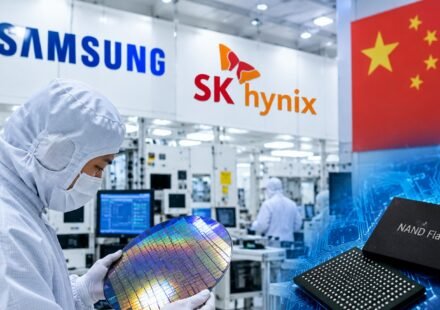
Samsung and SK Hynix Upgrade China Plants to Make More Advanced Memory Chips
South Korean semiconductor giants Samsung Electronics and SK Hynix are upgrading their manufacturing facilities in China to produce more advanced memory chips, as they seek to meet rising demand from the artificial intelligence (AI) industry and compete with China's rapidly growing domestic chipmakers.
According to a Reuters report citing four people familiar with the plans, both companies are working to manufacture NAND flash memory chips with more than 200 layers at their Chinese plants. The upgrades could help them maintain their competitiveness in a market increasingly shaped by AI data centres, cloud computing and high-capacity data storage.
However, the companies face a difficult operating environment as US export controls restrict access to certain American semiconductor manufacturing equipment and require annual licensing for equipment installations at their Chinese facilities.
Samsung Targets 286-Layer NAND Chips in China
Samsung is upgrading its semiconductor facility in Xi’an, northwestern China, to produce its 286-layer V9 NAND memory chips, Reuters reported.
The Xi’an plant is particularly important to Samsung because it accounts for approximately 40% of the company’s global NAND production, according to people familiar with the plans cited in the report.
The project, internally known as “Monami”, is targeting monthly output of 5,000 wafers by December 2026, followed by a planned increase to 40,000 wafers per month by December 2027.
Samsung said the upgrade complies with US export regulations and is intended to meet growing demand from global customers, including those in the United States. The company also said the project does not involve expanding production capacity or constructing new manufacturing facilities.
NAND flash memory is a type of non-volatile storage that retains information even when power is switched off. It is widely used in smartphones, personal computers, solid-state drives and data-centre storage systems.
Increasing the number of layers in a NAND chip allows manufacturers to pack more storage capacity into a smaller physical space, potentially improving efficiency and reducing costs.
SK Hynix Plans Advanced Production at Dalian Facility
SK Hynix is also working to upgrade its NAND manufacturing operations at Dalian, in northeastern China.
The company is looking to shift production from its existing 192-layer products to NAND chips with 240 layers or more, according to people familiar with the plans cited by Reuters.
The Dalian facility was acquired when SK Hynix purchased Intel’s NAND memory business in 2021. The business subsequently became known as Solidigm, which focuses on enterprise storage products.
One source told Reuters that SK Hynix is authorised to produce chips with up to 240 layers at the Dalian site. The company may also seek US permission to conduct research and development on chips with more than 300 layers.
Such research could help the company prepare for future manufacturing requirements, although the extent and timing of any further production upgrades remain uncertain.
US Export Controls Create Challenges
The upgrades come amid continuing technology tensions between Washington and Beijing.
Since 2022, the United States has introduced restrictions on exports of certain advanced semiconductor manufacturing equipment to China. These measures are intended to limit China's access to technologies that could support its advanced computing and semiconductor capabilities.
Samsung and SK Hynix have faced additional uncertainty over the equipment they can install at their Chinese factories. Following changes to their previous authorisations in 2025, the companies must seek annual US licences for certain American-made manufacturing tools.
The US Commerce Department has said it intends to allow the companies to continue operating their existing facilities in China, while indicating that licences for technological upgrades and capacity expansion would not generally be granted under its stated policy. The precise status of approvals for the newly reported projects was not clear from the Reuters report.
Both companies have said their current upgrade efforts are being carried out in consultation with Washington and in accordance with applicable US regulations. The situation highlights the challenge of balancing access to the Chinese market with compliance with export-control requirements.
Chinese Rival YMTC Increases Competition
Another major factor behind the upgrades is the rise of Yangtze Memory Technologies Co (YMTC), a Chinese NAND manufacturer that has expanded its position in the domestic market.
According to market research firm Omdia, cited by Reuters, YMTC held 38.5% of China's NAND market in the second quarter of 2026, overtaking Samsung, whose share stood at 33.5%. SK Hynix's share was reported at 17%.
YMTC produces NAND chips with up to 232 layers in its main product lineup and also manufactures a smaller quantity of 294-layer chips, according to people familiar with its operations. The company is reportedly planning products with more than 300 layers.
The growing presence of Chinese manufacturers increases competitive pressure on foreign chipmakers, particularly as domestic customers look for alternatives to imported memory products.
For Samsung and SK Hynix, maintaining advanced production capabilities in China could help them serve customers in one of the world's largest electronics markets. However, US restrictions could complicate their ability to keep pace with technological changes.
AI Demand Drives the Memory Chip Market
The rapid growth of AI services is increasing demand for storage and memory technologies. Data centres require substantial amounts of memory and storage to support AI training, inference, cloud services and large-scale data processing.
Although high-bandwidth memory used alongside AI accelerators has attracted considerable attention, NAND flash remains essential for storing the enormous volumes of data handled by modern computing infrastructure.
More advanced NAND technology can help manufacturers deliver higher storage density and improve the economics of large-scale data storage.
Outside China, Samsung has already commercialised 286-layer NAND products and unveiled a prototype with more than 400 layers. SK Hynix offers NAND products with up to 321 layers.
What Happens Next?
The future of the Chinese upgrades will depend on equipment availability, regulatory approvals, production schedules and market demand.
Samsung and SK Hynix must also consider the long-term risks of operating facilities in China while US technology restrictions continue to evolve. Any delay in accessing essential manufacturing equipment could affect their ability to introduce newer products on schedule.
For now, the reported projects demonstrate how the world's leading memory chipmakers are attempting to protect their market positions amid two powerful forces: growing demand for AI-related storage and intensifying geopolitical competition over semiconductor technology.