Quad Targets Economic Pressure Risks With $85 Million Plan to Expand Trusted AI

The four countries of the Quad have announced a new technology and economic cooperation push, pledging more than $85 million in technical and financial assistance to expand access to trusted artificial intelligence across the Indo-Pacific. At the same time, the grouping has raised concerns about economic coercion and export restrictions that can disrupt international supply chains.
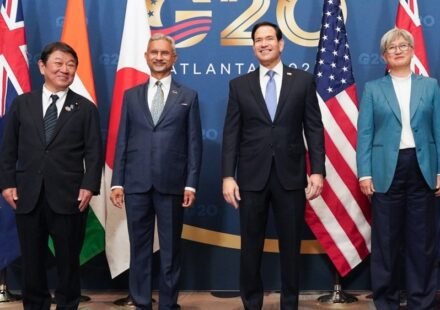
The announcement followed a meeting of foreign ministers from India, the United States, Japan and Australia in Atlanta, Georgia, on October 31, on the sidelines of the G20 Foreign Ministers’ Meeting. The ministers reaffirmed their commitment to a free and open Indo-Pacific and identified technology security, critical minerals, maritime trade and economic resilience as important areas for cooperation.
The initiative comes as governments across the region seek to strengthen access to advanced technology while reducing vulnerabilities in supplies of semiconductors, critical minerals and other strategically important products.
More Than $85 Million for Trusted Artificial Intelligence
The Quad countries said they intend to provide more than $85 million in technical and financial assistance to improve access to trusted AI technology across the Indo-Pacific. The support is expected to include cooperation through the Quad AI accelerator initiative.
The joint statement did not specify how much each country would contribute, how the total would be divided or which countries and projects would receive individual allocations. Those details will be important in determining how quickly the announcement translates into practical benefits.
For countries across the Indo-Pacific, improved access to AI infrastructure and expertise could create opportunities in areas such as digital services, industrial automation, education, healthcare and public administration. However, the actual benefits will depend on project selection, implementation, technical capacity and the availability of reliable digital infrastructure.
The ministers also highlighted the importance of artificial intelligence and initiatives such as Pax Silica for future economic growth. Their wider objective is to encourage trusted technology cooperation while strengthening the systems that support the region's digital economy.
Quad Raises Concern Over Economic Coercion
Economic security was another central theme of the meeting. The four governments expressed serious concern about economic coercion, including arbitrary export restrictions and non-market policies that can create excess production capacity and disrupt supply chains in critical industries.
The joint statement did not explicitly name a country as responsible for these practices. Nevertheless, the discussion comes amid wider international concerns about concentrated supplies of critical minerals and restrictions affecting materials used in advanced manufacturing and technology.
Export restrictions can have consequences far beyond the countries imposing them. If manufacturers cannot obtain essential raw materials or components, production costs may rise, delivery schedules can be disrupted and businesses may be forced to seek alternative suppliers.
For the Quad, building more reliable and open supply chains is therefore both an economic priority and a strategic objective. Cooperation could help member countries identify vulnerabilities earlier and develop alternatives before disruptions spread across industries.
The initiative does not mean that every supply-chain problem will be resolved or that the four countries have agreed to impose new restrictions on another economy. Its stated emphasis is on resilience, cooperation and reducing exposure to disruptive practices.
Critical Minerals Get a Separate $10 Million Commitment
Alongside the AI announcement, the United States committed $10 million to support infrastructure and facilities for recovering critical minerals from electronic waste and scrap materials in India and Association of Southeast Asian Nations (ASEAN) countries.
This commitment is separate from the more than $85 million intended for trusted AI access.
Critical minerals are used in a range of products, including electronics, batteries and advanced manufacturing equipment. Recovering usable materials from discarded products could help diversify supplies and reduce dependence on a limited number of sources.
The Quad countries also welcomed private-sector investment in waste collection networks, processing plants and refineries. They said they would explore ways to streamline the movement of recyclable materials across borders while maintaining existing regulations.
For India, the effort could create opportunities to expand recycling capabilities, strengthen domestic processing and attract investment into parts of the technology supply chain. The scale of those benefits will depend on implementation, commercial viability and the development of effective collection and processing systems.
Semiconductor Supply Chains and Next-Generation Networks
The ministers also agreed to begin identifying vulnerabilities in semiconductor and AI hardware supply chains before they cause major disruptions.
Advanced semiconductors are essential to data centres, AI systems, telecommunications equipment and a growing range of industrial applications. Disruptions in their supply can affect businesses well beyond the technology sector.
The Quad plans to explore cooperation on trusted advanced communications technologies, including 5G, 6G and Open Radio Access Networks. The countries also intend to identify priority partners for cooperation and develop a pipeline of trusted communications projects.
Work on mapping digital identity standards is expected to continue, while cybersecurity cooperation remains part of the grouping's broader technology agenda.
These initiatives could help countries improve the security and reliability of digital infrastructure. However, identifying supply-chain weaknesses is only an initial step; addressing them may require significant investment, skilled workers and cooperation between governments and private companies.
Maritime Security and Regional Trade
The joint statement also emphasized the importance of protecting freedom of navigation and the uninterrupted flow of commerce through strategically important waterways, including the Strait of Hormuz, the Red Sea and the Bab el-Mandeb Strait.
These routes are important for international shipping and energy trade. Disruptions can increase transport costs, delay deliveries and create uncertainty for businesses that depend on international markets.
The Quad also highlighted progress in maritime cooperation, including information-sharing and efforts to improve regional awareness of activity at sea. The four countries are planning further cooperation to strengthen their ability to respond to maritime challenges.
In addition, the ministers announced a Quad Business Leaders' Forum intended to connect companies, government representatives and policy experts. The forum is designed to encourage commercial partnerships and investment in strategic sectors. The countries' export credit agencies are also scheduled to meet in Tokyo on November 18 to explore practical areas of cooperation.
What the Announcements Could Mean for India
For India, the Quad's latest initiatives offer potential opportunities in AI adoption, semiconductor supply-chain resilience, critical-mineral recycling and digital infrastructure.
Better access to trusted AI technology could support businesses and public institutions seeking to adopt advanced digital tools. Cooperation on critical minerals could also encourage investment in recycling and processing, while stronger supply-chain links could give Indian companies additional opportunities to participate in regional technology markets.
The impact, however, should not be overstated. The AI assistance is a planned commitment, and the public statement does not yet provide a detailed allocation or implementation timetable. Its eventual value will depend on which projects receive support and whether they deliver measurable improvements.
Analysis: The Quad is increasingly connecting technology cooperation with economic security. By focusing on AI access, semiconductor vulnerabilities, critical minerals and maritime trade, the four countries are seeking to make the Indo-Pacific's economic networks more resilient. The initiative's success will be judged not only by the money announced but also by whether it produces practical projects, diversified supplies and wider access to reliable technology.
For now, the October 31 meeting marks a further step in the Quad's efforts to deepen economic and technological cooperation without explicitly naming a country in its warning about economic coercion.