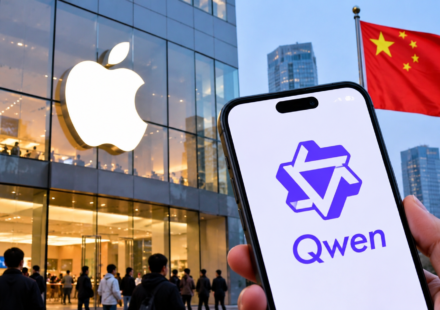
Apple Turns to Alibaba’s Qwen as AI Features Prepare for China Debut

Apple is preparing to bring its long-awaited artificial intelligence services to users in China, with Alibaba’s Qwen model set to play an important role in the technology rollout expected in December. The move could mark a significant step in Apple’s efforts to strengthen its position in one of its most important smartphone markets, where domestic manufacturers have been expanding their AI capabilities.
The initial launch of Apple Intelligence in China is expected to accompany the release of iOS 27.3. Developer testing is scheduled to begin with an iOS beta on November 4, according to reports published on October 31. The rollout will introduce selected AI-powered tools to eligible users, although the full range of Apple’s latest AI capabilities may not be available in the Chinese market from the outset.
Alibaba’s Qwen Becomes Part of Apple’s China Strategy
Alibaba Group’s Qwen is a family of artificial intelligence models designed to understand and generate language and handle a range of other AI tasks. By incorporating Qwen into selected Apple Intelligence experiences, Apple can adapt its services to the technical and regulatory requirements of China.
The integration is expected to support functions involving Siri, Writing Tools and Visual Intelligence. These capabilities could help users work with text, understand information through their devices and access AI assistance within Apple’s software environment.
Writing Tools can assist with tasks such as rewriting, proofreading and summarising text. Visual Intelligence is designed to help users obtain information about objects and scenes captured through their devices’ cameras. Siri provides a voice-based interface for interacting with supported features.
However, the planned launch should not be interpreted as confirmation that every new AI function announced by Apple will reach Chinese users in December. Reports indicate that some of the company’s newer, AI-powered Siri capabilities will not be included in the initial release. The first phase is expected to focus on a selected set of existing Apple Intelligence features.
Why China Requires a Different AI Approach
Apple’s AI strategy in China differs from its approach in several other markets. In countries where its services are available, Apple Intelligence can work with Apple’s own technology and supported external AI services. In mainland China, however, companies must navigate local requirements governing generative AI services and their public availability.
China’s regulatory authorities registered Apple Intelligence for use in the country in July 2026, clearing an important hurdle for the rollout. Alibaba’s Qwen is part of the technology arrangement supporting the service, while Apple has also been reported to be working with Chinese technology company Baidu on certain features.
The regulatory process helps explain why the Chinese release has taken time. Apple has had to prepare a version of its AI experience that can operate within the local market’s rules while delivering features that are useful to customers.
The arrangement also highlights how international technology companies may need different partnerships and product configurations to reach users in markets with distinct regulatory frameworks.
Privacy and User Control Remain Important Questions
The companies have indicated that users will be able to choose whether to enable the Qwen integration and decide what information they share. Alibaba has also said that user requests and AI-generated responses will not be used to train its models.
These commitments are relevant because AI assistants can process personal messages, written material, questions and other potentially sensitive information. Users will want to understand how requests are handled, what information leaves their devices and which privacy protections apply to different features.
The precise handling of information can depend on the feature and the system architecture involved. Therefore, users should consult Apple’s official documentation and applicable privacy disclosures when the service becomes available, rather than assuming that every AI task is processed in the same way.
The rollout will also offer an opportunity to assess whether the promised controls are clear and practical for everyday users.
Which iPhone Users Can Access the Features?
The planned integration is aimed at compatible Apple devices in the Chinese market. Eligibility is expected to depend on device compatibility and regional settings, including the device’s location and the country or region associated with the user’s Apple Account.
This means the December launch should not be treated as a worldwide release of Qwen-powered Apple Intelligence. An iPhone user in India, the United States or another market should not assume that changing a single setting will automatically provide access to the China-specific service.
Apple’s final software release and eligibility guidance will determine which devices can use the features and under what conditions.
For existing customers, the practical questions will include whether their devices qualify, which tools are available at launch and whether the experience supports their preferred language and everyday needs.
A Competitive Challenge for Apple in China
The launch comes as Chinese smartphone makers continue to build AI features into their devices. Companies competing in the market have introduced tools intended to improve productivity, assist with communication and make smartphone functions more responsive to users.
Apple’s delayed AI rollout has therefore become more than a software update. It is also an opportunity for the company to demonstrate that its devices can remain competitive as AI becomes a more visible part of the smartphone experience.
The Qwen partnership could help Apple deliver locally adapted services while drawing on Alibaba’s experience developing AI models. For Alibaba, the integration offers an opportunity to extend Qwen’s reach through Apple’s hardware and software ecosystem.
The commercial outcome, however, is not guaranteed. Customers will judge the service on its usefulness, reliability, privacy protections and the quality of its performance in real-world situations. A partnership alone does not establish that Apple will regain market share or that users will prefer its AI tools over alternatives.
What the December Launch Could Mean
Analysis: If the rollout proceeds as planned, Apple could begin closing an important gap between its AI offering in China and the experience available to customers elsewhere. More useful writing assistance, visual information tools and other integrated features could make compatible devices more attractive to consumers who increasingly expect AI capabilities from their phones.
The partnership may also illustrate a wider shift in the global AI industry. Rather than relying on one model or provider everywhere, technology companies may increasingly combine their own systems with local partners to meet market-specific needs.
For now, the confirmed direction is clearer than the ultimate impact: Apple Intelligence is preparing for a phased China launch, and Alibaba’s Qwen is expected to support selected experiences. The December release will show how much functionality reaches users initially—and whether Apple can turn the partnership into a meaningful competitive advantage.