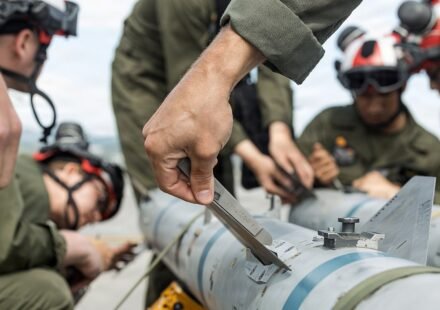
US and Japan Move to Expand Missile Production as Regional Security Concerns Grow

The United States and Japan have agreed to establish a missile assembly and inspection facility in Japan, marking a new step in their efforts to strengthen military cooperation and improve the supply of advanced weapons in the Indo-Pacific region.
The agreement covers the Advanced Medium-Range Air-to-Air Missile (AMRAAM), a weapon used by modern fighter aircraft, including the F-35. Japan's Defence Minister Shinjiro Koizumi announced the arrangement following talks with US Defence Secretary Pete Hegseth in Cebu, Philippines, on October 28.
The initiative, part of a broader bilateral effort known as Operation Supercharge, is intended to expand defence production capacity and strengthen the ability of both countries to obtain essential munitions. Officials have emphasised the importance of improving deterrence and responding more quickly to the increasingly complex regional security environment.
The location of the planned facility, its construction schedule and its expected production volume have not yet been publicly announced.
What the New Missile Facility Will Do
The planned facility will focus on final assembly and inspection of AMRAAM missiles in Japan. These weapons are designed to engage airborne targets at medium ranges and are used by several types of combat aircraft.
Establishing production-related capabilities in Japan could help diversify the manufacturing network that supplies the US military and its allies. Instead of relying exclusively on existing production locations, the two countries would have another facility supporting the assembly and inspection process.
The agreement also reflects a wider effort to increase the availability of critical military equipment. Demand for advanced missiles has grown as countries seek to strengthen their air forces and maintain sufficient weapons stocks for training, readiness and potential contingencies.
However, the announcement does not establish that the Japanese facility is already operating. Additional details will be needed to determine when production can begin and how much it will contribute to overall missile supplies.
Why AMRAAM Matters to the US and Japan
The AIM-120 AMRAAM is an important component of modern air combat. It provides fighter aircraft with an all-weather, beyond-visual-range air-to-air capability, allowing pilots to engage targets without necessarily needing to approach them closely.
The missile is compatible with several aircraft platforms, including the US-made F-35, which is operated by both the United States and Japan.
Reliable access to these weapons is important because advanced fighter aircraft require suitable missiles, spare parts, maintenance support and trained personnel to maintain operational readiness. Expanding the production network could therefore help both countries manage supply requirements.
The agreement also gives Japan a more substantial role in the defence-industrial supply chain supporting the alliance. Its contribution would extend beyond purchasing military equipment to include a greater role in producing and inspecting important components of the broader weapons system.
The actual effect on supply, however, will depend on the facility's production capacity, technical requirements and the time needed to establish operations.
China and the Changing Security Environment
The agreement comes amid continuing concerns among US allies about China's growing military capabilities and disputes over maritime territory in the Indo-Pacific.
China claims extensive areas of the South China Sea, where its maritime claims overlap with those of the Philippines, Vietnam, Malaysia, Brunei and Taiwan. The region is strategically important because it carries substantial international shipping traffic and contains contested maritime features.
Japan also has a separate territorial dispute with China over islands in the East China Sea. Both governments have periodically accused the other of activities that infringe on their maritime interests.
Although the missile agreement was announced against this wider security backdrop, Japanese and US officials did not describe the arrangement as being directed exclusively at China. Their public statements focused on strengthening the bilateral alliance, improving deterrence and opposing attempts to change the regional status quo through force or coercion.
The distinction matters: the agreement is a defence-cooperation measure, while its wider strategic consequences will depend on how it is implemented and how other regional governments respond.
Japan's Defence Industry Takes on a Larger Role
Japan has gradually expanded its defence cooperation with the United States while reviewing its security and defence policies in response to regional developments.
The new arrangement could support that shift by increasing Japan's participation in the production and inspection of advanced weapons. It may also create opportunities for Japanese industry to develop expertise in defence manufacturing, quality control and cooperation with foreign military suppliers.
At the same time, missile production involves strict technical and security requirements. The AMRAAM contains sophisticated guidance technology and other sensitive systems, meaning that any production arrangement must protect classified information and intellectual property.
The facility will therefore require more than buildings and manufacturing equipment. Its establishment will depend on technical approvals, quality standards, security procedures and the coordination of production responsibilities between the two countries.
Japan's role in the programme will become clearer when officials disclose the facility's location, investment requirements and intended operating schedule.
Could the Agreement Improve Missile Supplies?
One of the main potential benefits is a more diversified supply chain for an important air-to-air weapon.
A larger production network could help reduce the risk that a disruption at one facility or among particular suppliers significantly affects deliveries. It could also provide additional flexibility as the United States and its partners seek to maintain inventories while meeting training and operational requirements.
Nevertheless, a new assembly and inspection facility will not automatically solve every production bottleneck. Missile manufacturing depends on specialised components, propulsion systems, electronics and other materials that may have their own production constraints.
The scale of any improvement will depend on how the Japanese facility is integrated into the existing supply chain and whether it adds meaningful capacity rather than shifting work from another location.
No public production target for the new facility had been announced in the available information.
What the Agreement Means for the Indo-Pacific
The agreement reinforces the importance Washington and Tokyo place on their defence partnership at a time when regional governments are reassessing military readiness and security cooperation.
For Japan, the arrangement could deepen its role in supporting the equipment needs of the alliance. For the United States, it offers a way to broaden cooperation with a key regional partner and potentially strengthen the resilience of its weapons supply network.
Other countries in the Indo-Pacific may also take note of the development as they consider their own defence procurement, military cooperation and industrial capacity.
At the same time, expanding weapons production can raise concerns about an arms buildup and the risk of further strategic competition. Whether the arrangement contributes to greater stability will depend on the wider diplomatic environment, military deployments and the way governments communicate their intentions.
The announcement itself does not indicate that conflict is imminent, nor does it establish that the facility will immediately change the military balance in the region.
What Happens Next?
The next steps will involve clarifying the facility's location, technical arrangements, production schedule and responsibilities shared by the United States and Japan.
Officials will also need to determine how the new facility fits into existing missile production arrangements and what contribution it can make to future supplies.
For now, the agreement represents a concrete move toward deeper defence-industrial cooperation between the two allies. Its practical importance will ultimately depend on how quickly the facility becomes operational and how much additional capacity it delivers.