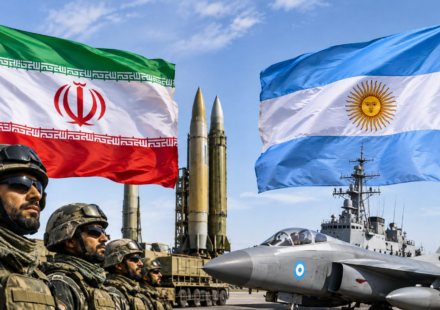
Tehran Expands Dispute With Buenos Aires, Labels Argentina’s Navy and Air Force Terrorist Organisations

Iran has designated Argentina’s Navy and Air Force as “terrorist organisations”, escalating a diplomatic dispute between the two countries after Argentina placed Iran’s Islamic Revolutionary Guard Corps (IRGC) on its own terrorist list earlier this year.
Iran’s Foreign Ministry announced the decision on Wednesday, November 11, describing it as a reciprocal measure. Tehran accused the Argentine government of taking a hostile step by designating the IRGC, which Iran considers an official component of its armed forces.
The Iranian statement said the decision was based on the principle of reciprocity and a domestic law adopted in 2019. It also warned that Argentina would be responsible for the consequences of the move, although it did not explain what specific action Tehran might take.
The declaration specifically names Argentina’s Navy and Air Force. It does not mention the country’s Army.
Why Iran has targeted Argentina’s military
The latest announcement is directly connected to Argentina’s decision on March 31, 2026, to designate the IRGC as a terrorist organisation.
Argentina’s government said its decision was based on security concerns and alleged links between the Iranian military organisation and terrorist attacks carried out on Argentine soil during the 1990s.
The government of President Javier Milei referred particularly to two major bombings in Buenos Aires. The first targeted the Israeli Embassy on March 17, 1992, killing 29 people and injuring more than 200. The second struck the Argentine Jewish community centre, known as AMIA, on July 18, 1994.
The AMIA bombing killed 85 people and injured more than 300, making it the deadliest terrorist attack in Argentina’s history.
Argentina has long accused Iran and Lebanon-based Hezbollah of involvement in the attacks. Tehran has rejected accusations of responsibility. The investigations and legal proceedings surrounding the bombings have remained a major source of tension between Argentina and Iran.
By placing the IRGC on its terrorist register, Argentina opened the way for financial sanctions and operational restrictions against the organisation under its domestic system.
Iran invokes its 2019 law
Iran has justified its latest action through legislation adopted in 2019, following the United States’ decision to designate the IRGC as a terrorist organisation.
The Iranian law provides for reciprocal measures against countries that support or comply with the American designation. Tehran says Argentina’s action falls within the scope of that legislation.
Iran’s Foreign Ministry described the Argentine decision as contrary to international law and argued that the IRGC is part of Iran’s official military structure. From Tehran’s perspective, Argentina’s designation therefore amounts to targeting a recognised component of the Iranian armed forces.
The ministry said the Argentine Navy and Air Force would be covered by the provisions of the 2019 law and formally declared both organisations terrorist entities.
However, the statement did not provide details about how the designation would be implemented in practice. It also did not specify whether Iranian authorities planned financial restrictions, travel measures or other steps involving Argentine military personnel.
The absence of a detailed explanation leaves the immediate practical consequences uncertain.
Argentina’s position and the AMIA case
Argentina’s decision against the IRGC was part of a wider effort by the Milei administration to strengthen measures against organisations it considers connected to terrorism and international security threats.
In its March announcement, the Argentine presidential office said investigations and intelligence assessments had established links between Iranian officials, the Revolutionary Guard and the attacks in Buenos Aires.
The government also referred to international arrest alerts issued against several Iranian citizens in connection with the investigations. Among those named was Ahmad Vahidi, a former Iranian defence minister who has held senior positions within the IRGC.
Argentina’s action was not limited to a political declaration. The organisation was added to the country’s Public Registry of Persons and Entities Linked to Acts of Terrorism and Their Financing, known as RePET.
That registration allows Argentine authorities to apply financial sanctions and restrictions intended to prevent the use of the country’s financial system for activities linked to terrorism.
The two governments therefore have adopted opposing official positions. Argentina maintains that its decision responds to security concerns and the unresolved legacy of the Buenos Aires bombings. Iran considers the designation an unjustified attack on one of its state military institutions.
A wider pattern of diplomatic retaliation
Iran’s latest action also comes amid a broader pattern of retaliatory designations involving foreign military and intelligence institutions.
Earlier in November, Tehran announced measures against British institutions, designating the Royal Navy and Royal Air Force as terrorist organisations and describing the British Secret Intelligence Service, commonly known as MI6, as a hostile group.
Iran has also used similar reciprocal measures in disputes involving other Western countries. These announcements reflect the growing use of domestic terrorism-related legislation as a diplomatic response to foreign sanctions and security designations.
Such decisions can deepen political tensions even when their practical effects outside the issuing country remain limited.
What could happen next?
The immediate question is whether Argentina will respond formally to Iran’s announcement. Tehran has warned Buenos Aires about possible consequences but has not specified any planned measures.
The designation could add further strain to diplomatic relations, complicate official contacts and increase political pressure between the two governments. Any concrete impact would depend on how Iran applies its decision and whether Argentina announces countermeasures.
It is also important to distinguish between a country's domestic designation and an internationally binding decision. Iran's announcement reflects Tehran's own legal and political position; it does not automatically mean that other countries or international organisations will recognise Argentina's military branches as terrorist organisations.
For now, the development represents a new chapter in a long-running dispute rooted in the 1990s bombings in Buenos Aires and the competing security positions of the two governments.
The latest move has widened the confrontation from the IRGC to Argentina's conventional military institutions. Whether the dispute remains a diplomatic exchange or leads to further measures will depend on the next steps taken by Tehran and Buenos Aires.