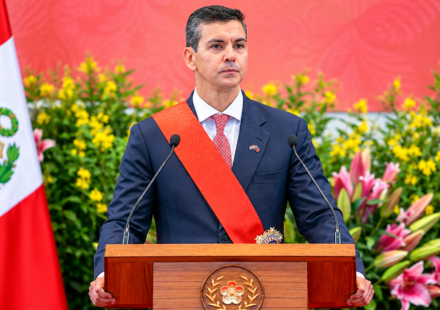
Ueno Bank Collapse Triggers Political Earthquake in Paraguay as President Peña Faces Impeachment

Paraguay has been plunged into a major political and financial crisis after the collapse of digital lender Ueno Bank triggered widespread public anger and pushed President Santiago Peña towards the end of his presidency. The banking crisis, which disrupted access to savings for millions of customers, has raised serious questions about financial regulation, political connections and the handling of public funds.
Peña, an economist who took office in August 2023, announced his resignation on November 5, 2026, as pressure mounted from opposition lawmakers, protesters and members of his own political camp. However, his attempt to leave office did not immediately end the political confrontation. Paraguay's Chamber of Deputies voted 78-0 to advance impeachment proceedings against him, and the Senate subsequently opened the impeachment process.
As of November 6, the resignation had not been formally accepted by Congress, and Peña was expected to appear before the Senate to defend himself. The crisis has therefore developed beyond the failure of a financial institution into a wider confrontation over accountability and the country's political institutions.
What happened to Ueno Bank?
Ueno, a digital lender launched in 2021, expanded rapidly from a relatively small financial business into one of Paraguay's prominent banking institutions. Its mobile-first services attracted customers through digital payments, savings products and other financial services.
The bank said it had approximately three million customers in a country with a population of around 6.5 million. It also administered approximately $850 million in public funds, including money connected to state institutions and pension-related bodies.
The crisis escalated after Paraguay's Central Bank intervened in Ueno when its financial position fell below the legally required solvency threshold. Regulators identified poorly documented lending, loans to companies connected to the bank's controlling shareholder and expenses that had reportedly been incorrectly recorded as assets.
After the bank's accounts were reviewed and adjustments were made, its capital fell to less than half the legal minimum, according to reports on the regulatory findings. The central bank placed the institution under official intervention and began the process of transferring customer accounts and recoverable assets.
The intervention disrupted the bank's digital services, including its application, cards and transfers. Customers found themselves unable to access their money, while long queues formed outside branches in the capital, Asunción.
Why did the banking crisis reach the presidential palace?
The political controversy intensified because of Peña's previous business connections to Grupo Vázquez, the business group associated with Ueno's ownership.
Peña has acknowledged that he held a stake in Grupo Vázquez but said he sold it in March 2025. He has also maintained that he had no direct shareholder or investor relationship with Ueno Bank and has rejected suggestions of improper involvement in its operations.
Opposition lawmakers, however, have raised allegations of conflicts of interest, misuse of pension funds and inadequate government oversight. They have questioned whether public institutions placed excessive amounts of money with the bank and whether the regulator acted quickly enough when concerns about its lending practices emerged.
Another issue involved Carlos Carvallo, who had previously led Financiera Ueno, the predecessor to the digital bank, before becoming president of Paraguay's Central Bank. His appointment attracted scrutiny because the central bank was responsible for supervising the institution. Carvallo resigned after the regulatory intervention, although the central bank had maintained that he recused himself from decisions involving Ueno.
These issues have become central to the political investigation. The allegations have not been established as criminal findings against Peña, who has denied wrongdoing and argued that the matter should be addressed through legal and institutional procedures.
President announces resignation, but impeachment moves forward
On November 5, Peña announced in a recorded address that he had decided to submit his resignation. He said his decision was intended to protect national stability, social peace and democratic institutions. He also stressed that his priority was ensuring that people who had deposited their savings in the financial system could recover their money.
However, lawmakers did not simply allow the resignation to close the matter. The Chamber of Deputies approved impeachment proceedings by 78 votes to zero, sending the case to the Senate.
The Senate opened the impeachment process later that day. Peña indicated that he would appear before senators to exercise his right to defend himself.
The political significance of the proceedings is considerable. Under Paraguay's constitutional arrangements, a former president can become a senator for life, a position associated with legal protections. Opposition lawmakers have argued that allowing Peña to leave office through resignation could affect the possibility of holding him accountable through an impeachment process.
The situation remained unresolved on November 6, with the Senate process underway and no final judgment announced.
Millions of customers face uncertainty over their money
The immediate human impact of the Ueno crisis has been felt by depositors who suddenly lost access to their accounts. The bank served a substantial share of Paraguay's population, including people who relied on its services for everyday transactions and savings.
Some customers also received pensions and other payments through the institution. The disruption therefore affected not only private savings but also people dependent on regular financial transfers.
The government and central bank have started arrangements to transfer accounts and protect depositors through the country's deposit-guarantee framework. Emergency measures were also approved to accelerate payments to affected customers.
Authorities have indicated that the wider banking system remains stable and that the intervention is focused on Ueno. Nevertheless, the disruption caused concern across the financial sector, with customers attempting to open accounts at other institutions and banking applications experiencing additional pressure.
The collapse has also affected employment. Reports have estimated that approximately 7,000 direct and indirect jobs connected to the bank and related businesses were affected.
Investigations and arrests add to the crisis
The financial failure has prompted criminal investigations into the bank's lending practices and the conduct of people associated with its management.
Prosecutors have charged 27 bank officials and associates in connection with alleged offences including breach of trust and attempted fraud. Arrest warrants were issued for eight executives, while judicial action was taken against several senior figures.
Investigators are examining whether loans were extended to companies linked to the bank's owners without adequate guarantees and whether funds were handled improperly. The investigation has also expanded to examine possible failures in regulatory oversight and the handling of public money.
These proceedings are separate from the political impeachment process. Allegations against individuals must be assessed through the courts, and the charges do not by themselves establish guilt.
What the crisis means for Paraguay's economy
Paraguay had built a reputation as one of South America's relatively stable and investment-friendly economies. Its economic profile, agricultural exports, energy resources and efforts to attract international capital had helped strengthen its position among regional markets.
The Ueno crisis has created questions about the country's financial oversight and the relationship between political power and private business. Reuters reported that the country's currency weakened sharply against the US dollar following Peña's resignation, while sovereign bond prices also fell.
The longer-term impact will depend on how authorities resolve the banking failure, protect depositors and establish accountability. Investors will also be watching whether the regulatory system can demonstrate independence and transparency.
The Ueno Bank collapse has therefore become much more than a banking problem. It has exposed the consequences of financial risk, weakened public confidence and triggered a major political confrontation. For Paraguay, restoring trust in its banking institutions and democratic processes will be a central challenge in the days ahead.