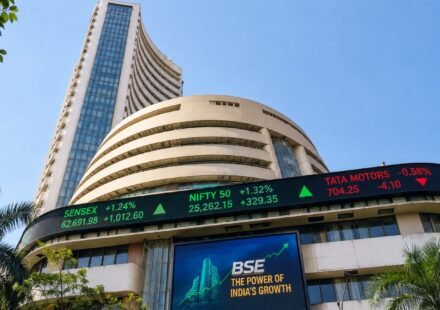
Stock Market Today: Sensex, Nifty Eye Opening Cues as GIFT Nifty, Canara Bank and BHEL Take Centre Stage

Indian equity markets are set for another closely watched session on Wednesday, October 14, as investors assess global market signals, quarterly earnings announcements and movements in crude oil prices. The headline points to a potentially weaker opening for the Sensex and Nifty 50, although the opening direction should be confirmed using the latest GIFT Nifty data before the market begins trading.
The focus is also on Canara Bank, which is scheduled to consider its September-quarter results, while investors will monitor developments involving Bharat Heavy Electricals Limited (BHEL) and other companies reporting or drawing attention during the second-quarter earnings season.
Sensex and Nifty 50: What Happened in the Previous Session?
Indian benchmark indices staged a strong recovery on Tuesday. The BSE Sensex climbed 1,109.10 points, or 1.54%, to close at 73,033.78, while the NSE Nifty 50 gained 358.60 points, or 1.60%, to settle at 22,721.95.
The rally was supported by buying in information technology shares after quarterly results from HCL Technologies and Tata Consultancy Services drew investor attention. Comments from Finance Minister Nirmala Sitharaman regarding discussions around capital-gains and securities transaction taxes also contributed to market sentiment.
However, one strong session does not necessarily establish a sustained recovery. Investors will look for follow-through buying and fresh corporate earnings signals to assess whether the rebound can continue.
GIFT Nifty and Asian Markets in Focus
GIFT Nifty futures are an important early indicator for the Indian market because they trade outside regular domestic cash-market hours. Traders commonly use their movement to gauge the likely opening tone for the Nifty 50.
A lower GIFT Nifty reading can point to a weaker start, but it does not guarantee that Indian benchmarks will open lower or remain under pressure throughout the session. Global equity movements, currency changes, oil prices and domestic institutional flows can all alter the direction after the opening bell.
Asian markets are another key indicator. Weakness in regional technology stocks or renewed concerns about global inflation could weigh on sentiment, while a recovery in overseas equities may offer support.
Canara Bank Q2 Results: Key Details to Watch
Canara Bank is scheduled to consider its financial results for the quarter ended September 30, 2026, at a board meeting on October 14. The results will provide investors with an updated picture of the public-sector lender’s performance during the second quarter of FY2026–27.
Investors are likely to examine several indicators:
• Net interest income: The difference between interest earned on loans and investments and interest paid on deposits and borrowings.
• Net profit: Whether earnings growth is supported by core operations.
• Asset quality: Changes in gross and net non-performing assets.
• Provisions and credit costs: The amount set aside for potential loan losses.
• Deposit and loan growth: Trends in funding, lending and margins.
The actual figures should be taken from the bank’s official results announcement after publication. Expectations or pre-results estimates should not be treated as confirmed financial performance.
BHEL and Other Stocks on Investors’ Radar
Bharat Heavy Electricals Limited (BHEL), a state-owned engineering and power-equipment manufacturer, may attract attention as investors track corporate announcements and the wider earnings season.
For BHEL, market participants typically monitor order inflows, project execution, revenue growth, operating margins and working-capital requirements. Any company-specific announcement should be checked against its official stock-exchange disclosures before being presented as a fresh development.
Investors may also track other companies scheduled to announce results or disclose material business updates. In an earnings-driven market, individual shares can move sharply even when the broader indices remain relatively stable.
Crude Oil, Inflation and the Rupee
Oil prices remain an important risk factor for India because the country imports a substantial share of its crude requirements. Higher oil prices can increase the import bill and put pressure on inflation, the rupee and corporate costs.
Investors are also assessing the implications of recent inflation data and Reserve Bank of India measures aimed at easing pressure on the currency. A weaker rupee can benefit some exporters but raise costs for companies dependent on imported inputs.
Developments in the Middle East could influence oil prices and broader risk sentiment. Any sharp movement in crude or the rupee may affect sectors differently, including aviation, oil marketing, energy, paints and information technology.
What Investors Should Watch Today
The main factors likely to shape Wednesday’s session are the latest GIFT Nifty signal, trends across Asian markets, crude oil prices, rupee movement, foreign-investor activity and company-specific earnings announcements.
A weaker opening, if confirmed, would not by itself establish the direction for the entire trading day. Investors should distinguish between opening indicators and confirmed market prices once trading begins.
Market disclaimer: This article is for informational purposes only and is not investment advice or a recommendation to buy or sell any security. Stock prices can be volatile, and investors should assess their own financial circumstances and risk tolerance.