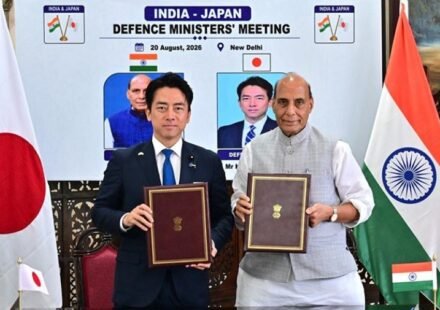
Rajnath Singh and Japan’s Koizumi Discuss Defence Cooperation at Cebu Summit

Indian Defence Minister Rajnath Singh held bilateral talks with his Japanese counterpart, Shinjiro Koizumi, on the sidelines of the 13th ASEAN Defence Ministers’ Meeting-Plus (ADMM-Plus) in Cebu, the Philippines, bringing maritime security and strategic cooperation between the two Asian partners into focus.
The meeting took place as defence ministers from ASEAN member states and their dialogue partners gathered to discuss regional and international security challenges. India and Japan have been expanding their defence relationship through military exercises, naval coordination, technology cooperation and discussions on strengthening industrial links.
The latest engagement provides another opportunity for New Delhi and Tokyo to review their strategic partnership amid changing security conditions across the Indo-Pacific. However, specific agreements or new initiatives arising from the Cebu meeting should be treated as unconfirmed unless announced by the two governments.
Maritime Security Remains a Key Priority
Protecting maritime routes is an important part of India–Japan defence cooperation. Both countries depend on secure sea lanes for international trade and energy supplies, making freedom of navigation and regional stability central to their security interests.
India's location in the Indian Ocean and Japan's position in East Asia give the two countries complementary roles in regional maritime affairs. Cooperation between their navies can improve information-sharing, operational coordination and preparedness for security challenges at sea.
During an earlier meeting in New Delhi on August 20, Singh and Koizumi signed a memorandum of arrangement on maritime security cooperation. The agreement established a framework for closer collaboration between the Indian Navy and Japan Maritime Self-Defense Force, including maritime-domain awareness, search-and-rescue operations and humanitarian assistance during disasters.
The two sides also discussed naval shipbuilding, defence technology, ship-repair arrangements and expanded military exercises. These existing commitments provide an important foundation for their continued dialogue in Cebu.
A Broader Strategic Partnership
India and Japan describe their relationship as a Special Strategic and Global Partnership. Defence cooperation has become an increasingly important part of that relationship, alongside trade, investment, infrastructure and technology.
Military exercises allow the two countries to practise working together, improve communication between their forces and develop familiarity with each other's procedures. Naval cooperation is particularly relevant because maritime emergencies can require rapid coordination across long distances.
Both governments have also expressed interest in expanding cooperation in defence manufacturing and technology. Joint development and industrial collaboration could create opportunities for companies in both countries, although individual projects depend on technical requirements, commercial terms and government approvals.
The relationship also has a regional dimension. India's Act East Policy seeks stronger engagement with Southeast Asian countries, while Japan promotes a Free and Open Indo-Pacific. Both approaches emphasise regional stability, cooperation and respect for international law.
Why the ADMM-Plus Meeting Matters
The ADMM-Plus brings together the 11 ASEAN member states and eight dialogue partners: India, Japan, the United States, China, Russia, South Korea, Australia and New Zealand.
The forum provides a platform for defence ministers to discuss common challenges and develop practical cooperation. Its areas of engagement include maritime security, counter-terrorism, humanitarian assistance, disaster relief and military medicine.
Unlike a collective-defence alliance, ADMM-Plus is a consultative mechanism. Its participants retain their independent foreign policies and may have different views on regional disputes. The forum nevertheless creates opportunities for dialogue and cooperation among countries with varied strategic interests.
India's participation reflects its interest in maintaining regular contact with Southeast Asian governments and strengthening its role in regional security discussions.
Implications for the Indo-Pacific
Closer India–Japan defence coordination could contribute to improved maritime awareness, more frequent military exchanges and greater cooperation in defence technology. It could also support the development of practical arrangements for responding to emergencies and protecting shipping routes.
For the wider region, such partnerships provide additional channels for consultation at a time when maritime disputes and strategic competition remain significant concerns.
However, a bilateral meeting does not automatically translate into a new defence agreement or a change in military policy. The significance of the Cebu talks will depend on any concrete decisions, follow-up arrangements or joint initiatives announced by the two governments.
What Happens Next?
The focus now turns to the outcomes of the ADMM-Plus discussions and any official statements issued by India and Japan following their bilateral engagement.
Further announcements could clarify whether the two countries intend to advance existing maritime-security commitments, expand military exercises or pursue additional defence-industrial projects.
For now, the Cebu meeting underscores the continued importance of India–Japan defence dialogue. The longer-term impact will depend on how effectively both sides translate their shared strategic priorities into practical cooperation.
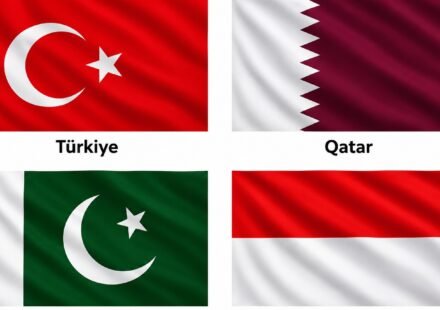
Türkiye, Qatar, Pakistan and Indonesia Sign Defence Cooperation Accord
Türkiye, Qatar, Pakistan and Indonesia have signed a multilateral defence cooperation agreement aimed at strengthening military capabilities, expanding defence production and deepening strategic partnerships among the four countries.
The agreement, known as the Badr Memorandum of Understanding, was signed in Doha on October 21, according to Türkiye’s Defence Ministry. The initiative is designed to encourage cooperation in military manufacturing, technical training, research and development, and the advancement of modern defence systems.
Four Countries Seek Stronger Defence Industry Ties
The agreement brings together four countries with different military and industrial capabilities. Türkiye has developed a growing defence manufacturing sector, Pakistan has experience in military production and training, Qatar has invested heavily in defence and security, while Indonesia is seeking to expand its domestic defence industry.
Under the memorandum, the countries intend to combine their respective capabilities to support joint projects, improve industrial integration and strengthen their ability to meet defence requirements. The agreement also aims to promote cooperation in technical military education and research.
The signing ceremony in Doha was attended by Türkiye’s Defence Minister Yaşar Güler, Qatar’s Deputy Prime Minister and Minister of State for Defence Affairs Sheikh Saud bin Abdulrahman Al Thani, Pakistan’s Defence Minister Khawaja Muhammad Asif and Indonesian Deputy Defence Minister Yusuf Jauhari. Türkiye’s defence industry chief, Haluk Görgün, also attended.
Focus on Joint Production and Technology
The Badr memorandum places emphasis on cooperation that goes beyond purchasing finished military equipment. The participating countries have highlighted technology sharing, joint development and stronger domestic production capabilities as important areas for future collaboration.
Türkiye’s defence industry leadership said the agreement could help turn the four countries’ complementary capabilities into concrete projects. However, details of specific weapons programmes, production targets, funding arrangements or implementation schedules have not yet been publicly outlined.
The accord could create opportunities for cooperation in defence manufacturing, technical expertise and research, although the scale and pace of any projects will depend on subsequent decisions by the participating governments and industries.
Regional Security Cooperation Expands
The agreement comes as countries across the Middle East and Asia reassess their security needs and seek stronger domestic defence industries. Türkiye has maintained close military and defence industry ties with Qatar and Pakistan, while its cooperation with Indonesia has also included defence technology and procurement.
In August 2026, Türkiye signed a separate mutual defence agreement with Pakistan and Saudi Arabia. The new Badr memorandum, however, is focused on defence cooperation and industrial collaboration among Türkiye, Qatar, Pakistan and Indonesia; no publicly announced provision says an attack on one of the four would automatically be treated as an attack on all.
The latest agreement signals a push toward deeper military-industrial partnerships, but its practical impact will depend on whether the countries proceed with joint manufacturing, technology development and training initiatives.