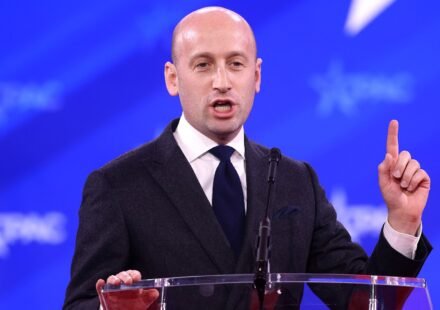
Trump Elevates Immigration Strategist Stephen Miller to Top White House Role Amid Political Backlash

US President Donald Trump’s decision to appoint longtime adviser Stephen Miller as the next White House chief of staff has triggered strong criticism from Democratic leaders and renewed debate over the direction of his administration. Miller, one of the key architects of Trump’s immigration agenda, will replace Susie Wiles, with the transition scheduled to take effect on November 9.
The appointment comes days after Republicans suffered major losses in the November 3 midterm elections, losing control of both chambers of Congress. The political setback has increased pressure on the administration and raised questions about how Trump plans to pursue his agenda during the remainder of his presidency.
Trump announced the leadership change in a post on Truth Social on Friday. He described Miller, who currently serves as deputy chief of staff for policy and homeland security adviser, as one of his most trusted advisers. The president also praised Wiles for her work and said she would move to his political operation.
The announcement immediately drew criticism from prominent Democrats, who have repeatedly opposed Miller’s role in shaping the administration’s immigration and domestic policies.
Democrats describe appointment as a warning sign
House Democratic leader Hakeem Jeffries criticised the decision in a statement on social media, describing Miller as a “dangerous xenophobe and reckless extremist”. Jeffries also accused him of being responsible for policies that had caused serious harm.
Senate Democratic leader Chuck Schumer also condemned the appointment. He said Trump could not have made a worse choice and indicated that Democratic lawmakers would challenge the administration’s policies.
The criticism reflects wider opposition among Democrats to Miller’s influence over immigration enforcement, deportation operations and the expansion of presidential authority.
Miller has been closely associated with the administration’s efforts to increase immigration arrests and accelerate deportations. According to reporting on the administration’s enforcement strategy, he pushed for a target of 3,000 arrests per day. The policy has drawn criticism from civil rights groups and Democratic lawmakers, particularly over arrests involving people without criminal records and long-established residents.
The appointment is therefore being viewed by critics as a signal that Trump intends to retain, rather than moderate, his existing approach to immigration and domestic governance.
Why Stephen Miller is influential in the Trump administration
Miller, 41, has been one of Trump’s most influential political advisers since the president’s first term. He joined Trump’s 2016 campaign and became a central figure in developing speeches and policies, particularly on immigration.
During Trump’s second administration, Miller has served as deputy chief of staff for policy and homeland security adviser. His influence has extended beyond immigration to federal government restructuring, domestic security and foreign policy.
He has supported an aggressive approach to border enforcement and mass deportations. He has also advocated broad presidential powers to implement the administration’s priorities.
Miller’s political positions and public statements have repeatedly attracted controversy. He has defended restrictive immigration measures and used forceful language when discussing migration and political opponents. Supporters of the administration, however, regard him as a committed advocate of Trump’s agenda and a figure capable of translating the president’s priorities into government action.
The appointment gives Miller a more prominent formal position within the White House. The chief of staff manages the president’s schedule, coordinates senior advisers, oversees the flow of information to the president and helps manage relations across the administration and Congress.
A major change after Susie Wiles’ departure
Susie Wiles, who has served as Trump’s chief of staff, is leaving the position after playing a significant role in his 2024 election campaign and second-term administration. She made history as the first woman to hold the White House chief of staff position.
Trump praised her performance and said she would continue working within his political operation. Wiles also expressed pride in her time at the White House.
Her departure comes at a difficult political moment for the administration. Republicans’ losses in both the House of Representatives and the Senate mean Trump will face a Democratic-controlled Congress, creating the possibility of more investigations, legislative disputes and oversight hearings.
The change in leadership could affect how the White House responds to congressional scrutiny and attempts to advance its remaining policy priorities.
Immigration and executive power likely to remain central issues
Miller’s appointment has also drawn attention because of his involvement in several controversial government initiatives. These include immigration enforcement, changes to the federal workforce and disputes with universities and diversity programmes.
He has also supported the administration’s tougher foreign policy positions, including military operations against suspected drug-smuggling vessels and actions involving Iran. Some of these policies have raised legal questions and attracted criticism from lawmakers and international observers.
Democratic lawmakers have indicated that immigration enforcement will remain a major area of scrutiny. They have also raised concerns about the legal basis and consequences of certain administration actions.
Trump’s allies, meanwhile, have welcomed Miller’s promotion. Supporters argue that he understands the president’s priorities and will help maintain a consistent policy direction during a politically challenging period.
What the appointment means for Washington
The change places a close Trump ally in one of the most powerful operational positions in the White House at a time when the administration faces increased opposition in Congress.
A chief of staff cannot independently determine government policy, but the role carries substantial influence over which issues reach the president, how decisions are coordinated and how the administration responds to political pressure.
Miller’s appointment does not automatically change existing laws or policies. However, it indicates that Trump has chosen an adviser closely associated with his current agenda rather than a figure publicly identified with a shift in direction.
The coming weeks will show how the new leadership arrangement affects relations with congressional Democrats, immigration enforcement and the administration’s approach to oversight.
For now, the decision has sharpened an already intense political debate in Washington. While Trump views Miller as a trusted adviser who can help execute his priorities, Democratic leaders see the appointment as a reason to intensify their opposition to the administration’s policies.

Elon Musk Mocks Republican Losses With ‘Space Lasers Didn’t Work’ Remark After Trump’s Midterm Setback
Billionaire entrepreneur Elon Musk has responded with sarcasm after Republicans suffered major setbacks in the 2026 US midterm elections, joking that his supposed “election-interfering space lasers” had failed to deliver the political outcome he wanted. The remark came as Democrats made significant gains across the country, with US media projections indicating that they had secured control of both chambers of Congress.
Musk posted the comment on his social media platform X early Wednesday, November 4, following a difficult election night for President Donald Trump and Republican candidates whom the technology billionaire had financially supported.
“Guess my election-interfering space lasers didn’t work this time,” Musk wrote, adding a shrugging emoji.
Guess my election-interfering space lasers didn’t work this time 🤷♂️
— Elon Musk (@elonmusk) November 4, 2026
The statement was widely interpreted as a sarcastic reference to his substantial financial involvement in Republican election campaigns and the scale of the party's losses. It was not a literal claim that space-based technology had been used to influence voting.
Musk makes two sarcastic posts after election results
Musk made another post shortly before the space-lasers remark, writing: “Data centers in space looking pretty appealing right now.”
The two comments attracted considerable attention because of the election results and the growing debate over the political influence of major technology companies and wealthy donors.
The reference to space-based data centres also connected the election outcome to Musk's business interests. He has repeatedly discussed the possibility of using space infrastructure to support artificial intelligence and computing operations.
The timing of the comments was particularly notable. Democrats had scored major victories in several closely watched contests, including races in Texas, where Republican candidates had received substantial financial backing from conservative donors.
Musk's remarks appeared to acknowledge that his political spending had not translated into the electoral success Republicans had hoped for.
Democrats gain control of Congress
The 2026 midterm elections have delivered a significant political setback for Trump's Republican Party. Democrats made substantial gains in congressional contests, with major US television networks projecting that they would take control of both the House of Representatives and the Senate.
The outcome is important because the president's party will no longer enjoy the same level of congressional control during the remaining two years of Trump's current term.
Control of the House gives Democrats greater authority over legislative priorities, committee investigations and congressional oversight. A Democratic-controlled Senate could also make it more difficult for the administration to secure approval for certain appointments and legislative proposals.
The change in the balance of power could therefore affect Trump's domestic policy agenda, negotiations over government spending and other major political decisions.
Although the final certification of individual races remains part of the normal electoral process, the projected Democratic victories represent a major change in Washington's political landscape.
Musk's huge financial support for Republicans
Musk's reaction has drawn attention partly because of the amount of money he reportedly spent supporting Republican candidates and political organisations during the election cycle.
According to election-finance reporting, Musk contributed hundreds of millions of dollars to Republican political efforts. One estimate put his contributions at approximately $445.6 million through October 14, although the final figure could change as additional financial disclosures become available.
His spending included support for America PAC, the political action committee he founded, as well as contributions to other organisations working to elect Republican candidates.
This level of financial involvement made Musk one of the most prominent individual political donors in the 2026 election cycle.
However, the results demonstrated that substantial campaign spending does not guarantee electoral victory. Several candidates supported by Republican donors faced strong Democratic challenges, while voters in a number of states delivered results that differed from the expectations of the party establishment.
Musk's sarcastic post appeared to recognise that reality without offering a detailed explanation for the Republican defeats.
Texas becomes a major setback for Republicans
Texas emerged as one of the most closely watched battlegrounds during the election. Democrats recorded significant victories in contests that had attracted national attention and heavy campaign spending.
Democrat Gina Hinojosa won the Texas governor's race, defeating Republican incumbent Greg Abbott, according to election projections. The result was particularly significant because Texas has traditionally been a strong Republican state.
Another major development came in the Senate contest, where Democrat James Talarico defeated Republican Ken Paxton. His victory represented an important Democratic breakthrough in a state where Republicans have maintained considerable political strength.
Talarico also referred to powerful political and financial interests during his victory speech. He described the contest as a challenge against influential figures and organisations, including Musk and Trump.
Musk's second post about space-based data centres was also linked to the Texas results. Data-centre expansion had become a controversial issue during the campaign, with concerns about electricity consumption, infrastructure and the impact of large computing facilities on local communities.
Hinojosa had opposed aspects of data-centre expansion, making her victory relevant to the future of major technology infrastructure projects in the state.
What could the results mean for Musk's businesses?
The election outcome could have implications beyond party politics. Musk leads major technology and industrial businesses, including Tesla and SpaceX, and has substantial interests in artificial intelligence, energy and digital infrastructure.
A change in congressional control could bring increased scrutiny of federal policies affecting technology companies, government contracts, energy development and artificial intelligence.
The results in Texas may also influence discussions about future data-centre construction and the infrastructure needed to support AI operations.
Musk's suggestion that data centres in space looked increasingly attractive was therefore more than a passing reference to his space ambitions. It came at a time when the political and regulatory environment surrounding large computing facilities was becoming an important issue for technology investors.
However, there is no confirmation that Musk intends to move existing data-centre operations into space because of the election results. His comment should be understood as a sarcastic reaction rather than an announced business decision.
Musk and Trump's political relationship
Musk's political relationship with Trump has also experienced considerable changes. The billionaire became a prominent supporter of Trump and Republican causes, but the two men later had a public disagreement following Musk's departure from his government advisory role.
Despite those tensions, Musk continued to support Republican political efforts during the 2026 election cycle.
The latest results raise questions about whether he will maintain the same level of political spending in future election campaigns, particularly ahead of the 2028 presidential election.
For Trump, the Democratic victories mean a more difficult political environment for the remainder of his presidency. For Musk, they highlight the limits of financial influence in an election where voters ultimately determine the outcome.
His “space lasers” joke has consequently become one of the most widely discussed reactions to the Republican setbacks, combining political sarcasm with a reference to his ambitions in space technology.
The broader message from the election is that even the world's wealthiest business figures cannot guarantee political success through campaign contributions alone. The coming months will show how the new congressional balance affects Trump's agenda, Musk's business interests and the relationship between political power and America's technology industry.