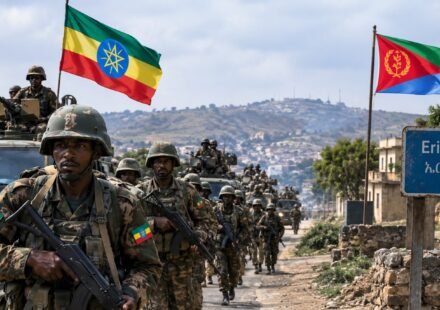
Ethiopian Troops Advance Into Border Town as Tensions With Eritrea Raise Fears of Wider War

Ethiopian government troops have advanced into Zalambessa, a town near the country’s northern border with Eritrea, raising fears that renewed fighting in the Horn of Africa could escalate into a wider conflict between the neighbouring countries.
According to Reuters, six sources said Ethiopian forces had reached the town by Tuesday, October 13. Zalambessa had previously been held by Tigrayan rebels, and the government’s latest advance comes amid an expanding military campaign against an opposition alliance led by the Tigray People’s Liberation Front (TPLF).
The development follows reports that Eritrean troops crossed into northern Ethiopia last week. However, their current presence in Zalambessa remains unclear, and Eritrea has denied carrying out an incursion.
The situation has heightened diplomatic tensions as both governments accuse each other of threatening regional stability
What Is Happening Near the Eritrean Border?
Fighting resumed in northern Ethiopia in September after a rebel alliance led by the TPLF launched an offensive against federal government forces.
Ethiopian troops and allied forces have since pushed the rebels out of several towns, according to Reuters. The advance towards Zalambessa represents another development in the campaign, although a spokesperson for a pro-government militia did not confirm that the military had fully taken control of the town.
Earlier reports from witnesses and conflict monitors described Eritrean troops entering towns in Ethiopia’s Tigray region, including Adigrat and Idaga Hamus. The Associated Press reported that it could not independently verify those accounts.
The reports have fuelled concerns that the renewed internal conflict could draw Ethiopia and Eritrea into direct confrontation.
Ethiopia and Eritrea Exchange Accusations
Ethiopia has accused Eritrea of sending troops across the border and supporting armed opposition groups operating in its northern regions. Addis Ababa has said Eritrean forces advanced as far as 60 kilometres inside Ethiopian territory.
Eritrea has rejected the accusations. Its government has argued that Ethiopia is using the allegations to justify possible military action and has appealed to the United Nations Security Council for intervention.
The competing claims have made it difficult to establish the full extent of the reported cross-border movements. Independent confirmation of the alleged incursion remains limited.
The Security Council has been drawn into the dispute, with both countries submitting letters setting out their positions. Diplomats are concerned that further military escalation could undermine regional security.
Why Access to the Red Sea Is Part of the Dispute
Ethiopia has been landlocked since Eritrea became independent in 1993. Access to the Red Sea has become an increasingly important strategic and economic issue for Addis Ababa.
Ethiopian officials have described access to the sea as a major national priority, while Eritrea views some Ethiopian statements on the issue as a potential threat to its sovereignty.
Ethiopia has said it wants to secure access through peaceful means and dialogue. Nevertheless, the maritime issue has added another source of tension to already deteriorating relations between the neighbours.
The countries severed diplomatic ties in October 2026, according to Reuters, following accusations surrounding the conflict in northern Ethiopia.
A Fragile Peace After the Tigray War
The latest escalation has revived memories of the devastating 2020–2022 Tigray war, which caused enormous civilian suffering and widespread displacement.
Ethiopia and Eritrea restored diplomatic relations in 2018, but their relationship deteriorated during and after the previous war. Eritrean forces fought alongside Ethiopia’s federal government during that conflict, yet tensions later returned over security and political issues.
A renewed interstate war could worsen humanitarian conditions in northern Ethiopia and create additional instability across the Horn of Africa, a region already affected by armed conflicts and competing regional interests.
What Happens Next?
The immediate questions are whether Ethiopian forces can secure Zalambessa, whether Eritrean troops remain inside Ethiopia and whether diplomatic efforts can prevent further clashes.
The United Nations Security Council and regional diplomats face pressure to encourage restraint and prevent the dispute from escalating.
For now, Ethiopian forces have reportedly reached the border town, but the situation on the ground remains fluid. The reported Eritrean incursion is disputed, and the available evidence does not establish that a full-scale war between the two countries has begun.
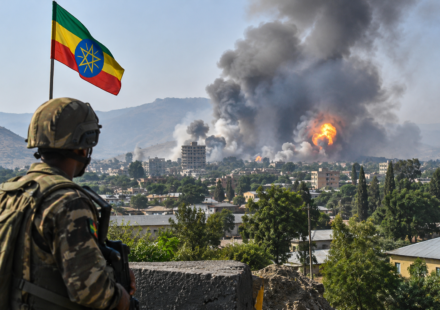
Airstrikes, Artillery Hit Northern Ethiopia as Tigray Capital Falls, Aid Sources Say
Airstrikes and heavy artillery fire have hit northern Ethiopia’s Tigray region as renewed fighting intensified after government-allied forces took control of the regional capital Mekelle, humanitarian sources said.
The latest violence comes less than two weeks after fighting erupted between Ethiopian federal forces and the Tigray People’s Liberation Front (TPLF), raising fears that the region could again descend into a prolonged conflict.
Airstrikes reported in Tigray
Humanitarian sources said airstrikes overnight and into Monday struck areas of Tigray.
At least 17 people were reported killed in separate strikes in and around Adwa and Sheraro, northwest of Mekelle, according to a humanitarian bulletin circulated among aid organisations. Reuters said it could not independently verify the casualty figures or determine who carried out the airstrikes.
In Adwa, about 100 kilometres northwest of Mekelle, nine people were reportedly killed. Another eight were reported dead in Sheraro.
A separate report from AFP said a drone strike on a camp for internally displaced people in Sheraro killed at least eight people, including a child, while six others were seriously wounded, according to a humanitarian source and witness.
Mekelle falls back under government control
The escalation follows the withdrawal of TPLF forces from Mekelle, Tigray’s regional capital.
Government-allied forces entered the city after the TPLF announced that its fighters were pulling back. The group said the withdrawal was intended to prevent further destruction in the city.
Ethiopian federal forces and allied Tigray Peace Force fighters subsequently established control over the capital and its airport.
Residents reported that some government institutions and shops were looted during the withdrawal, while communication services and normal activity in parts of Mekelle gradually began returning.
Fighting continues outside the capital
Although government forces now control Mekelle, fighting has continued elsewhere in Tigray.
Humanitarian sources reported heavy artillery exchanges near the Tekeze River, including around Mai Tsebri. The fighting indicates that the fall of Mekelle has not ended the conflict between federal forces and TPLF-linked fighters.
The renewed conflict is particularly concerning because Tigray is still recovering from the devastating 2020-2022 war, which caused enormous civilian suffering and left large humanitarian needs across the region.
Fears of a wider regional conflict
The latest fighting has also increased concerns about a broader conflict involving neighbouring countries.
Ethiopia has accused Eritrea, Sudan and Egypt of supporting armed opposition groups. The three countries have denied the allegations.
Relations between Ethiopia and Eritrea have deteriorated sharply in recent days. The two countries have severed diplomatic ties amid the escalating dispute and accusations surrounding the renewed fighting.
Ethiopia and Eritrea fought a border war from 1998 to 2000 and later normalised relations before tensions resurfaced.
US urges restraint
The United States has urged Ethiopia and Eritrea to exercise restraint and warned that further escalation could threaten regional stability and US cooperation with both countries.
The concern extends beyond Tigray because the Horn of Africa is already facing several overlapping conflicts, including the war in neighbouring Sudan.
The renewed Ethiopian fighting also comes amid wider political tensions involving Ethiopia’s relations with Eritrea and its long-running interest in securing access to the Red Sea.
Humanitarian situation remains fragile
Aid organisations are particularly concerned about civilians caught between the fighting.
Communication disruptions have made it difficult to independently verify events in several parts of Tigray. Access restrictions and continuing military operations are also complicating humanitarian efforts.
The reported deaths in Adwa and Sheraro, including the reported strike on an internally displaced people’s camp, have added to concerns about civilian safety as fighting spreads beyond the immediate area around Mekelle.
For residents who survived the previous Tigray war, the latest escalation has revived fears of another prolonged conflict.
The situation remains fluid, with government forces consolidating their control over Mekelle while fighting continues in other parts of northern Ethiopia.
Source attribution: Reuters, Associated Press, AFP, Al Jazeera and humanitarian sources.