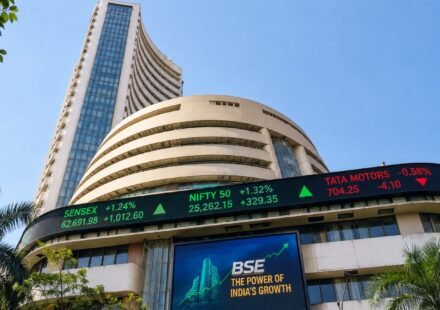
Stock Market Today: GIFT Nifty in Focus as Investors Track Global Cues and Q2 Earnings

Indian stock market investors are preparing for another closely watched trading session on Friday, October 16, 2026, with GIFT Nifty, global market movements and second-quarter earnings from major companies likely to influence sentiment. LTIMindtree, DLF and Punjab National Bank (PNB) are among the stocks in focus.
The market outlook follows a strong rally on Dalal Street on Thursday. The BSE Sensex advanced 1,533.72 points, or approximately 2.10%, to close at 74,315.61, while the NSE Nifty 50 gained 374.65 points, or 1.66%, to finish at 22,997.35.
The gains came as investors assessed global technology-sector volatility, expectations surrounding US interest rates and the possibility of renewed foreign investment in Indian equities.
GIFT Nifty and Global Markets: Key Signals
GIFT Nifty is an important indicator that traders monitor before the Indian stock market opens. Its movement can provide an early indication of market sentiment, although it does not guarantee how the Nifty 50 will perform during the session.
Investors are also watching Asian markets, including South Korea's KOSPI, alongside movements in US equities. Global markets have experienced volatility as concerns about elevated valuations in artificial intelligence-related companies and persistent inflation have affected investor confidence.
On Thursday, US markets ended higher. The Dow Jones Industrial Average rose 1.08%, the S&P 500 gained 0.33% and the Nasdaq Composite advanced 0.08%.
However, the broader international outlook remains uncertain. Investors are weighing the possibility of further US interest-rate increases against corporate earnings and changing expectations for technology-sector growth.
Sensex and Nifty Rebound Sharply
The Indian benchmarks recorded their strongest single-day performance in four months on Thursday, supported by buying in major stocks, including financial and information technology companies.
The Nifty 50 ended at 22,997.35, bringing it close to the 23,000 mark. The Sensex closed at 74,315.61 after gaining more than 1,500 points.
Information technology shares attracted attention amid quarterly earnings announcements and changing investor expectations about the global technology sector. Banking stocks also contributed to the broader recovery.
Despite the gains in benchmark indices, performance across the wider market was mixed. Small-cap and mid-cap stocks did not participate as strongly in the rally, highlighting the importance of examining individual sectors and shares rather than relying only on headline index movements.
LTIMindtree Shares in Focus
LTIMindtree will be closely watched as investors assess its second-quarter financial performance and management commentary.
Market participants are likely to examine revenue growth, operating margins, deal wins, demand from international clients and the company's outlook for the information technology services business.
Investors will also monitor how the company discusses spending by clients in key markets, particularly the United States and Europe. Changes in technology budgets, currency movements and demand for digital transformation services can affect the company's performance.
The broader IT sector has attracted attention following recent results from major Indian technology companies. However, individual share movements will depend on company-specific financial results, guidance and market expectations.
DLF Q2 Results on Investors' Radar
Real estate developer DLF is another major company in focus on October 16, with its second-quarter results scheduled for attention.
Investors will assess revenue, net profit, operating performance, new bookings and cash flows to evaluate the company's financial position.
The residential property market, premium housing demand, project launches and the pace of new sales are important factors for real estate companies. Investors may also examine the company's commentary on its project pipeline and the outlook for the property sector.
DLF's results could influence sentiment towards real estate shares, although the reaction will depend on the financial numbers and how they compare with market expectations.
Punjab National Bank: Banking Stock in Focus
Punjab National Bank is also on the market's watchlist as investors track its quarterly performance and developments in the banking sector.
Key indicators include net profit, net interest income, net interest margin, loan growth, deposit mobilisation and asset quality. Investors will also look for updates on bad loans, credit costs and provisions.
The performance of public-sector banks remains sensitive to credit demand, funding costs and the broader economic environment. Any company-specific earnings surprise or change in management guidance could affect the stock's movement.
Banking shares will also be influenced by expectations for interest rates, liquidity conditions and the outlook for lending activity.
Inflation and Interest Rates Remain Major Risks
Persistent US inflation remains an important concern for global financial markets. Stronger-than-expected inflation can increase expectations that the Federal Reserve may keep interest rates higher for longer or consider further tightening.
Higher US interest rates can influence global capital flows, currency movements and investor appetite for emerging-market equities, including Indian shares.
Investors will therefore monitor economic data and central-bank signals alongside domestic earnings announcements.
Foreign institutional investor activity is another factor to watch. Changes in overseas investment flows can influence large-cap shares and benchmark indices, while domestic institutional buying may provide support during periods of volatility.
What Investors Should Watch Today
The key factors likely to influence the Indian market on October 16 include:
• GIFT Nifty: Its latest movement ahead of the NSE opening.
• Global cues: Developments in Asian markets and the previous US trading session.
• Quarterly earnings: Results and commentary from LTIMindtree, DLF and Punjab National Bank.
• US inflation and interest rates: Their potential impact on global risk appetite.
• Institutional flows: Buying and selling by foreign and domestic investors.
• Sector performance: Trends in IT, banking, real estate and other heavyweight sectors.
Outlook
The strong gains recorded on Thursday have improved the recent closing picture for Indian benchmark indices, but they do not establish the direction of the next session.
Traders will be watching whether buying momentum continues and whether the Nifty 50 can sustain its position near 23,000. Corporate earnings, global market volatility and interest-rate expectations could all contribute to intraday swings.
Investors should verify live prices and official company announcements before making decisions. Market movements remain uncertain, and this report is intended for news and information purposes rather than investment advice.
Stock Market Today: GIFT Nifty Signals Weak Opening for Sensex, Nifty 50; Wipro, Nestlé and Tech Mahindra in Focus
Indian equity markets are expected to face a cautious start on Thursday, October 15, as weakness across global technology stocks, rising crude oil prices and concerns about US inflation weigh on investor sentiment. The Sensex and Nifty 50 will also be influenced by fresh quarterly earnings from major companies, including Wipro, Nestlé India and Tech Mahindra.
GIFT Nifty is an important indicator of the market’s potential opening direction. However, its latest live reading should be checked before publication, as futures prices can change quickly before the Indian market opens.
The previous session ended lower. On Wednesday, October 14, the Nifty 50 declined 99 points, or 0.44%, to close at 22,622.70, while the BSE Sensex fell 0.34% to 72,781.89. Higher oil prices and continued foreign investor outflows weighed on sentiment.
1. GIFT Nifty and Global Market Cues
Investors will monitor GIFT Nifty for clues about the opening direction of domestic benchmarks. A weaker futures signal can indicate a lower start, but it does not guarantee how the market will trade throughout the session.
Global markets are facing pressure after US inflation data came in hotter than expected. Asian shares fell on Thursday, led by sharp losses in South Korea and weakness in Japan. Technology and artificial-intelligence-linked stocks were among the sectors under pressure.
The direction of global technology shares is particularly relevant for Indian IT companies, which generate a substantial portion of their revenue from overseas clients.
2. US Inflation and Federal Reserve Policy
Fresh concerns about US inflation have raised questions about the future path of interest rates. Higher rates can increase borrowing costs and put pressure on equity valuations, particularly in sectors where share prices depend heavily on expectations of future growth.
Reuters reported that the stronger US inflation reading increased market expectations of another Federal Reserve rate increase. Investors will watch further economic data and comments from central-bank officials for clues about monetary policy.
For Indian markets, changes in US bond yields, the dollar and global risk appetite can influence foreign portfolio investment and currency movements.
3. Crude Oil Prices Remain a Key Risk
Crude oil remains another important factor for Indian equities. Higher oil prices can increase India's import bill and add pressure to inflation, corporate costs and the current-account balance.
Energy supply concerns have pushed oil prices higher amid renewed tensions around the Strait of Hormuz, according to Reuters.
Investors will monitor energy prices closely because sustained increases could affect sectors such as aviation, paints, chemicals, logistics and oil-dependent manufacturing.
4. Wipro Q2 Results in Focus
Wipro is scheduled to announce its September-quarter results on October 15. Investors will look at revenue growth, operating margins, demand conditions and management's outlook for the coming quarter.
Analysts have highlighted weak demand, pricing pressure and the potential impact of artificial intelligence on traditional IT services as factors to watch. The company's guidance for the next quarter could be particularly important in shaping market expectations.
The results may also influence sentiment towards other listed Indian IT companies.
5. Nestlé India and Tech Mahindra Earnings
Nestlé India is also scheduled to report its Q2 FY2027 results on Thursday. Investors will focus on sales growth, demand, product volumes, margins and the impact of input costs.
Brokerage previews have pointed to the possibility of improved revenue growth, supported by consumer demand and distribution strength, although actual results may differ from estimates.
Tech Mahindra is another major company on the earnings calendar. Investors will examine its revenue performance, profitability, deal wins and commentary on demand from global clients. Its results could provide additional information about the recovery prospects of the IT services sector.
What Should Investors Watch Today?
Market participants will track several developments during Thursday's session:
• GIFT Nifty's latest movement before the opening bell.
• Asian market performance and overnight US trading.
• Crude oil prices and developments affecting global energy supplies.
• Wipro, Nestlé India and Tech Mahindra's quarterly results.
• Foreign institutional investor activity and the movement of the rupee.
• Company guidance and broader market breadth after Wednesday's decline.
A weak opening does not necessarily mean that the market will remain lower throughout the day. Corporate earnings, global cues and intraday buying or selling can change the direction of both benchmark indices.
Market takeaway: Thursday's trading is likely to be shaped by a combination of global risk sentiment and domestic earnings. Investors should verify live market data and company announcements before making trading decisions.
Stock Market Today: Sensex, Nifty Eye Opening Cues as GIFT Nifty, Canara Bank and BHEL Take Centre Stage
Indian equity markets are set for another closely watched session on Wednesday, October 14, as investors assess global market signals, quarterly earnings announcements and movements in crude oil prices. The headline points to a potentially weaker opening for the Sensex and Nifty 50, although the opening direction should be confirmed using the latest GIFT Nifty data before the market begins trading.
The focus is also on Canara Bank, which is scheduled to consider its September-quarter results, while investors will monitor developments involving Bharat Heavy Electricals Limited (BHEL) and other companies reporting or drawing attention during the second-quarter earnings season.
Sensex and Nifty 50: What Happened in the Previous Session?
Indian benchmark indices staged a strong recovery on Tuesday. The BSE Sensex climbed 1,109.10 points, or 1.54%, to close at 73,033.78, while the NSE Nifty 50 gained 358.60 points, or 1.60%, to settle at 22,721.95.
The rally was supported by buying in information technology shares after quarterly results from HCL Technologies and Tata Consultancy Services drew investor attention. Comments from Finance Minister Nirmala Sitharaman regarding discussions around capital-gains and securities transaction taxes also contributed to market sentiment.
However, one strong session does not necessarily establish a sustained recovery. Investors will look for follow-through buying and fresh corporate earnings signals to assess whether the rebound can continue.
GIFT Nifty and Asian Markets in Focus
GIFT Nifty futures are an important early indicator for the Indian market because they trade outside regular domestic cash-market hours. Traders commonly use their movement to gauge the likely opening tone for the Nifty 50.
A lower GIFT Nifty reading can point to a weaker start, but it does not guarantee that Indian benchmarks will open lower or remain under pressure throughout the session. Global equity movements, currency changes, oil prices and domestic institutional flows can all alter the direction after the opening bell.
Asian markets are another key indicator. Weakness in regional technology stocks or renewed concerns about global inflation could weigh on sentiment, while a recovery in overseas equities may offer support.
Canara Bank Q2 Results: Key Details to Watch
Canara Bank is scheduled to consider its financial results for the quarter ended September 30, 2026, at a board meeting on October 14. The results will provide investors with an updated picture of the public-sector lender’s performance during the second quarter of FY2026–27.
Investors are likely to examine several indicators:
• Net interest income: The difference between interest earned on loans and investments and interest paid on deposits and borrowings.
• Net profit: Whether earnings growth is supported by core operations.
• Asset quality: Changes in gross and net non-performing assets.
• Provisions and credit costs: The amount set aside for potential loan losses.
• Deposit and loan growth: Trends in funding, lending and margins.
The actual figures should be taken from the bank’s official results announcement after publication. Expectations or pre-results estimates should not be treated as confirmed financial performance.
BHEL and Other Stocks on Investors’ Radar
Bharat Heavy Electricals Limited (BHEL), a state-owned engineering and power-equipment manufacturer, may attract attention as investors track corporate announcements and the wider earnings season.
For BHEL, market participants typically monitor order inflows, project execution, revenue growth, operating margins and working-capital requirements. Any company-specific announcement should be checked against its official stock-exchange disclosures before being presented as a fresh development.
Investors may also track other companies scheduled to announce results or disclose material business updates. In an earnings-driven market, individual shares can move sharply even when the broader indices remain relatively stable.
Crude Oil, Inflation and the Rupee
Oil prices remain an important risk factor for India because the country imports a substantial share of its crude requirements. Higher oil prices can increase the import bill and put pressure on inflation, the rupee and corporate costs.
Investors are also assessing the implications of recent inflation data and Reserve Bank of India measures aimed at easing pressure on the currency. A weaker rupee can benefit some exporters but raise costs for companies dependent on imported inputs.
Developments in the Middle East could influence oil prices and broader risk sentiment. Any sharp movement in crude or the rupee may affect sectors differently, including aviation, oil marketing, energy, paints and information technology.
What Investors Should Watch Today
The main factors likely to shape Wednesday’s session are the latest GIFT Nifty signal, trends across Asian markets, crude oil prices, rupee movement, foreign-investor activity and company-specific earnings announcements.
A weaker opening, if confirmed, would not by itself establish the direction for the entire trading day. Investors should distinguish between opening indicators and confirmed market prices once trading begins.
Market disclaimer: This article is for informational purposes only and is not investment advice or a recommendation to buy or sell any security. Stock prices can be volatile, and investors should assess their own financial circumstances and risk tolerance.
Sensex, Nifty 50 Today: GIFT Nifty, Crude Oil and US-Russia Diesel Deal Among 5 Key Triggers
Indian stock markets are set for a closely watched session on Monday, October 12, as investors assess signals from GIFT Nifty, falling crude oil prices, the US-Russia diesel deal and the latest geopolitical developments.
Early market indicators pointed to a positive start for the Sensex and Nifty 50, following a recovery in the previous session. However, uncertainty surrounding global energy supplies, elevated bond yields and foreign investor selling could limit gains.
On Friday, October 9, the Nifty 50 closed at 22,520.45, gaining around 1.3%, while the BSE Sensex rose approximately 1.2% to 72,472.33. The rebound ended an eight-week losing streak for both benchmark indices.
Investors will now look for signs that the recovery can continue as the new trading week begins.
1. GIFT Nifty: A Positive Start in Focus
GIFT Nifty is an important early indicator of how Indian equity benchmarks may open. Its positive signal suggests that domestic shares could begin Monday’s session on a firm note.
However, GIFT Nifty movements do not guarantee the actual opening direction of the Sensex or Nifty 50. Global market swings, institutional trading and fresh geopolitical headlines can change sentiment before and during the session.
Traders will monitor whether early buying interest continues after the opening bell and whether the benchmarks can sustain their previous session’s gains.
2. US-Russia Diesel Deal and Energy Ceasefire
US President Donald Trump’s announcement of a Russian diesel supply arrangement has become an important factor for global energy markets.
Trump said Russia would supply more than 300,000 metric tonnes of diesel to the United States and global markets following discussions with Russian President Vladimir Putin. The US also temporarily eased sanctions on Russian fuel to facilitate supplies.
The announcement has drawn criticism from some US lawmakers, while Ukrainian President Volodymyr Zelenskyy has argued that the arrangement could benefit Moscow.
Trump subsequently claimed that Russia and Ukraine had agreed to stop attacks on each other’s energy infrastructure. However, the details and implementation of the proposed arrangement remained uncertain, with Ukraine seeking clarification and Russia yet to confirm the agreement in the reports available before Monday’s session.
For Indian markets, the potential impact will depend on whether these developments lead to a sustained improvement in energy supplies and lower prices.
3. Crude Oil Prices: A Key Risk for India
Oil prices eased on Monday amid expectations of additional Russian supplies. Brent crude was reported near $103.35 per barrel, while US West Texas Intermediate crude traded around $90.55 in early trading.
Despite the decline, crude remains expensive, and continuing tensions in the Middle East are keeping supply risks in focus.
India imports a substantial share of its crude oil requirements, making international oil prices an important influence on inflation, the rupee, corporate costs and the country’s import bill.
A sustained fall in crude could support market sentiment by easing cost pressures. Conversely, renewed disruptions to shipping routes or energy infrastructure could push prices higher and weigh on equities.
4. US Bond Yields, Inflation and the Rupee
Investors will also watch US Treasury yields, inflation expectations and movements in the Indian rupee against the US dollar.
Higher US bond yields can make American assets more attractive relative to emerging-market investments. This can put pressure on foreign portfolio investment flows into India and increase volatility in domestic equities.
Energy prices are another important consideration because a renewed increase in fuel costs could complicate efforts to control inflation.
A weaker rupee may also raise the cost of imported commodities, including crude oil. Investors will therefore assess whether global financial conditions become more supportive or remain a source of pressure for Indian shares.
5. IT Earnings, HCL Technologies and Institutional Flows
Corporate earnings will be another major driver as India’s September-quarter results season gathers pace.
HCL Technologies is among the companies in focus on Monday. Investors will look for updates on revenue growth, demand for technology services, margins and management commentary on spending by global clients.
The performance of major IT companies could influence sentiment across the technology sector after IT stocks helped support the previous session’s rebound.
Institutional activity will also matter. Foreign institutional investors have been selling Indian equities, while domestic institutional investors have helped provide support during periods of weakness.
A change in the balance between foreign selling and domestic buying could influence whether the latest recovery gains momentum.
What Should Investors Watch Today?
The Sensex and Nifty 50 enter Monday’s session with a positive opening signal, but the direction of the market will depend on how investors respond to global developments and domestic trading activity.
The main factors to monitor are GIFT Nifty, crude oil prices, the US-Russia diesel arrangement, global bond yields and the rupee, alongside corporate earnings and institutional flows.
A positive opening alone would not confirm a sustained rally. Investors will watch whether buying continues through the session and whether the benchmarks can hold on to their gains.
This article is for news and informational purposes only. It is not investment advice.
Stock Market Today: GIFT Nifty Signals Muted Start for Nifty 50, Sensex; TCS, HCL Tech, Ola Electric in Focus
Indian equity markets are likely to open on a cautious note on Thursday, October 8, after the Nifty 50 and Sensex ended sharply lower in the previous session following the Reserve Bank of India's unexpected interest-rate hike and a shift towards a tighter monetary policy stance.
GIFT Nifty futures were trading around 22,600.5, indicating a subdued opening for the Nifty 50, which closed at 22,603.05 on Wednesday. The Sensex had fallen 429.11 points, or 0.59%, to close at 72,638.70, while the Nifty declined 173.05 points, or 0.76%.
RBI rate hike weighs on investor sentiment
The RBI raised its benchmark repo rate by 25 basis points to 5.50% on Wednesday, marking its first rate increase in nearly four years. The central bank also changed its policy stance from "neutral" to "calibrated tightening", raising expectations that monetary conditions could remain restrictive for longer.
Higher interest rates can increase borrowing costs for companies and consumers and may put pressure on equity valuations, particularly when investors are already concerned about global inflation and rising crude oil prices.
Crude oil crosses $101 a barrel
Oil prices remain another major factor for Indian markets. Brent crude moved above $101 per barrel amid concerns over Middle East supplies and disruptions affecting shipping in the Gulf and Strait of Hormuz.
Higher crude prices are particularly important for India because the country imports a large portion of its oil requirements. Expensive crude can increase inflationary pressure and put additional pressure on the rupee.
FII selling remains a concern
Foreign investors continued to sell Indian equities. Provisional data showed foreign investors sold around ₹6,121 crore worth of Indian shares on Wednesday, marking their ninth consecutive session of net selling.
Persistent foreign outflows, combined with higher global bond yields and a weaker rupee, could keep market sentiment cautious in the near term.
TCS in focus as earnings season begins
Tata Consultancy Services (TCS) is expected to remain one of the biggest stocks in focus as India's September-quarter earnings season gets underway.
Investors will closely watch TCS's quarterly results and management commentary for indications about global technology spending, demand from key markets and the outlook for the IT services sector. Reuters identified TCS as a key market focus for Thursday.
HCL Tech, Ola Electric among stocks in focus
HCL Technologies is also likely to attract attention after its shares declined 1.52% on Wednesday to ₹1,183.80. The stock underperformed the broader market during the session.
Ola Electric is another stock on investors' radar following recent corporate developments. Other stocks expected to remain in focus include Adani Enterprises, Tata Power, Jubilant FoodWorks and Varun Beverages.
Global markets offer mixed signals
Asian equities opened lower on Thursday, while elevated US Treasury yields continued to weigh on global risk sentiment. The US 10-year Treasury yield was around 5.3%, according to market reports, while Brent crude remained above $100.
US equities also ended lower in the previous session, adding to the cautious tone ahead of India's market opening.
What investors should watch today
Traders are likely to track the movement of the Nifty 50 and Sensex, crude oil prices, the rupee-dollar exchange rate, Asian markets, US bond yields and foreign institutional flows.
The market may also remain sensitive to comments from RBI officials and developments in the Middle East because higher oil prices could increase India's inflation risks.
For Thursday's session, 22,600 on the Nifty 50 will be an important near-term reference point after the index closed at 22,603.05 on Wednesday. Investors will also watch whether the index can recover towards the 22,800 resistance zone highlighted by market analysts.

Stock Market Today: GIFT Nifty Signals Weak Start for Sensex, Nifty Ahead of RBI Policy Decision
Indian equity markets are set for a cautious start on Wednesday, with GIFT Nifty pointing to a lower opening for the Sensex and Nifty 50 as investors await the Reserve Bank of India's monetary policy decision later in the day.
The weak opening indication comes after the domestic benchmarks recovered strongly over the previous two sessions. Rising crude oil prices, continued foreign investor selling and uncertainty over the RBI's next interest-rate move are keeping sentiment under pressure.
GIFT Nifty signals weak opening
GIFT Nifty was indicating a decline of around 100 points in early trading, pointing towards a weaker start for India's benchmark indices.
The signal comes after the Nifty 50 gained about 1% on October 6, extending its recovery for a second consecutive session. However, the broader market trend remains under pressure after the index suffered a prolonged decline.
Global cues were mixed. U.S. equities remained relatively strong, with the S&P 500 and Nasdaq reaching record levels, but Asian markets were weaker on Wednesday.
RBI policy decision in focus
The biggest domestic trigger for Wednesday's trading session is the RBI Monetary Policy Committee's decision.
The RBI is expected to announce its policy decision on Wednesday after its three-day meeting. Markets have largely priced in a 25-basis-point increase in the repo rate, which would take the rate above the current 5.25%.
Such a move would represent the first RBI rate hike since February 2023.
A Reuters poll found that nearly 60% of economists expected a 25-basis-point increase, while market instruments have also been reflecting expectations of a hike.
Investors will therefore be watching not only the rate decision but also the RBI's commentary on inflation, liquidity, economic growth and the future policy stance.
Crude oil remains a major risk
Oil prices are another major concern for Indian markets.
Brent crude returned above $101 a barrel, adding to concerns about India's import bill and inflation. Higher crude prices can also put pressure on the rupee and corporate margins.
India's dependence on imported crude makes oil prices particularly important for the domestic economy. A prolonged rise in energy costs could complicate the RBI's inflation-management efforts.
Rupee under pressure
The Indian rupee also remains under pressure ahead of the RBI decision.
The rupee closed at ₹96.42 against the U.S. dollar on October 6, its lowest level in about two months. Foreign equity outflows and higher global bond yields have contributed to the currency's weakness.
The RBI has been using several measures to manage liquidity and support the currency, including foreign-exchange operations and bond-market measures.
FII selling remains a concern
Foreign institutional investor outflows have been one of the biggest challenges for Indian equities in 2026.
Reuters reported that foreign investors had withdrawn around $27.8 billion from Indian equities during 2026, contributing to the market's prolonged weakness.
Higher U.S. Treasury yields have made dollar-denominated assets more attractive, while geopolitical uncertainty and elevated oil prices have further affected investor sentiment.
What investors will watch today
Apart from the RBI decision, traders are likely to track:
• RBI's repo-rate decision and policy stance
• Governor's comments on inflation and growth
• Brent crude prices
• Rupee-dollar movement
• FII and DII activity
• Asian market trends
• Banking and rate-sensitive stocks
The market's immediate reaction could depend heavily on whether the RBI's decision and guidance broadly match what investors have already priced in.
For now, the GIFT Nifty signal suggests a cautious opening, but the direction of the market through the session could be influenced significantly by the RBI's policy announcement and subsequent commentary.