Jaishankar Says US Has Deliberately Become a ‘Lonelier Power’ as Global Order Shifts

External Affairs Minister S. Jaishankar has described the United States as a “deliberately” more isolated global power, saying Washington’s changing posture and the rise of China are among the defining developments reshaping the international order.
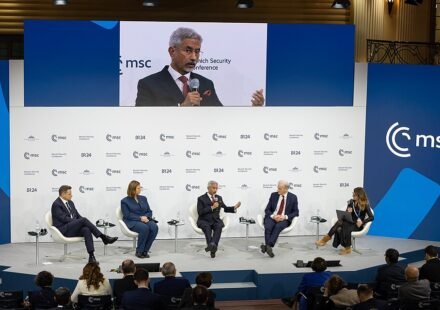
Speaking at the Munich Leaders Meeting in New Delhi on Sunday, Jaishankar said the global landscape was undergoing a “radical repositioning” of the United States, which he described as a choice in policy and posture rather than an accidental development.
Jaishankar points to a changing US role
Jaishankar said the United States had increasingly adopted a different approach to its role in international affairs.
He described Washington's repositioning as a “posture of choice” and said the US had, in his words, “deliberately become a lonelier power.”
The remark came as Jaishankar discussed the broader transformation taking place in global politics and the changing relationship between major powers.
His comments were not framed as a prediction that the United States was withdrawing from the world altogether. Rather, he was highlighting a shift in the way Washington is positioning itself as global competition becomes more intense.
China’s rise is another major factor
Jaishankar identified China's growing economic and political influence as the second major feature of the changing world order.
He said China's expanding capabilities were contributing to increasingly sharp competition between Beijing and Washington. According to Jaishankar, the rivalry between the two powers has implications well beyond their bilateral relationship.
The competition is also influencing how other countries assess their own economic, security and diplomatic interests.
India, like several other emerging and middle powers, is increasingly seeking flexibility in its international relationships rather than relying exclusively on a single major power.
Global competition is turning leverage into a weapon
Jaishankar also warned that growing geopolitical competition was leading countries to use whatever strategic leverage they possess.
That leverage can include economic strength, technology, trade, critical supply chains, energy resources and diplomatic influence.
He said this “weaponization” of leverage was taking place even as countries remained deeply interconnected economically.
This creates a complicated international environment in which countries can be competitors in one area while remaining partners in another.
Middle powers seek greater strategic flexibility
According to Jaishankar, emerging and middle powers are increasingly interested in strengthening cooperation among themselves while maintaining relationships with both the United States and China.
He pointed to arrangements and initiatives involving multiple countries as examples of how nations are trying to build additional options in an increasingly uncertain global environment.
The approach allows countries to cooperate where their interests overlap without necessarily aligning themselves completely with one major power.
This trend is particularly important for countries that want to protect their strategic autonomy while benefiting from economic, technological and security partnerships.
India’s approach to a multipolar world
Jaishankar said the world was witnessing an accelerated emergence of multipolarity.
In such an environment, countries may have to maintain relationships with several major powers even when their interests do not always coincide.
He described this as a strategy of advancing through “hedging”, reflecting the need for countries to diversify their partnerships and reduce excessive dependence on any single source of power.
India has increasingly pursued this approach through different regional and international groupings, while continuing its relationships with Washington, Moscow, Beijing and other major centres of influence.
Pressure on the existing international system
The changing balance of power is also creating pressure on established multilateral institutions.
Jaishankar pointed to difficulties within the international system, including visible gridlock at the United Nations.
As major powers compete more directly and countries pursue more narrowly defined interests, smaller and flexible groupings could become increasingly important for international cooperation.
Such arrangements can allow countries to work together on specific issues without requiring complete agreement on every aspect of foreign policy.
A more fragmented but interconnected world
Jaishankar's comments highlight a central contradiction in today's international politics.
Countries are becoming more competitive over security, technology, trade and strategic resources, while their economies remain heavily interconnected.
The result is a world in which governments are simultaneously trying to protect themselves from geopolitical risks and preserve access to global markets and partnerships.
For India, the changing environment creates both challenges and opportunities.
New Delhi is seeking greater influence in global decision-making while maintaining strategic autonomy and developing partnerships with different groups of countries.
Jaishankar's remarks therefore underline India's broader view that the emerging international system is likely to be more multipolar, competitive and dependent on flexible partnerships.
The minister's assessment comes at a time when the United States-China rivalry, China's growing influence and the changing strategies of middle powers are increasingly shaping the global political and economic landscape.
Source attribution: The report is based on current reporting by The Times of India, Moneycontrol, The New Indian Express and India Today, which reported Jaishankar's remarks at the Munich Leaders Meeting on October 4, 2026.