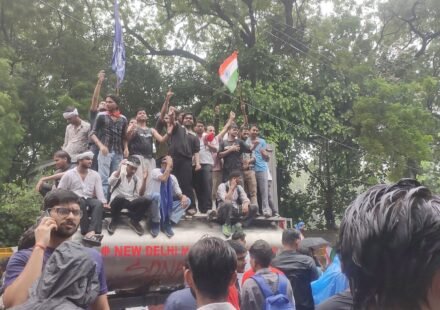
Opposition March Puts Delhi’s Voter List Controversy in Focus

Thousands of opposition supporters and political leaders gathered in central New Delhi on Monday as the INDIA bloc moved ahead with a march towards the Supreme Court, escalating its campaign over alleged irregularities in voter list revisions.
The Congress-led mobilisation, associated with the slogan “Chalo Delhi – March for Democracy”, was aimed at drawing attention to concerns over the Special Intensive Revision (SIR) of electoral rolls and demanding the resignation of Chief Election Commissioner Gyanesh Kumar.
The opposition has alleged that the voter verification exercise could exclude eligible voters and disproportionately affect certain communities. The Election Commission and the Bharatiya Janata Party (BJP) have rejected allegations of political manipulation, maintaining that the process is intended to remove duplicate and ineligible entries.
Supreme Court route becomes the focus
The planned march was scheduled to begin near the Connaught Place–Barakhamba Road junction and proceed towards the Supreme Court. Opposition leaders had sought to submit a memorandum to Chief Justice of India Surya Kant.
However, the Chief Justice declined a proposed meeting, explaining that related issues were already before the court and that discussing pending matters in such a meeting would be inappropriate.
The development did not end the opposition’s effort to bring the issue into public focus. The march added to days of political mobilisation in the capital over the voter list revision and the treatment of demonstrators.
Security tightened across central Delhi
Authorities implemented security measures and traffic restrictions ahead of the mobilisation. Six metro stations—Janpath, Mandi House, Barakhamba Road, Central Secretariat, Rajiv Chowk and Patel Chowk—were scheduled to remain closed for entry and exit from 6 am to 4 pm on Monday, according to reports.
The closures were expected to affect commuters travelling through central Delhi. Interchange facilities were reported to remain available at interchange stations.
The latest mobilisation followed a tense weekend in the capital, when police detained thousands of people during demonstrations linked to the wider protest movement. The Supreme Court subsequently issued directions concerning peaceful protests, detentions and the restoration of normal public movement.
What is the dispute about?
At the centre of the confrontation is the revision of electoral rolls, a process intended to update voter records. Opposition parties argue that the scale and implementation of the exercise raise questions about whether eligible citizens could lose their right to vote.
The Election Commission has denied allegations that the process favours a political party and has said that people whose names are wrongly removed can seek re-enrolment. The BJP has also rejected the opposition’s accusations.
The controversy now places electoral administration, citizens’ voting rights and the conduct of political protests at the centre of a broader national debate. Any legal determination on the issues raised will depend on the proceedings and evidence considered by the courts.
What happens next?
The opposition is seeking further scrutiny of the voter list revision and accountability from the election chief. The Election Commission’s position remains that the exercise is intended to clean up electoral rolls, while the opposition continues to challenge its implementation.
The dispute is likely to remain a major political issue as the legal and political arguments continue.