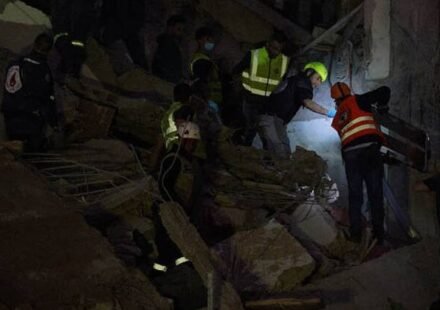
Hezbollah Announces Up to $14,000 in Aid for Lebanese Families Whose Homes Were Destroyed

Hezbollah has announced a financial assistance programme for Lebanese families whose primary homes were destroyed or rendered uninhabitable during the 2026 conflict with Israel. Under the plan announced by the group’s Executive Council chairman, Ali Damoush, eligible households in Beirut and its southern suburbs will receive up to $14,000, while families in other parts of Lebanon will receive up to $12,000.
According to Reuters, the assistance is intended to help affected residents cover furniture replacement and rental expenses while they face the consequences of damaged or destroyed homes.
The announcement comes as Lebanon continues to deal with extensive displacement, damaged infrastructure and the financial challenges of rebuilding communities affected by the conflict.
How Much Financial Assistance Will Families Receive?
The programme sets different assistance amounts depending on where eligible families lived before their homes were damaged.
Under the announced plan:
• Beirut and its southern suburbs: Up to $14,000 per eligible family, comprising $8,000 for furniture and $6,000 for rent.
• Other regions of Lebanon: Up to $12,000 per eligible family, comprising $8,000 for furniture and $4,000 for rent.
Payments are scheduled to be distributed in four instalments over one year. The first instalment will be $3,500 for eligible families in Beirut and its southern suburbs and $3,000 for families elsewhere.
The announced rates are similar to those used in Hezbollah’s previous assistance programme following the 2024 conflict.
Who Qualifies for the Aid?
The programme is intended for households whose primary residences were destroyed, severely damaged or assessed as uninhabitable. It also covers certain families displaced from areas under Israeli occupation or nearby locations, according to Damoush.
Eligibility will depend on assessments of property damage and other criteria established by the organisation.
The assistance is restricted to families that used the affected property as their main residence. Secondary properties, summer homes and abandoned houses are excluded under the announced conditions.
The programme is designed to address immediate housing and household needs. The announced payments do not, by themselves, establish that the full cost of rebuilding destroyed homes will be covered.
Hundreds of Thousands Displaced by the Conflict
The new aid plan comes amid a severe humanitarian and reconstruction challenge in Lebanon. The conflict has forced hundreds of thousands of people from their homes, particularly in southern Lebanon and Beirut’s southern suburbs.
Lebanon’s Health Ministry has reported more than 4,300 deaths from Israeli attacks since the latest phase of the conflict began in March 2026. The ministry’s figures do not distinguish between civilians and combatants.
For displaced families, finding affordable accommodation and replacing household belongings remain major concerns. Residents whose towns or neighbourhoods have been extensively damaged may also face uncertainty over when they can safely return.
The scale of destruction means that temporary financial support is only one part of the broader recovery challenge.
Questions Over Funding and Reconstruction
The announcement follows a Reuters report published on October 7 that cited two people familiar with a reported $200 million transfer from Iran to Hezbollah intended to support displaced Lebanese families.
The United States disputed that report. A US State Department spokesperson said the money was not there, while Iran had not publicly confirmed the reported transfer.
Damoush declined to confirm the reported amount or disclose the total funding Hezbollah would allocate to the housing assistance programme.
The competing accounts leave questions about the programme’s overall funding and whether the announced assistance will be sufficient to meet demand.
Lebanon also faces the wider challenge of financing reconstruction amid economic difficulties and extensive damage to homes and infrastructure. The Lebanese government has a central role in national recovery, while international assistance and private resources may also be important to rebuilding affected areas.
What Happens Next?
The next steps will involve assessing damaged properties, establishing eligibility and distributing the payments in instalments over the announced one-year period.
For families whose homes have been destroyed, the immediate priority is securing shelter and replacing essential household items. Long-term recovery, however, will depend on whether homes can be rebuilt, infrastructure restored and displaced residents return to their communities.
The effectiveness of the programme will become clearer as payments are distributed and more details emerge about the number of families covered and the funding available.