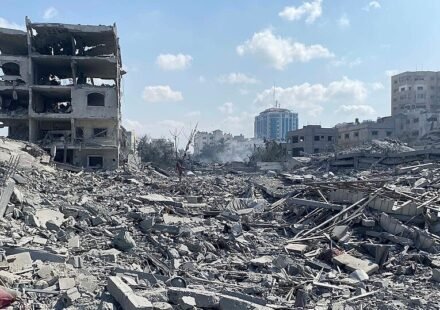
Israel Strikes Gaza on October 7 Anniversary, Five Reported Dead

Israel carried out fresh strikes in the Gaza Strip on October 7, the third anniversary of the Hamas-led attacks on southern Israel, with Palestinian officials reporting that five people were killed in separate incidents across the territory.
The strikes came as Israelis gathered at memorial events to mark the October 7, 2023 attack, which killed about 1,200 people and saw 251 people taken hostage, according to widely reported figures.
Five reported dead in Gaza
According to an AFP report published after the initial casualty reports, Al-Shifa Hospital in Gaza City said two people were killed in an overnight Israeli strike. Gaza's Civil Defense identified one of them as Mohamed Tamous, who it said was a volunteer with the emergency service.
The Israeli military said it had targeted two Hamas members who had left Kamal Adwan Hospital in northern Gaza. The military alleged that one of them had been preparing explosives near the so-called Yellow Line, which separates areas controlled by Israeli forces and Hamas.
In Khan Yunis in southern Gaza, Nasser Hospital reported that a 60-year-old man, Hisham Ibrahim Abu Mustafa, was killed in an Israeli strike. The hospital also reported receiving the body of Ziad Zaarab, who it said had been killed in an airstrike south of Khan Yunis.
Later, another person was reported killed when a strike hit a tent in the Al-Buraq camp, bringing the reported death toll from the day's strikes to five, according to Palestinian officials cited by AFP.
Strikes came as Israel marked October 7 anniversary
The latest violence occurred as Israel observed three years since the Hamas attack of October 7, 2023. Families and survivors gathered at locations connected to the attack, including the site of the Nova music festival, where more than 300 people were killed.
The anniversary remained a deeply emotional moment in Israel, while Palestinians in Gaza marked three years of war, destruction and displacement
Ceasefire has not ended violence
A US-brokered ceasefire that took effect in October 2025 has reduced the scale of fighting, but violence has continued. Gaza's Health Ministry, which operates under Hamas authorities, says more than 74,200 Palestinians have been killed since the beginning of the Israeli military campaign. The United Nations has considered the ministry's overall casualty figures broadly reliable, while noting the source is controlled by Hamas.
Israel says it continues to conduct operations against Hamas and has maintained control over parts of Gaza. The conflict has displaced much of the territory's population and left large areas severely damaged.
The latest strikes on the anniversary underscore how fragile the ceasefire remains, even as both Israelis and Palestinians continue to live with the consequences of the October 7 attack and the war that followed.

‘Fighter Jets in Air’: How Israel Prepared for Worst-Case Scenario During Flydubai Scare
Israel scrambled fighter jets and activated emergency security procedures after a Flydubai passenger aircraft travelling from Dubai to Tel Aviv transmitted emergency signals during a frightening mid-air incident, Israeli officials said.
Flight FZ1073 was carrying 174 people, including 27 children, when an incident involving members of the flight crew triggered an emergency response. The Boeing 737-8 MAX eventually diverted to Tabuk in Saudi Arabia, where it landed safely.
Israeli authorities initially had limited information about what was happening aboard the aircraft. Because the plane was heading toward Israel and the emergency signals raised concerns about unlawful interference, the country's military and political leadership prepared for several possible outcomes.
Fighter jets were scrambled
Israeli Ambassador to India Reuven Azar said Israel's civil aviation authorities, Air Force and political leadership were alerted immediately after the aircraft reported an emergency.
According to Azar, fighter jets were called into the air as officials assessed the situation.
The aircraft was still outside Israeli airspace, but authorities had to prepare for the possibility that the situation could deteriorate before the plane reached the country.
Israeli media reported that two Air Force fighter jets were scrambled toward the aircraft while officials assessed the situation. The Jerusalem Post noted that scrambling fighter aircraft does not automatically mean that an aircraft is going to be shot down; the jets can also be used to establish visual contact and determine what is happening aboard a plane that cannot communicate normally.
Worst-case scenarios considered
While the situation remained unclear, Israeli authorities reportedly prepared for several possibilities, including a crash, a hijacking or the aircraft reaching Israeli territory while remaining under the control of an attacker.
Israeli media reports said officials also considered the possibility of having to prevent the aircraft from being used in a major attack if control could not be restored.
However, there was no need for the fighter jets to take action against the passenger aircraft.
Azar said the situation could have required a decision at the highest political level if the crew and passengers had not regained control. He did not say that a decision to shoot down the aircraft had actually been made.
Attack inside the cockpit
The emergency began after an alleged confrontation inside the cockpit.
According to reports from Israeli and international media, the Omani co-pilot attacked Indian captain Smit Machchhar, stabbing him and attempting to take control of the aircraft. The plane subsequently experienced a dramatic loss of altitude.
The aircraft dropped from roughly 33,000 feet to around 17,000 feet in about a minute before the situation began to stabilize.
The injured captain was reportedly able to open the cockpit door, allowing passengers and crew members to intervene.
Several passengers helped subdue the alleged attacker, allowing the remaining crew to regain control of the aircraft.
The plane was then diverted to Saudi Arabia and landed at Prince Sultan Bin Abdulaziz Airport in Tabuk.
Passengers helped prevent a disaster
The actions of the captain and passengers became a central part of the incident.
Captain Smit Machchhar, who was injured during the confrontation, managed to help open the cockpit door. Passengers then moved toward the cockpit and helped restrain the attacker.
Israeli officials praised the actions of those involved, while Indian Prime Minister Narendra Modi also publicly recognized the captain's role in helping protect those aboard the flight.
The aircraft eventually arrived safely in Saudi Arabia, preventing the situation from developing into a larger aviation disaster.
Why the emergency response was so rapid
Israel maintains extensive procedures for dealing with aircraft that present unusual or unexplained security situations.
The Jerusalem Post reported that aircraft approaching Israeli airspace pass through designated identification points where air traffic authorities confirm their identity and authorization.
If an aircraft fails to identify itself or an unusual emergency develops, fighter jets can be scrambled to establish contact and monitor the aircraft.
Visual identification can be particularly important when communication with the aircraft is disrupted. Fighter pilots can attempt to determine whether the crew is in control and whether there are visible signs of trouble inside the aircraft.
The Flydubai incident therefore activated a security system designed to deal with precisely the kind of uncertainty that authorities faced during the flight.
Investigation into the motive continues
Despite the dramatic events aboard the aircraft, the precise motive behind the cockpit attack remains unclear.
Israeli Prime Minister Benjamin Netanyahu has described the incident as involving an attempt to crash the aircraft and has suggested that the suspect may have been influenced by extremist ideology. However, authorities have not publicly established a final motive, and investigators from several countries are examining the incident.
The suspect was arrested after the aircraft landed in Saudi Arabia.
Authorities from Saudi Arabia, Israel, the United Arab Emirates, Oman and the United States are involved in different aspects of the investigation, according to reports.
Flydubai has suspended flights to and from Israel while the investigation continues and has asked the public to avoid premature speculation while authorities establish the facts.
No fighter-jet intervention was ultimately required
The Israeli military response was prepared for a potentially catastrophic situation, but the worst-case scenarios did not materialize.
The aircraft did not continue toward Israel under the control of an attacker. Instead, passengers and crew regained control and the flight was diverted to Saudi Arabia.
The fighter jets that had been scrambled therefore did not need to take action against the passenger aircraft.
The episode nevertheless demonstrated how quickly a cockpit emergency on an Israel-bound aircraft can trigger a major national security response, particularly when authorities cannot immediately determine whether they are dealing with a technical emergency, a hijacking or a deliberate attempt to crash the aircraft.
Investigators are now working to determine exactly what happened inside the cockpit, why the attack occurred and whether anyone else was involved.
Source attribution: This report is based on current reporting from Reuters, Associated Press, Times of India/PTI, The Jerusalem Post and other contemporary sources. Details concerning motive and the precise circumstances remain subject to investigation.