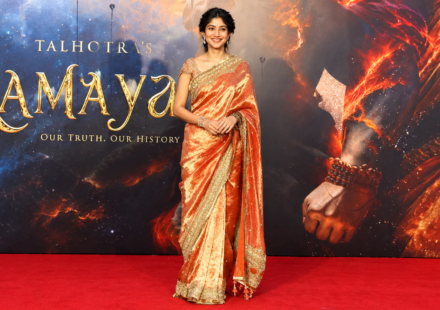
Yash’s Son Could Not Accept Ravana Killing Jatayu: Sai Pallavi Shares an Emotional Moment From Ramayana

A powerful scene from the upcoming mythological epic Ramayana: Rise of a Legend reportedly left a deep emotional impression on Yash’s young son. Actor Sai Pallavi, who plays Sita in the film, has revealed that the child became upset after watching his father portray Ravana in a confrontation with Jatayu, the legendary bird who attempts to stop Ravana from abducting Sita.
The incident took place when Yash brought his children, Ayra and Yatharv, to the film’s world premiere in Los Angeles on October 27. It was an unusual experience for the children, who were seeing their father perform on the big screen in a major mythological role.
According to Sai Pallavi, Yatharv was particularly disturbed by the scene in which Ravana attacks and kills Jatayu. Although he understood that his father was acting, the emotional impact of the scene was strong enough to make him question the character’s actions.
The moment has attracted attention because it offers a glimpse into how a dramatic scene from an epic story can affect a young viewer, even when the person playing the character is someone he knows and loves.
Sai Pallavi Recalls the Child’s Reaction
During a media interaction connected with the film’s promotions, Yash spoke about his children’s response to watching the movie. He explained that they had many questions after seeing the story unfold on screen.
Sai Pallavi then shared a particularly touching detail about Yatharv’s reaction to the Jatayu sequence.
According to her account, the young boy told his father that he did not like seeing him kill the bird in the film. He reportedly questioned why Ravana had done something like that, even in a fictional performance.
Sai Pallavi explained that the child knew Yash was an actor and understood that he had appeared in films before. Nevertheless, the distinction between the actor and the character did not prevent him from feeling upset about what happened to Jatayu.
Her account highlighted the innocence of a child who could recognise the difference between acting and reality but still respond emotionally to the actions shown on screen.
For Yatharv, the scene was not simply a dramatic confrontation between two mythological figures. It was also a moment in which his father appeared to do something he believed was wrong.
Why the Jatayu Scene Matters in the Ramayana
Jatayu occupies an important place in the traditional story of the Ramayana. He is a noble bird who attempts to protect Sita when Ravana carries her away to Lanka.
Despite being unable to defeat Ravana, Jatayu challenges him and tries to prevent the abduction. His struggle is remembered as an act of courage, loyalty and sacrifice.
The episode has emotional significance because Jatayu risks his life to help Sita, even though he faces an opponent with far greater power. His actions represent the decision to stand against wrongdoing, regardless of the personal cost.
For viewers familiar with the epic, the encounter is more than an action sequence. It represents the conflict between Ravana’s determination to carry out the abduction and Jatayu’s attempt to protect Sita.
This emotional foundation helps explain why the scene can leave a strong impression on audiences. A child watching the sequence may focus less on its mythological significance and more on the simple idea that a bird is being hurt while trying to help someone.
Yatharv’s reported response reflects that immediate emotional connection. Rather than evaluating the scene as part of a cinematic performance, he reacted to what he saw happening to Jatayu.
Yash on the Challenge of Playing Ravana
The incident also comes as Yash has been discussing the challenges of portraying Ravana in the film.
Ravana is one of the most complex and widely discussed figures in Indian mythology. He is commonly remembered as the antagonist of the Ramayana, but his character is also associated with immense power, knowledge, ambition and pride.
For an actor, presenting such a figure convincingly requires more than an imposing appearance or an intimidating voice. The performance must communicate the character’s authority while allowing audiences to understand the motivations and weaknesses that shape his decisions.
Yash has explained that one of his main challenges was making Ravana’s extraordinary power believable to viewers. He wanted audiences to feel that the character was formidable rather than simply being told that he was difficult to defeat.
The actor has also spoken about his interest in moving beyond a one-dimensional portrayal of Ravana. He wants audiences to consider the character’s different qualities and understand where his choices led him astray.
Such an approach does not necessarily justify Ravana’s actions. Instead, it allows the character to be presented with greater complexity, giving viewers more to consider than a straightforward division between a hero and a villain.
The Jatayu sequence is particularly relevant to this approach because it shows Ravana’s power through a consequential act. The scene also illustrates how the character’s decisions affect others, making the conflict emotionally significant rather than purely physical.
Ranbir Kapoor and Sai Pallavi Lead the Film
Directed by Nitesh Tiwari, Ramayana: Rise of a Legend features Ranbir Kapoor as Lord Ram, Sai Pallavi as Sita and Yash as Ravana. The cast also includes Sunny Deol as Hanuman and Ravi Dubey as Lakshman, among other actors.
The film is scheduled for a worldwide theatrical release on November 5, 2026, making it one of the major cinematic releases attracting attention in India ahead of its opening.
Its story draws on the Ramayana, one of the most influential epics in Indian cultural and literary traditions. Bringing such a familiar narrative to the screen creates a particular challenge: audiences may already have strong expectations about its characters, important episodes and moral themes.
The filmmakers must therefore balance the familiarity of the source material with a cinematic presentation capable of engaging viewers who know the story as well as those encountering its details for the first time.
Performances by major cast members are likely to be central to that effort. In Yash’s case, the portrayal of Ravana carries the additional challenge of presenting a legendary antagonist whose actions have profound consequences for the other characters.
A Small Family Moment With a Larger Emotional Meaning
While the film’s scale, cast and visual presentation are attracting attention, Sai Pallavi’s account offers a more personal perspective on the production.
For Yash, the premiere was an opportunity to watch his children experience his work in a new setting. For his son, however, the experience became an emotional encounter with the character his father was playing.
The reaction also illustrates an important aspect of storytelling: audiences do not always respond to a scene in the way its creators might expect. A sequence designed to establish a villain’s strength can also prompt sadness, sympathy or questions about right and wrong.
Jatayu’s role makes that possibility especially clear. His attempt to protect Sita gives the confrontation an emotional dimension that extends beyond the battle itself.
The reported incident does not reveal how every viewer will respond to the film, but it provides an early glimpse of the emotional questions its characters and story may raise.
As the release approaches, audiences will be watching to see how the film presents the relationship between Ram, Sita, Ravana and the other figures central to the epic.
For now, one of the most memorable stories from the film’s promotional period is not about its scale or spectacle. It is about a child who watched his father play a powerful mythological figure and felt that, even in a movie, Jatayu deserved better.