Israel Election Leaves Netanyahu Short of Power as Arab Parties Gain Historic Influence

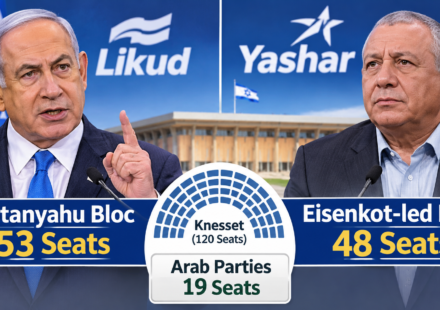
Israel’s election has produced an uncertain parliamentary landscape, with Prime Minister Benjamin Netanyahu’s political bloc leading the partial seat count but falling short of the numbers required to govern independently. With more than 85% of the overall vote represented in the count, Netanyahu’s bloc stood at 53 seats, while the opposition grouping led by former military chief Gadi Eisenkot held 48. Arab parties had secured 19 seats, giving them a potentially important role in negotiations over the next government.
The figures released during the count reflected approximately 85.6% of all votes cast, although around 93% of ordinary ballots had been processed. The remaining votes, including hundreds of thousands cast through double envelopes, were still awaiting counting or verification. The distribution was therefore not yet final, and the political consequences remained uncertain.
Neither Main Bloc Has Reached a Majority
Israel’s parliament, the Knesset, has 120 seats. A government normally needs the support of at least 61 lawmakers to command a majority.
At the reported stage of the count, Netanyahu’s bloc was eight seats short of that threshold. Eisenkot’s grouping was further away on its own, meaning that neither side could rely solely on its current seat total to form a majority government.
The arithmetic leaves political leaders facing difficult choices. Netanyahu could seek support from parties outside his existing alliance, while opposition leaders would need to bring together groups with different political priorities if they hope to replace his government.
Although the partial results put Netanyahu’s bloc ahead of Eisenkot’s grouping, a lead in seats does not automatically translate into the ability to form a government. Coalition agreements, parliamentary support and the positions of smaller parties will determine what happens next.
Arab Parties Record a Historic Parliamentary Presence
The 19 seats attributed to Arab parties represented a significant result and could make their political decisions particularly important during coalition negotiations.
Their combined representation gives them the potential to influence whether an alternative parliamentary majority can be assembled. However, their seat total does not guarantee that they will enter a governing coalition or that the other opposition parties will agree to cooperate with them.
Political differences remain a major obstacle. Some opposition figures have called for cooperation with Arab parties to prevent Netanyahu from returning to power, while other politicians have expressed reservations about such an arrangement.
The central question is whether parties that campaigned against Netanyahu can agree on a shared programme and a practical plan for governing. Their ability to do so will matter as much as the seat totals themselves.
Eisenkot Faces a Coalition-Building Challenge
Gadi Eisenkot, leader of the Yashar party and a former military chief, has emerged as the central figure in the opposition grouping.
His path to power depends on more than his own party’s performance. He would need to secure sufficient support from other political groups and overcome disagreements that could prevent them from working together.
Some opposition leaders have argued that cooperation with Arab parties could provide the numbers needed to form a government. Such a partnership, however, would require negotiations over policy priorities, political representation and the terms on which parliamentary support would be provided.
Even if an alternative majority appears possible on paper, translating it into a stable government could prove difficult. Parties may disagree over security policy, relations with Palestinians, religious issues, public spending and other matters that have divided Israeli politics.
Netanyahu Calls for a Right-Wing Government
Netanyahu has continued to argue for a right-wing government and has rejected the idea of relying on Arab parties to secure his political future.
His position reflects the difficulties facing both major camps. While his bloc remained ahead in the reported count, it had not reached the 61-seat threshold. He would therefore need to secure additional parliamentary backing if the final figures remain similar.
Netanyahu’s supporters may seek to maintain the existing political alliance, but the outcome will depend on the final distribution of seats and the willingness of potential partners to join or support a government.
The election result also leaves open the possibility of further negotiations, political compromises or a prolonged period of uncertainty if neither side can assemble a workable majority.
Why the Remaining Votes Matter
The reported figures were based largely on ordinary ballots, with hundreds of thousands of double-envelope votes still to be counted. Such ballots can include votes from groups whose voting procedures differ from those used at regular polling stations, including military personnel.
These outstanding votes could alter party totals and affect the final allocation of seats. Although the latest reported count suggested that immediate updates were unlikely later on Wednesday, the result was still provisional.
The Central Elections Committee must complete the counting and verification process before the final outcome is established. Until then, political claims about who has won or lost the election should be treated cautiously.
The difference between a narrow lead and a parliamentary majority is particularly important in Israel, where government formation depends on agreements among multiple parties rather than simply on which bloc finishes first.
What the Result Means for Israel
The election has left Israel facing another difficult period of coalition bargaining. The next government’s composition will influence domestic policy and the country’s approach to security, regional diplomacy and relations with international partners.
For Netanyahu, the immediate challenge is to find enough parliamentary support to continue leading the government. For Eisenkot and the opposition, the task is to demonstrate that their parties can cooperate despite ideological differences.
Arab parties may have increased leverage in the negotiations, but their influence will depend on whether other political groups are willing to work with them and what agreements can be reached.
If the major blocs remain unable to secure a majority, negotiations could become prolonged and raise the possibility of further political instability. The final ballot count will help clarify the available options, but it may not resolve the underlying disagreements.
The key takeaway: Netanyahu’s bloc was leading the partial count, but it remained short of a majority. Eisenkot’s opposition grouping also lacked sufficient seats on its own, while Arab parties held a potentially influential position. The next stage of Israeli politics will depend on the final results and the coalition agreements that follow.
Record Early Voting Puts Netanyahu’s Wartime Leadership Under National Scrutiny
Israel’s parliamentary election has drawn an unusually strong early turnout, placing Prime Minister Benjamin Netanyahu’s leadership under renewed public scrutiny as voters weigh national security, the consequences of war and the government’s handling of the October 7, 2023, attacks.
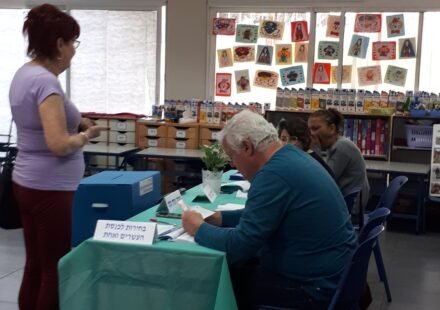
Early voting figures showed that 16.7% of eligible voters had cast ballots by 10 a.m. local time, with approximately 1.2 million votes recorded. The pace was reported as the fastest early turnout in decades, reflecting the high stakes surrounding the country’s first national election since the Hamas-led attacks of October 2023.
The election could determine whether Netanyahu remains in power or whether a rival political bloc can assemble enough parliamentary support to form a government. However, strong turnout alone does not indicate which side will win.
Why This Election Matters
The vote comes after a period of profound security and political upheaval in Israel. The October 7 attacks exposed major failures in the country’s security system and triggered a prolonged war in Gaza, followed by wider regional confrontations.
Netanyahu’s critics argue that his government must answer for the security breakdown and the decisions made during the war. They have called for greater accountability, including an independent investigation into the circumstances that allowed the attacks to occur.
Netanyahu has rejected calls to accept personal responsibility for the security failure. He has instead defended his record, arguing that his government’s military operations have strengthened Israel’s position against its adversaries.
For many voters, the election is therefore about more than party politics. It is also a judgment on how the country has been governed during a period of conflict and whether its leadership should change.
Netanyahu Faces a Competitive Challenge
Netanyahu, Israel’s longest-serving prime minister, is seeking to retain power through the right-wing Likud party and its political allies.
His principal challenge comes from opposition forces seeking a change in leadership. Former military chief Gadi Eisenkot has emerged as a prominent figure in the contest, presenting himself as an alternative focused on accountability, national recovery and changes to the country’s political direction.
Eisenkot has criticised the government’s handling of the war, arguing that military action has not achieved all its stated objectives against Hamas. He has also called for a strategy to dismantle the organisation’s military and governing capabilities.
The contest is complicated by Israel’s parliamentary system, in which parties must negotiate alliances to form a government. Even a party that finishes first in the popular vote cannot govern alone unless it secures sufficient support in the 120-member Knesset.
Pre-election polling suggested that neither major political camp had an easy path to a stable parliamentary majority. The final distribution of seats and the decisions of smaller parties could therefore prove as important as the performance of the leading candidates.
October 7 Remains Central to Voters’ Decisions
The Hamas-led attack on October 7, 2023, remains one of the defining events in modern Israeli politics. Approximately 1,200 people were killed in the attack, and 251 people were taken hostage, according to widely reported figures.
The assault led to a major Israeli military campaign in Gaza and a prolonged period of fighting that affected the wider region.
Families of victims and former hostages have continued to demand accountability and answers about the security failures. Their concerns have become part of the broader debate over political responsibility and the government’s response to the crisis.
For Netanyahu’s opponents, the election offers voters an opportunity to express their views on whether the current leadership should continue.
Supporters of the prime minister, meanwhile, point to his experience in security affairs and his approach to confronting Israel’s regional adversaries. They argue that changing leadership during a period of continuing threats could create additional uncertainty.
These competing arguments have made security and political accountability major issues in the campaign.
High Turnout Does Not Guarantee a Change of Government
The unusually strong early turnout has attracted attention because participation can affect how political parties perform, particularly when different voter groups turn out at different rates.
Arab citizens of Israel have also attracted attention during the election, with reports pointing to stronger participation than in some previous contests. Their votes could influence the balance between political blocs, although the ultimate effect will depend on the final turnout and the distribution of votes among parties.
Israel’s proportional representation system makes the outcome difficult to determine from turnout figures alone. Parties must cross the electoral threshold to enter parliament, and the resulting seats are distributed according to their share of the vote.
After the final results are established, Israel’s president consults political parties before asking a candidate to form a government. Coalition negotiations can take considerable time, especially when no political bloc has secured a clear majority.
Netanyahu could therefore remain in office in a caretaker capacity if the election produces a prolonged period of negotiations without an immediate agreement on a new government.
What the Result Could Mean for Israel
The election’s consequences will extend beyond the question of who occupies the prime minister’s office.
A government led by Netanyahu would likely seek to continue its existing security and foreign-policy approach, while an alternative coalition could attempt to change the direction of domestic governance and reassess aspects of the country’s wartime strategy.
Nevertheless, a change of leadership would not automatically resolve Israel’s security challenges or the political disputes surrounding the conflict. Any incoming government would face difficult decisions involving military policy, relations with neighbouring countries, the future of Gaza and the demands of citizens seeking accountability.
The composition of the next coalition will also matter. Smaller parties may influence policy priorities, government appointments and the scope of any proposed reforms.
For international partners, the outcome will provide an indication of the political direction Israel may take in the months ahead. However, the extent of any policy change will depend on the final coalition agreement and the decisions taken by the government.
When Will the Election Result Be Known?
Voting is scheduled to continue until 10 p.m. local time on Tuesday. Broadcasters are expected to publish exit polls after polling stations close, offering the first indications of the possible result.
Exit polls are estimates rather than official counts. The final allocation of parliamentary seats may take longer, particularly if several parties are close to the electoral threshold or if the leading blocs remain closely matched.
The official process will determine how many seats each party wins and which candidate has the best chance of forming a government.
For now, the strongest early turnout shows that the election has attracted considerable public participation. It does not establish whether voters will retain Netanyahu or support an alternative.
The final verdict will emerge from the ballots cast across Israel and the coalition negotiations that follow.