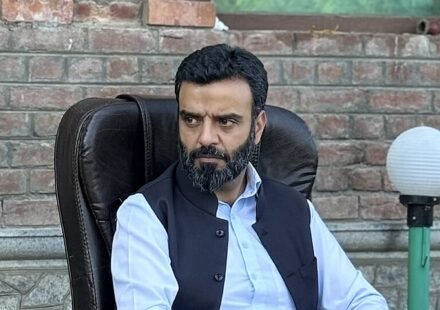
Aga Ruhullah’s Exit Deals Major Blow to Omar Abdullah as Srinagar MP Quits National Conference

Jammu and Kashmir’s political landscape witnessed a major development on Tuesday, November 3, 2026, as Srinagar Member of Parliament Aga Syed Ruhullah Mehdi announced his departure from the ruling National Conference (NC) and his resignation from the Lok Sabha. His decision marks a significant break with a party he had represented for years and adds to the political challenges facing Chief Minister Omar Abdullah.
Ruhullah made the announcement while addressing a large gathering at Behisht-e-Zehra Park in Budgam, where supporters had assembled on the death anniversary of his father, Aga Syed Mehdi. During the event, the Srinagar MP accused the party leadership of moving away from commitments made to voters and said he was unwilling to remain associated with a political organisation that, in his view, had failed to uphold its promises.
The announcement comes at a sensitive time for the National Conference, which is already dealing with reported dissatisfaction among sections of its legislators over the functioning of the government and recent decisions concerning the state cabinet. Ruhullah’s departure could intensify questions about the party’s internal unity and its ability to maintain confidence among voters who supported it during the 2024 elections.
Why Aga Ruhullah Decided to Leave the National Conference
Ruhullah’s principal criticism centres on what he describes as a gap between the National Conference’s election promises and its actions after returning to power in Jammu and Kashmir.
He has repeatedly raised concerns over the restoration of Article 370, the protection of constitutional rights, changes to reservation arrangements and the release of political prisoners. According to Ruhullah, these were important political commitments on which the party sought public support, but he believes the leadership has not pursued them with the determination voters expected.
Article 370, which had granted special constitutional status to the former state of Jammu and Kashmir, was effectively revoked by the Centre in August 2019. Its restoration remains a politically sensitive issue in the region, particularly among parties and sections of the public who argue that Jammu and Kashmir’s constitutional position and political aspirations must be addressed.
Ruhullah has also questioned the government’s approach to reservation policy, an issue that has prompted protests and public debate in the Union Territory. His differences with the party became increasingly visible after he supported students protesting over reservation-related concerns in late 2024.
The MP’s latest move reflects a dispute over political direction and accountability. However, his claims about the party abandoning its commitments represent his assessment of the government’s record; the National Conference’s position and its response to his latest allegations should be considered separately.
A Direct Challenge to Omar Abdullah’s Leadership
Ruhullah’s resignation is particularly significant because it comes amid growing pressure on Omar Abdullah’s government from within the National Conference itself.
Reports in recent days have described dissatisfaction among a group of NC legislators following changes to the cabinet and concerns about consultation within the party. A section of lawmakers has reportedly sought a wider cabinet overhaul and changes in the way key decisions are made.
Ruhullah’s departure adds another public challenge to the party leadership. While the concerns raised by legislators and the MP are not necessarily identical, both developments highlight the difficulties the NC faces in managing internal disagreements while leading the government.
For Omar Abdullah, the immediate challenge is political as well as organisational. The party will need to address questions about whether its elected representatives feel adequately consulted and whether its government can demonstrate progress on the commitments that helped it secure public support.
Ruhullah’s resignation does not, by itself, mean that the government has lost its majority in the Jammu and Kashmir Assembly. The parliamentary seat he won is separate from the assembly seats held by NC legislators. The broader impact on the government will depend on how other lawmakers respond, whether the internal disagreements deepen and whether the party can reach an understanding with dissatisfied members.
From Party Break to a Possible New Political Platform
Ruhullah has indicated that leaving the National Conference does not automatically mean he intends to join another existing political party. Instead, he has spoken about bringing together honest and committed young people from Jammu and Kashmir to work for public welfare and the rights of local communities.
That statement leaves open the possibility of a new political platform, although its structure, leadership, objectives and organisational plans have not yet been fully established publicly. Whether such an initiative develops into a formal political organisation will depend on its ability to attract supporters, build a local network and establish a clear programme beyond opposition to the existing leadership.
Creating a new platform would not be an easy task. Jammu and Kashmir has a complex political environment, and any new formation would need to demonstrate credibility on constitutional questions, employment, economic opportunities, governance and public services. It would also need to translate public support for an individual leader into sustained political organisation.
Ruhullah’s standing among sections of the electorate could give such an initiative visibility, but its future influence cannot be assessed solely on the basis of the resignation announcement.
What Happens to the Srinagar Lok Sabha Seat?
Ruhullah has announced his resignation from the parliamentary seat, but the formal status of the Srinagar constituency depends on the applicable parliamentary procedure. The seat becomes vacant once the resignation is formally accepted by the Lok Sabha Speaker.
If the resignation is accepted, the Election Commission would have to address the vacancy under the relevant electoral rules. Any by-election would depend on the applicable legal provisions and the election schedule. Until the formal process is completed, it would be premature to describe the constituency as definitively vacant.
The parliamentary resignation and the departure from the National Conference are separate matters: leaving a political party does not automatically end a member’s status as an MP. Ruhullah’s announcement is therefore both a political break and the beginning of a formal process concerning his parliamentary position.
What the Resignation Could Mean for Jammu and Kashmir Politics
The immediate consequence of Ruhullah’s move is likely to be renewed scrutiny of the National Conference’s internal cohesion and its record on campaign promises. The party will face questions from political opponents and voters about its handling of constitutional demands, reservation policy and governance.
For the opposition, the development offers an opportunity to highlight divisions within the ruling party. For the NC leadership, the priority will be to prevent a single resignation from becoming a wider organisational crisis.
The longer-term effect will depend on several factors: the party’s response to Ruhullah’s accusations, the position taken by dissatisfied legislators, and whether the former MP can build a credible political alternative. It will also depend on how voters judge the government’s performance and the feasibility of the promises made during the electoral campaign.
Ruhullah’s departure is an important setback for the National Conference, but it is too early to conclude that it will fundamentally alter the balance of power in Jammu and Kashmir. The next test will be whether the party can contain internal dissent and whether Ruhullah’s decision develops into a broader political movement.
For now, his announcement has brought the debate over political promises, constitutional rights and leadership accountability back to the centre of Jammu and Kashmir’s political conversation.
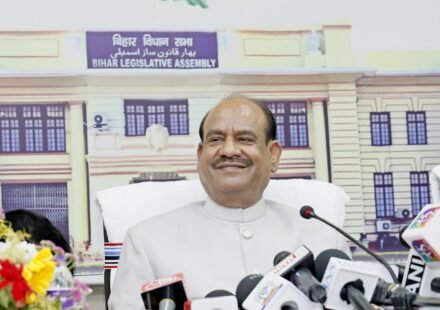
Om Birla Says Any Fresh Move to Remove Election Chief Will Follow Parliamentary Rules
Lok Sabha Speaker Om Birla has said that any fresh notice seeking the removal of Chief Election Commissioner Gyanesh Kumar will be examined under established parliamentary rules and procedures, as opposition parties continue to raise concerns over the Election Commission’s handling of electoral roll revisions.
Speaking to reporters in New Delhi on Thursday, Birla indicated that the matter would be considered if a fresh notice were formally submitted. He said the process for removing the head of the Election Commission was laid down in law and would be followed accordingly.
His remarks come amid an intensifying political dispute over the Special Intensive Revision (SIR) of electoral rolls, an exercise that has drawn criticism from opposition parties and prompted demands for the chief election commissioner’s resignation or removal.
Opposition concerns over electoral roll revision
Opposition parties have questioned aspects of the SIR process and alleged irregularities in the way electoral roll revision decisions have been handled. They have argued that the Election Commission must ensure transparency, fairness and accountability in the preparation of voter lists.
The controversy has become a wider political issue, with opposition leaders seeking action against Kumar and raising concerns about the functioning of the country’s electoral machinery.
The allegations remain contested. The demand for removal does not itself establish wrongdoing, and any formal proceedings would have to be assessed under the constitutional standards governing the office.
The dispute has also drawn attention to the role of the Election Commission, the independent constitutional body responsible for overseeing elections and administering the electoral process in India.
Earlier removal attempts
The opposition has already made two attempts to initiate proceedings against Kumar.
Notices submitted during the first attempt were rejected by the presiding authorities in both the Lok Sabha and the Rajya Sabha. Notices submitted during the second attempt remain pending in the Upper House, according to reports published on October 22.
Birla’s latest statement concerns the possibility of another notice. It does not mean that a fresh motion has been admitted or that proceedings to remove Kumar have begun.
Whether a new notice advances will depend on the applicable rules, the grounds presented and the formal decision on its admissibility.
What does the law say about removing a CEC?
The Chief Election Commissioner has constitutional protection against removal similar to that afforded to a Supreme Court judge. This safeguard is intended to protect the independence of the office and prevent removal through an ordinary political decision.
Under the constitutional framework, removal requires a special parliamentary process on grounds of proved misbehaviour or incapacity. The process is substantially more demanding than a routine parliamentary motion.
The Judges (Inquiry) Act, 1968, provides a framework for investigating allegations once a removal motion is admitted. A three-member committee is constituted to examine the charges. Its members include the Chief Justice of India or a Supreme Court judge, a chief justice of a high court and a distinguished jurist.
The committee examines the allegations and reports its findings. If the charges are not established, the removal process does not proceed on that basis. If the committee finds the allegations established, the motion can be considered by Parliament in accordance with the prescribed procedure.
For removal to take effect, both Houses must adopt the required address during the same session, with support from a majority of the total membership of each House and at least two-thirds of members present and voting. The President then issues the removal order in accordance with the constitutional process.
These requirements make clear that a demand for removal and the actual removal of a chief election commissioner are two distinct matters.
Speaker’s role and parliamentary procedure
Birla’s comments underline the importance of following formal procedures rather than making a decision before a notice is received and examined.
As Lok Sabha Speaker, he is responsible for applying the relevant rules to matters placed before the House. His statement did not indicate whether a future notice would be accepted or rejected; it addressed how such a notice would be handled if submitted.
The issue also highlights the balance between parliamentary oversight and the independence of constitutional institutions. Political parties have the right to raise concerns, while any removal process must satisfy the legal requirements established for the office.
What happens next?
The immediate question is whether opposition parties will submit another notice and, if they do, whether it meets the required conditions for consideration.
Until a fresh notice is formally submitted and examined, no conclusion can be drawn about the next procedural step. The notices from earlier attempts also have to be distinguished from any possible future motion.
The controversy over the electoral roll revision is likely to remain part of the political debate, but the outcome of any removal effort will depend on the constitutional process rather than public demands alone.
Birla’s statement therefore offers a procedural assurance, not a decision on Kumar’s future. Any new move will have to pass through the prescribed legal and parliamentary stages before it can lead to further action.