Nobel Economics Prize 2026: The Two Economists Whose Ideas Shape Global Economic Policy

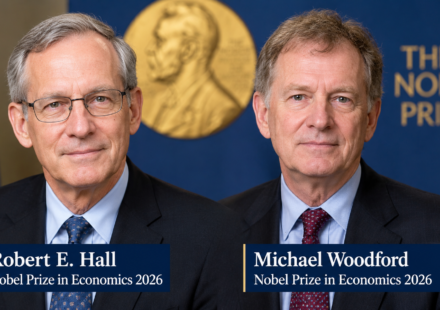
American economists Robert E. Hall and Michael Woodford have won the 2026 Nobel Memorial Prize in Economic Sciences for research that has helped strengthen the theoretical foundations of economic stabilisation policies.
The Royal Swedish Academy of Sciences announced the award in Stockholm on Monday, October 12. The economists were recognised for their work on the “microeconomic foundations of macroeconomic stabilization,” which examines how decisions made by households and businesses influence the wider economy.
Their research has contributed to the development of economic models used to understand fluctuations in output, consumption and inflation. These models help policymakers assess how monetary and fiscal measures can reduce the severity of economic downturns and respond to sudden shocks.
Why Their Research Matters
Economies rarely move in a straight line. Consumer spending, business investment, inflation and employment can change in response to energy-price shocks, financial instability or shifts in demand.
Hall and Woodford’s work connects the decisions of individual economic actors with broader economic outcomes. Rather than relying only on statistical relationships between large-scale economic indicators, this approach builds macroeconomic models on the underlying behaviour of households and businesses.
The framework helps economists examine how people respond to interest rates, expected future income, prices and government policies. It also provides a basis for studying how policy decisions affect consumption, production and economic stability over time.
According to the prize announcement, the laureates’ contributions have provided a theoretical foundation for models used by central banks and governments around the world.
Who Are Robert E. Hall and Michael Woodford?
Robert E. Hall is an American economist and professor at Stanford University in California. His research has examined consumption, labour markets, economic growth and the behaviour of households and firms.
Michael Woodford is an American economist and professor at Columbia University in New York. He is widely known for his research on monetary policy and the theoretical foundations of modern macroeconomics.
Their work has helped shape discussions about how central banks should respond to inflation and changes in economic activity. The research is relevant to policymakers deciding how to balance price stability with employment and sustainable growth.
What the Award Means for Economic Policy
Central banks often adjust interest rates to influence borrowing, spending and inflation. Governments also use taxation and public spending to support economic activity or manage downturns.
Economic models built on household and business behaviour can help policymakers assess how these measures might work in different circumstances. For example, an energy-price shock can raise production costs, reduce household purchasing power and place upward pressure on inflation.
Understanding how consumers and firms react to such changes can help policymakers evaluate the likely effects of different responses. The models do not eliminate uncertainty, but they offer a structured way to analyse complex economic decisions.
The prize highlights the role of economic theory in shaping real-world policy. It also recognises the importance of understanding how individual choices combine to produce economy-wide outcomes.
Prize Money and Award Ceremony
The 2026 award carries prize money of 12 million Swedish kronor, approximately $1.2 million. The economics award is formally known as the Sveriges Riksbank Prize in Economic Sciences in Memory of Alfred Nobel.
Unlike the original Nobel Prizes established under Alfred Nobel’s will, the economics prize was created by Sweden’s central bank in 1968. It is nevertheless awarded alongside the other Nobel prizes.
The laureates are scheduled to receive the award at the traditional ceremony on December 10, the anniversary of Alfred Nobel’s death.
Hall and Woodford’s recognition concludes the 2026 Nobel announcements, bringing attention to research that continues to influence how economists and policymakers understand the forces shaping modern economies.