
Qatar and Saudi Arabia Push for Iran Peace Deal as Trump Keeps US Military Option Open

US President Donald Trump has said that Qatar and Saudi Arabia want a peaceful settlement to the conflict involving Iran, while warning that Washington remains prepared to resume military strikes if circumstances require. His remarks highlight the diplomatic efforts underway in the Gulf region alongside the continuing military and economic pressure on Tehran.
Trump made the comments after meeting Qatar's Prime Minister Sheikh Mohammed bin Abdulrahman Al Thani at the White House on Monday. In a subsequent phone interview, the US president said both Qatar and Saudi Arabia preferred a peaceful solution. He also made clear that the United States had not ruled out further military action.
The president indicated that he was not in a hurry to order fresh strikes. Instead, he said Washington was prepared to maintain its naval blockade against Iran in the Strait of Hormuz while developments were monitored.
Qatar and Saudi Arabia favour diplomacy
Qatar and Saudi Arabia have strong reasons to seek an end to the confrontation. Both countries are located in a region where any expansion of military operations could threaten energy infrastructure, commercial shipping, aviation and wider economic activity.
For Qatar, diplomatic engagement is particularly important because it has maintained communication channels with different sides in regional disputes. Doha has frequently played a role in facilitating negotiations and carrying messages between governments that do not maintain direct or effective diplomatic contact.
Saudi Arabia also has significant interests in preventing a wider conflict. The kingdom's energy facilities, ports, trade routes and economic development plans could face serious risks if military operations spread across the Gulf.
Trump's remarks suggest that Washington is aware of these regional concerns. He specifically referred to the preference of Qatar and Saudi Arabia for a peaceful outcome, while maintaining that the United States would retain the ability to use military force.
However, the public statements do not establish that either Gulf country has secured an agreement between Washington and Tehran. They indicate support for diplomacy rather than confirmation of a completed negotiation.
Trump signals no immediate rush for fresh strikes
The most significant element of Trump's comments was the distinction between military readiness and an immediate decision to attack.
The president said the United States was ready to act if necessary, but his remarks also indicated that he was comfortable continuing pressure through the naval blockade for the time being.
That approach gives Washington an option between launching another round of attacks and accepting an agreement on terms it considers insufficient. Maintaining military pressure could also be intended to strengthen the US position in any future negotiations.
Trump did not announce a timetable for a new diplomatic meeting or provide details of a possible agreement. Nor did he set out specific conditions that Iran would have to meet before the United States considered ending its pressure campaign.
His position therefore leaves two possibilities open: a negotiated arrangement that reduces tensions or a return to military action if the situation changes.
Strait of Hormuz remains central to the crisis
The Strait of Hormuz is one of the most important maritime passages for global energy supplies. A substantial share of the world's seaborne oil trade normally passes through this narrow waterway, making its security a major concern for energy-importing countries.
Any prolonged disruption can affect shipping costs, insurance premiums, oil prices and the movement of goods across international markets. Countries outside the Middle East can also face the economic consequences of instability in the Gulf.
The US naval blockade against Iran has therefore become a central part of Washington's pressure strategy. Continuing it allows the administration to maintain economic and strategic pressure without immediately announcing a new military campaign.
At the same time, a prolonged blockade could make diplomatic negotiations more difficult. Iran has objected to restrictions affecting its ports and maritime trade, while Washington has linked its pressure campaign to its broader demands in the conflict.
The situation places regional governments in a difficult position. They want to prevent a wider confrontation, but they also have to consider the security and economic consequences of any agreement or continued escalation.
Diplomatic engagement faces major obstacles
The meeting between Trump and Qatar's prime minister was an important diplomatic contact, but it did not produce a publicly announced final agreement with Iran.
Qatar has been an important intermediary in regional diplomacy, and its prime minister's discussions with the US president could help keep communication channels active. His visit also followed diplomatic engagement with Tehran, giving Doha a possible role in conveying positions between the two sides.
Nevertheless, the gap between the American and Iranian positions remains a major obstacle.
Iran has called for changes to the restrictions imposed on its economy and maritime activity. Washington, meanwhile, has shown little willingness to accept Tehran's proposed conditions without addressing its own security demands.
The disagreement is not limited to the immediate question of military operations. A durable settlement would need to address the arrangements governing maritime movement, sanctions, security guarantees and the wider terms of the confrontation.
No details released after the Trump-Al Thani meeting confirmed that these issues had been resolved.
Regional countries concerned about escalation
The diplomatic preference expressed by Qatar and Saudi Arabia reflects a broader concern among Gulf countries that renewed attacks could create consequences beyond the immediate battlefield.
A wider conflict could increase the risk to commercial vessels, energy installations and critical infrastructure. It could also complicate regional trade and discourage investment at a time when Gulf economies are pursuing long-term development projects.
For countries that depend on stable energy exports and international shipping, uncertainty around the Strait of Hormuz is particularly serious.
The United States also has to consider the wider consequences of its decisions. A new military campaign could increase pressure on regional partners and create further uncertainty in international energy markets.
What happens next?
Trump's latest comments do not amount to an announcement that the conflict is ending. They show that the US administration is keeping military options available while allowing diplomatic efforts to continue.
Qatar and Saudi Arabia are seeking a peaceful outcome, but their preference alone cannot guarantee an agreement. Progress will depend on whether Washington and Tehran can find common ground on the conditions required to reduce tensions.
For now, the US position combines continued pressure with an open door to negotiations. The naval blockade remains an important part of that strategy, while the possibility of renewed strikes continues to shape the calculations of governments across the region.
The next significant indication will be whether diplomatic contacts produce concrete steps towards an agreement. Until then, the Gulf region remains exposed to uncertainty, with the security of shipping routes and the future of US-Iran relations closely connected.
Tanker Attack Near Oman Raises Alarm Over Safety of 21 Indian Seafarers in Hormuz
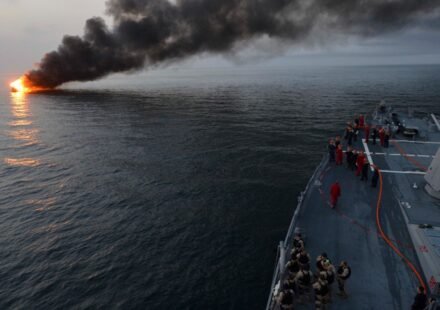
A Kuwait-flagged oil product tanker carrying 21 Indian seafarers was struck by an unidentified projectile while passing through the strategically important Strait of Hormuz, prompting renewed concern over the safety of commercial shipping in the Gulf region. All Indian crew members and the rest of the crew were reported safe following the incident, according to India's shipping minister.
The vessel, identified as M/T Al Dasma, was hit on October 21 while transiting the busy maritime corridor. Union Minister for Ports, Shipping and Waterways Sarbananda Sonowal said Indian authorities were monitoring the situation and remained in contact with the ship management company to protect the crew.
The origin of the projectile has not been officially established. Maritime security reports indicated that the incident occurred about 11 nautical miles west of Bukha, Oman. Reports also said a fire broke out aboard the tanker after the strike and was subsequently extinguished.
Indian Government Monitoring the Situation
The incident has placed the safety of Indian maritime workers back in focus as security risks continue to affect commercial shipping around the Gulf.
Sonowal said the government was maintaining close contact with the vessel's management company to ensure the wellbeing of the seafarers. The immediate priority is to confirm the crew's safety, assess the vessel's condition and determine the appropriate steps for its next movement.
Although all crew members were reported safe, the full extent of damage to the tanker and its cargo was not immediately clear in the available reports. The identity of those responsible for the strike also remained unconfirmed.
For India, the safety of its seafarers is a significant concern because thousands of Indian nationals work aboard merchant ships operating on international routes. Incidents involving vessels in conflict-affected waters can require coordination between ship operators, maritime security agencies and diplomatic missions.
Why the Strait of Hormuz Matters
The Strait of Hormuz connects the Persian Gulf with the Gulf of Oman and the wider Arabian Sea. It is one of the world's most important routes for transporting crude oil, petroleum products and liquefied natural gas.
Large volumes of energy supplies from Gulf producers pass through this narrow waterway on their way to international markets, including countries in Asia. Any threat to commercial vessels can therefore have consequences beyond the immediate area of an attack.
When shipping companies face increased security risks, they may need to reassess routes, strengthen onboard precautions or delay voyages. These measures can increase operating costs and complicate the movement of fuel and other goods.
The latest strike adds to concerns about whether commercial vessels can continue operating safely amid wider regional tensions. Even when no crew members are injured, repeated attacks can undermine confidence among ship operators, insurers and cargo owners.
Another Incident in a Series of Shipping Security Concerns
The Al Dasma incident follows another strike involving an oil tanker carrying Indian seafarers in the same waterway.
On October 16, crude oil tanker MT ST 3, which had 15 Indian seafarers aboard, was struck by a projectile while transiting the Strait of Hormuz. Indian authorities said the Indian nationals on that vessel were safe and no casualties had been reported.
Other recent incidents involving commercial shipping in the Gulf region have also raised concerns about crew safety and the protection of maritime trade. However, the details of individual incidents differ, and the perpetrators or precise circumstances have not been established in every case.
India has previously expressed concern over attacks on commercial vessels and the risks faced by merchant mariners. Protecting seafarers and ensuring the safe movement of commercial shipping remain important priorities for a country that relies heavily on maritime transport for international trade.
Potential Impact on Oil and Shipping Markets
An attack on a tanker does not automatically mean that oil supplies have been disrupted. The effect on energy markets depends on factors such as the vessel's cargo, the extent of damage, whether the ship can resume its voyage and whether similar incidents become more frequent.
However, repeated security incidents in the Strait of Hormuz can raise concerns about transport delays, insurance premiums and the cost of moving energy supplies. Shipping companies may also face additional expenses if they need to take precautionary measures or change their operating plans.
For major oil-importing economies such as India, sustained disruption in the region could contribute to volatility in international energy prices. Higher shipping and fuel costs may eventually affect businesses and consumers, although the impact would depend on the scale and duration of any disruption.
At this stage, the confirmed information about the Al Dasma incident establishes a security threat to a commercial tanker, but it does not by itself demonstrate a measurable interruption to global oil supplies.
What Happens Next?
The immediate focus will remain on the safety of the crew, the condition of the vessel and the circumstances surrounding the strike. Further information from maritime authorities and the ship's operator may clarify whether the tanker suffered significant damage and when it can safely continue its voyage.
Indian authorities are expected to continue monitoring developments and coordinating with the relevant parties. Ship operators navigating the region will also be watching security updates as they assess risks to their crews and cargoes.
The incident serves as another reminder that commercial shipping can be vulnerable during periods of regional tension. While all 21 Indian seafarers aboard Al Dasma were reported safe, the attack underscores the importance of protecting merchant crews and maintaining safe passage through vital international waterways.