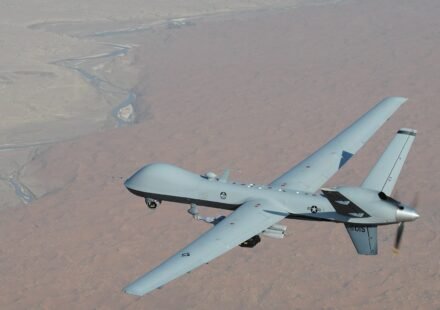
Iran Claims It Shot Down Another US MQ-9 Reaper Drone Over Strait of Hormuz

Iran has claimed that its air defence forces shot down another United States MQ-9 Reaper drone over the strategically important Strait of Hormuz, adding to tensions between Tehran and Washington. The Islamic Revolutionary Guard Corps (IRGC) said the interception took place early on Tuesday, October 20, while the unmanned aircraft was flying over the waterway.
The claim was reported by Iranian media, which cited an announcement from the IRGC. Iranian officials described the incident as the 54th US MQ-9 drone they had destroyed.
However, the reported shoot-down has not been independently verified, and the US military had not publicly confirmed the loss at the time of reporting. Details about the drone's precise location, the circumstances of the interception and the air defence system allegedly used remain limited.
The announcement comes amid continuing military and maritime tensions in the Gulf region, where the Strait of Hormuz remains a critical route for international energy shipments.
Iran Says Advanced Air Defence System Intercepted Drone
According to the IRGC's account, Iranian air defence units detected and destroyed the American drone using what officials described as a new, advanced air defence system operated by the force's aerospace division.
Iranian authorities did not publicly identify the specific system involved or provide independently verifiable evidence establishing how the interception occurred.
The reported incident is part of Tehran's broader messaging about its ability to monitor and defend the country's airspace and nearby strategic waters. Iranian officials have repeatedly highlighted their air defence capabilities during the confrontation with the United States and Israel.
Nevertheless, the claim that the aircraft was destroyed remains an assertion by the Iranian side. Confirmation from US authorities, independently verified wreckage or other corroborating evidence would be needed to establish the incident's full circumstances.
Why the MQ-9 Reaper Matters
The MQ-9 Reaper is an unmanned aircraft used by the US military for long-duration surveillance, intelligence gathering and precision-strike missions. Its ability to remain airborne for extended periods makes it useful for monitoring large areas and tracking activity around strategically important locations.
In the Gulf, surveillance aircraft can help monitor maritime movements, military deployments and potential threats to shipping. Their presence also makes them a focus of concern for countries seeking to restrict foreign military operations near their territory.
The MQ-9 is a valuable military platform because it combines endurance with the ability to carry sensors and, in certain configurations, weapons. Losing one can create both a financial cost and a potential gap in surveillance coverage.
Iran's latest announcement did not include enough independently verified information to establish the value of the aircraft allegedly destroyed or the operational consequences for the US military.
Tehran Claims Its 54th Drone
Iranian reporting described the latest aircraft as the 54th American MQ-9 drone destroyed by Iranian forces. That figure should be treated as an Iranian military claim rather than an independently confirmed count.
Different assessments of military aircraft losses can use different definitions. A drone may be destroyed in combat, damaged and later repaired, lost in an accident or rendered unusable for another reason. These categories are not necessarily equivalent.
A US Congressional Research Service assessment published in October documented American military aircraft and drone losses or damage during the conflict with Iran through a period ending in mid-September. That assessment used a broader category covering losses and damage from multiple causes, rather than confirming Iran's specific claim of 54 shoot-downs.
The available figures therefore cannot automatically be compared as though they measure exactly the same events. Further official information would be needed to establish the number of MQ-9 aircraft actually destroyed by Iranian air defences.
Strait of Hormuz Remains a Strategic Flashpoint
The Strait of Hormuz connects the Persian Gulf with the Gulf of Oman and the wider Arabian Sea. It is one of the world's most important maritime routes because large volumes of crude oil and other energy supplies pass through the narrow waterway.
Any military incident in or near the strait can raise concerns about commercial shipping, insurance costs and the reliability of energy deliveries. Even unconfirmed reports can influence perceptions of risk when tensions between regional and international powers are already high.
The waterway has become particularly sensitive during the confrontation involving Iran, the United States and Israel. Disagreements over maritime access, military operations and restrictions affecting Iranian ports have complicated efforts to restore stable navigation.
For energy-importing countries, prolonged disruption could increase transport costs and add uncertainty to international oil markets. However, the reported drone incident alone does not establish that commercial shipping has been disrupted as a direct result.
Renewed Military Tensions Add to Uncertainty
The latest announcement follows a series of competing claims and military developments involving Iran and the United States. Both sides have sought to demonstrate their capabilities and defend their respective positions, while questions about maritime security continue to dominate regional attention.
Iran's claim that it destroyed another MQ-9 could become a further point of dispute if Washington challenges the account or releases information about the aircraft's operational status.
For now, several important questions remain unanswered: whether a drone was actually lost, where the interception occurred, what equipment was involved and whether the incident will prompt a formal response from the United States.
No confirmed details available at the time of reporting establish that the claimed shoot-down has led to a new military operation or a change in US policy.
What Happens Next?
The next significant development would be an official statement from the Pentagon or US Central Command confirming or denying the loss. Evidence such as verified wreckage imagery, identifiable aircraft details or an independently documented incident could also help clarify the claim.
Until additional evidence becomes available, Iran's announcement should be reported as an unverified military claim, not as a confirmed destruction of an American aircraft.
The incident nevertheless highlights the continuing risks around the Strait of Hormuz, where military surveillance, competing security claims and the importance of energy shipments intersect. Any further escalation could have consequences beyond the immediate confrontation, particularly if it affects the safety or movement of commercial vessels.