Paris Calms After Overnight Curfews as France Tightens Crackdown on Rioters

PARIS — Calm returned to Paris on Tuesday after authorities imposed overnight curfews and tightened security following a weekend of violent unrest across France. The measures were introduced to prevent further looting, arson and clashes after demonstrations over the rising cost of living and poor conditions in schools escalated into some of the country’s most serious street violence in recent years.
Police reported no major incidents during the latest curfew period. However, the French government warned that restrictions could be imposed again in areas where local authorities consider them necessary.
The unrest has placed pressure on President Emmanuel Macron’s administration, with officials facing questions about how the violence spread and whether security forces were adequately prepared.
Curfews Help Restore Calm in Paris
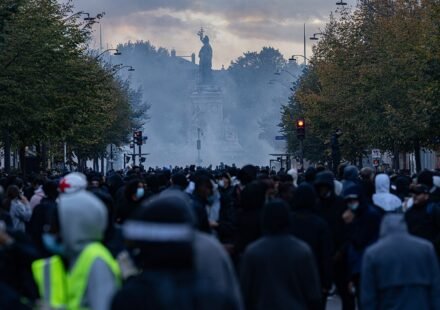
In Paris, a curfew was enforced from 11 p.m. Monday until 6 a.m. Tuesday around Place de la République and the Les Halles shopping district. Authorities also restricted gatherings and demonstrations in designated parts of the capital.
A police helicopter circled over Place de la République during the night, using a searchlight to monitor the area and check compliance with the restrictions.
By Tuesday morning, municipal workers had begun cleaning up the square. A large yellow vest displayed on a central statue was removed, and workers used pressure washers to clear graffiti from the monument.
The yellow vest imagery refers to the protest movement that emerged in France in 2018 over fuel prices and broader economic grievances.
Prime Minister Sébastien Lecornu said targeted curfews had helped maintain calm. He added that local prefects, working with mayors, would decide whether further restrictions were needed.
The government has favoured localised measures rather than imposing a blanket curfew across the entire capital.
Thousands Arrested After Weekend Violence
The government’s response follows widespread violence on Saturday, October 17, when demonstrations across France turned destructive in several cities.
Groups of rioters clashed with police, set vehicles and other objects on fire, looted businesses and attacked public buildings. A historic municipal building in Lyon was engulfed in flames during the unrest.
Further incidents were reported on Sunday evening, when small groups damaged property and looted shops in Paris, Lyon, Marseille and other locations.
At least 2,400 people had been arrested nationwide, according to reporting published on Tuesday. Other official figures placed the total at around 2,500, reflecting updates as authorities processed cases.
Justice Minister Gérald Darmanin said 149 people had been jailed nationwide by midday Tuesday. More than 800 people had been referred to prosecutors, according to figures cited by the authorities.
In Paris, the city prosecutor’s office said around 300 people had been referred to prosecutors in connection with the October 17 protests.
The figures may change as investigations continue and more cases move through the judicial system.
Government Faces Questions Over Security Failures
The scale of the destruction has triggered scrutiny of the government’s handling of the demonstrations.
Interior Minister Laurent Nuñez acknowledged that police had lost control in some cities during the weekend violence and recognised shortcomings in anticipating the unrest. Macron rejected Nuñez’s offer to resign and instructed him to examine failures in intelligence, planning and the deployment of security forces.
The government has pledged to take a firmer approach to looting and property destruction. Darmanin said prosecutors should appeal sentences they consider too lenient, while emphasising that the justice system would respond firmly to offences committed during the unrest.
France’s National Assembly has also announced an inquiry into the October 17 violence and the authorities’ policing strategy. Its findings are expected by the end of the year.
The government is simultaneously considering measures to support businesses affected by the destruction. Preliminary estimates cited in French reporting indicate that at least 3,000 businesses may have been affected, although the full financial cost remains uncertain.
Protests Driven by Economic and Education Grievances
The unrest followed weeks of demonstrations initially led by students demanding better conditions in high schools. Protesters raised concerns about overcrowded classrooms, shortages of teachers and inadequate investment in education.
The movement subsequently broadened into protests against rising living costs and pressure on public services, including housing, health and welfare.
Although many demonstrations began peacefully, violence by groups on the fringes of the crowds led to clashes with police and extensive damage in some urban centres.
The situation has also become politically sensitive, with France approaching its next presidential election in 2027. The government faces pressure to restore public order while addressing the economic and public-service concerns that have fuelled demonstrations.
Protest groups have called for another round of demonstrations on Saturday, October 24, raising the possibility of renewed tensions.
More Restrictions Possible
For now, the immediate priority for French authorities is to prevent another night of violence and protect residents, businesses and public infrastructure.
Lecornu has said additional curfews will be considered wherever local conditions require them. The restrictions are not uniform nationwide: their timing and geographic scope depend on decisions by local authorities.
The return of calm to Paris offers the government temporary relief, but it does not resolve the wider dispute over education, living costs and public spending. The authorities will face another test if demonstrations resume later this week.