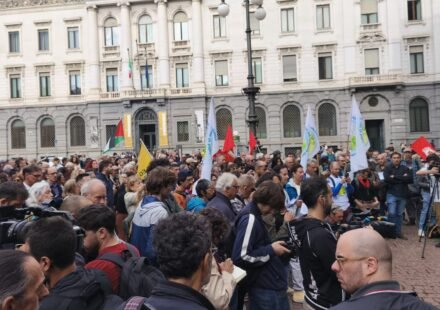
Europe Braces for Fresh Demonstrations as Milan Reinforces Security With 500 More Soldiers

Italy has deployed an additional 500 soldiers to Milan as authorities prepare for another round of demonstrations across the country and other parts of Europe. The increased security presence follows a weekend of clashes and looting in the Italian city, where officials are concerned that new protests could again turn violent.
The newly deployed troops are intended to reinforce existing security personnel and support police patrols. Authorities have also expanded surveillance and security checks around transport hubs as demonstrations linked to living costs, housing, education and government policies are expected in several European cities.
The deployment comes amid growing public discontent over economic pressures and political decisions. Although many demonstrations are planned as peaceful marches and rallies, last weekend’s violence in Milan has prompted officials to prepare for possible disorder.
Milan increases security after clashes and looting
The additional 500 soldiers will join personnel already stationed in Milan under Italy’s existing public-security arrangements. They are expected to assist with patrols and surveillance, while police retain their specific responsibilities for managing demonstrations and enforcing the law.
Authorities have also planned drone monitoring, railway station checks and rapid-response units. The measures are designed to help security teams identify emerging problems and respond quickly if violence breaks out.
The decision follows unrest during protests the previous weekend. Demonstrations over the cost of living were followed by incidents involving damaged shops, looting and clashes with police. Officials reported dozens of arrests, including a substantial number of minors.
The violence has raised concerns among business owners, particularly in central Milan’s shopping districts. Some retailers have taken precautions ahead of the planned demonstrations, while local officials have urged people not to assume that further protests will necessarily lead to disorder.
Demonstrations planned in several Italian cities
Milan is not the only Italian city preparing for demonstrations. Rallies have been announced in Rome, Turin, Bologna, Florence, Genoa and other urban centres.
The planned gatherings involve different groups and causes, including criticism of the cost of living and government policies. Organisers have promoted further mobilisation, while authorities are preparing security plans based on the expected size and location of each event.
Rome is also preparing for a substantial security operation. Police intend to monitor demonstrations and key public areas, with drones and other resources available to help manage crowds. Officials have said they aim to protect the right to demonstrate while preventing violence and damage.
The scale of the preparations reflects the challenge facing authorities: public demonstrations may bring together people with different grievances, and isolated incidents can create risks for participants, residents, businesses and police.
Protests reflect wider economic and social concerns
The demonstrations are taking place against a backdrop of economic anxiety across Europe. Housing affordability, energy and fuel costs, public services, wages and education funding have become prominent issues in several countries.
In Albania, students have been demanding lower tuition fees, increased investment in education and action against corruption. Their protests have also intersected with a wider opposition movement calling for political change.
In Spain, demonstrations have focused on pensions and the rising cost of housing. In Portugal, protesters have mobilised over rental costs and concerns about tenant protections. These movements have different national contexts, but they illustrate how economic pressures are prompting people to take their concerns into public spaces.
The protests should not be treated as a single coordinated movement across Europe. Their organisers, demands and political backgrounds vary, and the presence of demonstrations in several countries does not establish that they share one leadership or unified agenda.
Italy introduces tougher measures against protest violence
Italy’s government has also announced tougher measures following the unrest. The measures include provisions targeting violent participation in demonstrations and penalties linked to property damage caused by minors. Officials have argued that stronger enforcement is needed to deter vandalism and protect public safety.
The measures have also prompted debate about how to balance public order with the right to peaceful assembly. Governments have a responsibility to protect people and property, but security operations must distinguish between peaceful demonstrators and individuals who commit offences.
The presence of soldiers can provide additional support for patrols and monitoring, but it cannot by itself resolve the social and economic concerns driving many protests. Addressing those concerns may require separate policy responses involving housing, education, employment and household costs.
What the security build-up means for residents
For residents and visitors, the immediate effect may be more visible patrols, additional checks and changes to access around some public areas. Transport services and traffic could also be affected where demonstrations take place, although the precise impact will depend on local arrangements.
Businesses may face uncertainty if crowds gather near commercial districts, while peaceful demonstrators will be watching how authorities manage the events. The use of surveillance technology and expanded police resources may help with coordination, but the effectiveness of the measures will depend on how events unfold.
The coming demonstrations will test whether the increased security presence can prevent a repeat of the previous weekend’s disorder without unnecessarily restricting peaceful public gatherings.