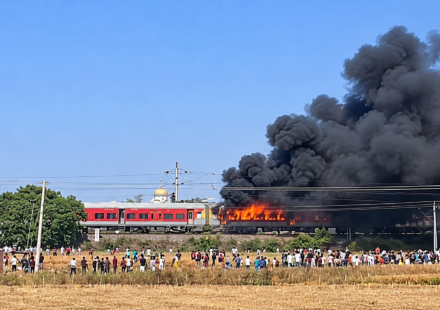
Karmabhoomi Express Fire in Punjab: Four Coaches Hit by Flames, Passengers Evacuated Safely

Panic spread among passengers aboard the Karmabhoomi Express on Friday after a fire broke out in four coaches of the train near Sarai Banjara railway station in Punjab's Patiala district. Thick clouds of smoke rose above the railway track as passengers rushed out of the affected compartments to escape the flames.
The train, numbered 12508, was travelling from Amritsar to New Jalpaiguri in West Bengal when the incident occurred near Rajpura. According to initial reports, the fire first broke out in a general coach and subsequently spread to adjoining compartments. Three coaches were reported to have caught fire, while a fourth was also affected.
The incident triggered an emergency response from railway authorities, local administration, police and fire brigade personnel. Passengers were evacuated, and the train was brought to a halt after its safety system was activated. No casualties or injuries had been reported in the initial official updates.
Fire Breaks Out Near Sarai Banjara
The incident was reported on Friday afternoon, shortly after the train departed from Sadhugarh railway station in Fatehgarh Sahib district. Railway-related reports placed the fire at around 1 pm, near Sarai Banjara, in the Rajpura area.
According to railway officials, the blaze was first noticed in the fifth coach from the engine. The fire spread to nearby compartments, filling the area with thick smoke and creating panic among passengers.
Videos shared from the location showed smoke rising from the affected coaches, with flames visible as emergency teams reached the spot. Passengers could be seen standing outside the train after getting off the affected compartments.
The train was stopped near the affected section to prevent further danger. The activation of the safety system helped bring the train to a halt, allowing passengers to move away from the burning coaches.
Passengers Evacuated, No Casualties Reported
Passenger safety became the immediate priority after the fire was detected. Railway personnel and local emergency teams assisted in evacuating people from the affected coaches.
Northern Railway officials said the train had stopped safely after its safety system was triggered near Sarai Banjara. The fire was being brought under control, and senior officials reached the location to supervise the response.
Ambala Divisional Railway Manager Vinod Kumar Bhatia also reached the site. Officials said that no deaths or injuries had been reported in the initial assessment.
The absence of reported casualties provided some relief amid the frightening scenes. However, the incident raised questions about how the fire started and how quickly it spread across multiple coaches.
Short Circuit Suspected, Official Cause Awaited
A short circuit was suspected as a possible cause of the fire, according to preliminary reports. However, railway authorities had not officially confirmed the reason.
Officials said the circumstances surrounding the incident would be examined as part of an investigation. The inquiry is expected to look into the coach where the fire originated, the electrical systems and equipment, and the sequence in which the flames spread.
The Railways also ordered a high-level inquiry to establish the cause and assess the damage. Until the investigation is completed, the suspected short circuit should not be treated as a confirmed explanation.
The extent of damage to the affected coaches is also being assessed. Reports indicated that three coaches had caught fire, while a fourth was slightly affected.
Alternative Train Arrangements for Stranded Passengers
The fire disrupted the journey of passengers travelling towards New Jalpaiguri and other destinations in eastern India. Since the affected train could not continue its scheduled journey normally, railway authorities began arranging alternative transportation.
According to Ambala railway officials, passengers were asked to move to a nearby railway station, approximately 500 metres away. An alternative train was arranged to help them continue their journey.
A medical relief train carrying Accident Relief Medical Equipment was also dispatched from Ambala at around 1:20 pm to support the emergency response.
Senior railway officials remained involved in managing the situation and coordinating assistance for passengers. The arrangements were aimed at ensuring that people stranded by the incident could reach their destinations safely.
Railway Safety Under Focus
The fire has once again drawn attention to passenger safety and emergency preparedness on India's railway network. Fires involving multiple coaches can spread rapidly, particularly when trains are crowded and passengers are unfamiliar with emergency procedures.
In this case, the activation of the safety system and the evacuation of passengers helped prevent reported casualties. However, the incident also highlights the importance of timely fire detection, functioning alarm systems, electrical maintenance and the availability of emergency equipment.
The investigation will be important in determining whether the fire resulted from an electrical fault, equipment failure or another cause. It will also help establish whether existing safety arrangements functioned as intended.
For passengers, the immediate concern was getting out of the affected coaches and continuing their journeys. For the Railways, the next steps involve completing the inquiry, assessing the damage and identifying any measures needed to prevent similar incidents.
As of Friday's initial updates, the fire had been brought under control and no casualties had been reported. Further details about the cause of the blaze and the condition of the affected coaches are awaited.

Delhi’s Winter Pollution Mystery: Evening Farm Fires May Be Escaping Satellite Detection
Delhi’s annual battle against air pollution is becoming more complicated as new observations raise concerns about agricultural fires taking place after satellites have completed their daily monitoring passes. Smoke from crop-residue burning in Punjab and Haryana may be travelling towards the national capital during evening and nighttime hours, adding to the pollution already produced by vehicles, industries, construction activities and other urban sources.
The issue highlights a possible weakness in the way agricultural fires are monitored. When satellites pass over a particular region during the daytime, they may record only the fires that are active at that moment. Fields where farmers begin burning crop residue later in the evening may not appear in those observations. As a result, the actual scale of burning could be higher than the figures suggested by certain satellite-based reports.
Why the Timing of Farm Fires Matters
Satellite technology has become an important instrument for monitoring stubble burning across northern India. It helps authorities identify agricultural fires, estimate their locations and understand how crop-residue burning changes during the harvesting season.
However, satellites do not all observe the Earth continuously. Some monitoring systems pass over the same agricultural region at particular times rather than recording every activity throughout the day. If a farmer starts burning leftover straw after a satellite has passed, that fire may remain undetected by that observation.
This creates a significant challenge for pollution monitoring. A reduction in the number of recorded fires does not necessarily prove that agricultural burning has declined by the same amount. The monitoring schedule itself can influence the final figures.
Recent observations during the November 2026 pollution episode have brought attention to this problem. Data reported from India's INSAT-3DS satellite showed an increase in detected evening fire activity between October 29 and November 1. The reported count increased from 17 to 90 during this period.
These figures represent fires identified by the particular monitoring system and should not be interpreted as a complete count of every agricultural field where burning occurred.
How Agricultural Smoke Reaches Delhi
Punjab and Haryana are important agricultural regions where farmers harvest rice before preparing their fields for the next crop. After harvesting, considerable quantities of straw and other plant material remain on the ground.
Some farmers burn this residue to clear their fields quickly. The resulting smoke contains fine particles, including PM2.5, which can remain suspended in the atmosphere and travel beyond the areas where the fires originated.
When winds blow from the northwestern agricultural belt towards Delhi, smoke can move into the capital and surrounding districts. The distance travelled and the amount of pollution reaching the city depend on wind speed, direction, atmospheric conditions and the intensity of the fires.
Winter weather can make the situation more dangerous. During colder months, weaker winds and limited vertical movement of air can prevent pollutants from dispersing efficiently. Smoke and other emissions may consequently remain concentrated closer to the ground.
This combination of regional emissions and unfavourable weather can contribute to sudden deterioration in air quality across Delhi-NCR.
However, agricultural burning is not the only explanation for the capital's pollution. Traffic emissions, industrial activity, construction dust, road dust, waste burning and other sources also contribute to the problem.
Delhi's Air Quality Shows a Sharp Deterioration
The pollution situation became particularly concerning on November 2, 2026, when Delhi's Air Quality Index reached 324 in the 4 pm reading, placing the city in the very poor category.
The deterioration followed a substantial increase in pollution over the preceding days. The reported AQI figures rose from 117 on Saturday to 261 on Sunday before reaching 324 on Monday.
An analysis of overnight pollution also highlighted the seriousness of the episode. Average PM2.5 concentration between 10 pm and 6 am reportedly reached 194 micrograms per cubic metre during the night leading into November 2.
The timing is important because agricultural fires occurring during evening hours could continue producing smoke after some daytime satellite observations have ended. If winds carry that smoke towards Delhi, it may contribute to higher pollution levels during nighttime and early morning hours.
Nevertheless, these measurements alone cannot establish exactly how much pollution came from agricultural fires. Detailed source-apportionment studies are needed to separate the contributions of different emission sources.
Why Farmers Continue Burning Crop Residue
Stopping stubble burning requires more than monitoring and penalties. Farmers face practical and financial difficulties when managing large quantities of leftover crop residue.
After harvesting rice, many farmers have limited time to prepare their fields for wheat cultivation. Delays can affect the next planting cycle and potentially influence agricultural productivity.
Burning provides a quick way to clear fields, while alternative methods may require machinery, additional labour, transportation and money. Even when agricultural equipment is available through government-supported programmes, access and operating costs can remain obstacles.
A long-term solution must therefore make residue management affordable and convenient. Machinery for collecting, managing and incorporating straw into the soil needs to be accessible at the village level.
Agricultural waste can also be used in biomass-based energy production, industrial applications and other commercial activities. However, these alternatives require reliable collection networks, storage facilities and sufficient demand.
Better Monitoring Could Help Authorities Respond Faster
The latest developments underline the importance of combining different monitoring technologies rather than depending on a single satellite observation.
Polar-orbiting satellites can provide detailed information about active fires, while geostationary satellites can observe the same region repeatedly. Ground inspections and drone-based monitoring can provide additional information about fires that might otherwise escape detection.
Weather forecasting is equally important. By studying wind direction and atmospheric conditions, authorities can estimate whether smoke from agricultural areas is likely to move towards densely populated regions.
Such information could help pollution-control agencies identify emerging problems earlier and coordinate action across state boundaries.
What It Means for Delhi Residents
For people living in Delhi-NCR, prolonged exposure to polluted air can increase the risk of respiratory and cardiovascular problems. Children, elderly people and individuals with existing health conditions are particularly vulnerable.
When pollution levels become very poor, residents should follow official health advisories, reduce prolonged outdoor exertion and take appropriate precautions. People with existing respiratory or heart conditions should follow medical advice.
The larger challenge is that Delhi's pollution cannot be controlled by one state or one department alone. Agricultural burning, transport emissions, industrial pollution and construction dust require coordinated action.
The latest observations offer an important warning: counting the fires that satellites can see is not enough. Authorities must also understand when fires are starting, where their smoke is travelling and how to provide farmers with practical alternatives.
Unless monitoring improves and the reasons behind crop burning are addressed, Delhi could continue facing similar pollution episodes during future harvesting seasons.