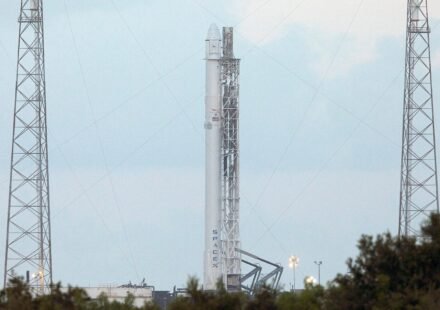
NASA and SpaceX Prepare to Send New Solar Arrays and 6,300 Pounds of Cargo to Space Station

NASA and SpaceX are preparing a new cargo mission to the International Space Station (ISS), carrying more than 6,300 pounds of scientific investigations, supplies and equipment. The mission will also deliver the final set of new roll-out solar arrays designed to increase the orbiting laboratory’s power-generation capacity.
The flight, designated SpaceX’s 35th Commercial Resupply Services mission for NASA, is scheduled to use a Falcon 9 rocket and an uncrewed Dragon spacecraft. NASA announced a target launch time of 6:33 a.m. Eastern Daylight Time on October 13 from Space Launch Complex 40 at Cape Canaveral Space Force Station in Florida.
The launch schedule can change because of weather, technical checks or other operational requirements. NASA’s latest mission updates should be consulted for confirmation of the actual liftoff.
New Solar Arrays to Boost Space Station Power
One of the mission’s major payloads is the final set of International Space Station Roll-Out Solar Arrays, known as iROSA.
Unlike traditional rigid solar panels, these arrays are designed to roll out after deployment. Their compact configuration allows them to be transported to orbit and installed alongside the station’s existing solar-power infrastructure.
The new arrays are intended to supplement the ISS power system, helping support onboard research, equipment and daily operations. The station relies on electricity for life-support systems, communications, scientific instruments and other essential functions.
The additional power capacity is particularly important as the station continues to host experiments that require reliable electrical supply.
Cargo Includes Experiments for Medical and Materials Research
The Dragon spacecraft will carry a range of scientific payloads in addition to routine supplies for astronauts.
Among the investigations are hardware intended to manufacture artificial retinas in microgravity, research involving three-dimensional heart-tissue models, and studies examining how new types of glass form in space.
The mission will also transport brain organoids—small, laboratory-grown models of brain tissue—that researchers hope can help identify possible treatment targets for neurodegenerative diseases, including Alzheimer’s, Parkinson’s and multiple sclerosis.
Microgravity provides scientists with experimental conditions that differ from those on Earth. Research conducted in orbit can help investigators study biological processes, materials and technologies that may be difficult to examine under normal gravitational conditions.
However, results from space-based experiments must be analysed and validated before their potential medical or industrial applications can be established.
How Dragon Will Reach the International Space Station
Following launch, the Dragon spacecraft is expected to travel to orbit aboard the Falcon 9 rocket. It will then conduct its approach to the space station and dock autonomously with the space-facing port of the Harmony module.
NASA’s published schedule placed docking at approximately 11 a.m. EDT on October 15, subject to operational conditions.
After docking, the crew will unload the supplies and research equipment. The solar arrays will require installation work, including operations involving the station’s robotic systems and astronauts.
The spacecraft is expected to remain attached to the ISS until around mid-November before departing with research materials and cargo returning to Earth.
Why Cargo Missions Matter
Regular cargo flights are essential to maintaining the space station, which has supported scientific research involving international partners for more than two decades.
Resupply missions bring food, replacement components, scientific instruments and other equipment required by the crew. They also allow researchers to send new experiments to orbit and return selected samples for analysis on Earth.
NASA’s commercial resupply programme works with private companies, including SpaceX, to transport cargo to and from the station. These partnerships help sustain the ISS while supporting the development of commercial spaceflight capabilities.
The CRS-35 mission combines routine resupply operations with a significant power-system upgrade and research that could contribute to future advances in medicine and materials science.