Indian Stock Market Today: GIFT Nifty Signals Recovery After Sell-Off; TCS Q2, Crude Oil and RBI Policy in Focus

India’s stock market is heading into Friday’s session after a sharp sell-off pushed the Sensex and Nifty 50 to their lowest closing levels in months. Early signals from GIFT Nifty pointed to a possible rebound, but investors remained cautious amid elevated crude oil prices, foreign fund outflows, a weaker rupee and uncertainty over global technology stocks.
The market’s direction on October 9 is likely to depend on five major factors: GIFT Nifty and Asian markets, the US technology sell-off, Tata Consultancy Services’ (TCS) September-quarter results, oil prices and the Reserve Bank of India’s tighter policy stance.
Sensex and Nifty 50: How the Market Closed on Thursday
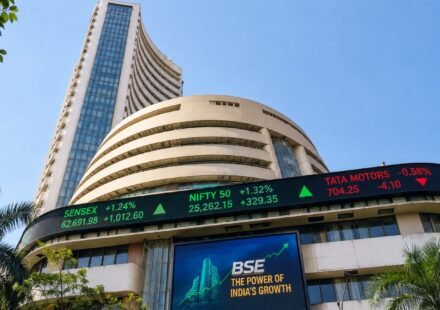
Indian equities came under heavy selling pressure on Thursday, October 8. The BSE Sensex fell 1,045.46 points, or around 1.44%, to close at 71,593.24. The NSE Nifty 50 dropped 371.25 points, or 1.64%, to settle at 22,231.80.
The declines reflected broad-based weakness rather than pressure on just a handful of companies. Rising crude oil prices, concerns about inflation, higher global bond yields and continued selling by foreign investors weighed on sentiment. Smaller companies also faced pressure, with mid-cap and small-cap indices recording steeper declines than the benchmarks.
The Sensex’s close was reported as its lowest in about 32 months, while the Nifty 50 ended at an 18-month low. The sharp fall has put investors on alert for further volatility as the week’s final trading session begins.
1. GIFT Nifty Signals a Possible Positive Opening
GIFT Nifty was trading around 22,359–22,370 in early trade on Friday, indicating a potentially higher opening for the Sensex and Nifty 50 compared with Thursday’s close.
The signal offers some hope of a technical rebound after the previous session’s steep losses. Short-covering—when traders buy back shares to close bearish positions—can also contribute to a recovery after a sharp fall.
However, GIFT Nifty is an indicator, not a guarantee of how the cash market will perform. Investors will also monitor Asian markets, currency movements, crude oil and global bond yields after the opening bell.
A positive opening alone would not establish that the broader downtrend has ended. The market would need sustained buying and participation across sectors to demonstrate stronger recovery momentum.
2. US Technology Stocks and Global Markets
US markets delivered a mixed performance on Thursday. The Nasdaq Composite fell about 1.25%–1.3%, dragged down by technology shares, while the S&P 500 declined around 0.5%. The Dow Jones Industrial Average edged higher.
The weakness in technology stocks is important for Indian IT companies because their earnings depend heavily on spending by clients in the United States and other major international markets. Investors will look for signs that customers are continuing to approve technology projects, particularly traditional IT services and artificial-intelligence-related work.
Indian technology shares may therefore remain sensitive to movements in US-listed technology stocks and American Depositary Receipts (ADRs) of Indian IT companies. Any sustained weakness in overseas technology shares could weigh on domestic IT sentiment, although individual companies may move differently depending on their earnings and outlook.
Global bond yields are another factor. Higher yields can make equities less attractive and raise concerns about borrowing costs and future economic growth. Investors will track whether yields continue to ease or rise again during Friday’s session.
3. TCS Q2 Results: Revenue, Profit and AI Business in Focus
Tata Consultancy Services is among the most closely watched stocks on Friday after announcing its results for the quarter ended September 30, 2026.
TCS reported consolidated revenue of ₹73,188 crore, up approximately 11.2% year-on-year, while net profit increased 15% to ₹13,884 crore. Its operating margin stood at 24%, and annualised revenue from artificial intelligence crossed $3 billion.
The company also reported total contract value of $9.6 billion for the quarter and announced a dividend of ₹12 per share. The record date for the dividend is October 14, 2026, according to the company’s results announcement.
Despite the growth in reported revenue and profit, investors will examine the quality and pace of that growth. TCS’s sequential revenue growth in constant-currency terms was 0.5%, its weakest September-quarter performance on that measure in three years, according to Reuters. The company also said customers continued to scrutinise discretionary technology programmes.
This creates two competing considerations for the stock: growth in profit and AI-related business on one side, and subdued sequential growth in traditional services on the other.
The results could influence sentiment across the wider IT sector, including Infosys, HCLTech, Wipro and Tech Mahindra, which are due to report their own quarterly numbers in the coming weeks.
4. Crude Oil Prices, the Rupee and Foreign Investor Selling
Oil remains one of the biggest risks for Indian equities. Brent crude rose above $104 a barrel during Thursday’s trading amid concerns about geopolitical tensions and supply disruptions. Higher oil prices can increase India’s import bill, put pressure on the rupee and add to domestic inflation.
The rupee also weakened against the US dollar, increasing concerns about imported inflation and the cost of overseas purchases. A sustained rise in oil prices could make it harder for Indian companies to manage costs and could complicate the inflation outlook.
Foreign institutional investors have also been selling Indian equities heavily. Reuters reported net foreign selling of approximately ₹46,990 crore over nine sessions, taking year-to-date outflows to a record level.
Continued foreign selling can add pressure to benchmark indices, particularly when global investors are reducing exposure to emerging markets. Domestic institutional buying may cushion some of the impact, but investors will watch the latest institutional flow data for signs of stabilisation.
Oil prices, the rupee and foreign flows are closely connected: higher oil prices can weaken the currency and worsen inflation concerns, while global uncertainty can encourage investors to move money away from riskier assets.
5. RBI’s Rate Hike and Stocks to Watch
The Reserve Bank of India raised its benchmark repo rate by 25 basis points to 5.5% and shifted its policy stance to “calibrated tightening,” signalling concern about inflation.
Higher interest rates can increase borrowing costs for businesses and households. Rate-sensitive sectors such as real estate, automobiles and some financial companies may therefore remain in focus. Investors will also consider whether tighter policy could affect consumption, investment and corporate earnings.
Apart from TCS, several stocks may attract attention on Friday:
• JSW Steel: The company reported a 5% year-on-year rise in crude steel production for the September quarter.
• Dr. Reddy’s Laboratories: Investors may monitor developments after a US Food and Drug Administration inspection resulted in two
• observations at its Andhra Pradesh facility.
• NCC: The company secured a road construction contract worth approximately ₹1,286 crore from the Hyderabad Growth Corridor.
• SML Mahindra: September commercial vehicle sales rose 32% year-on-year, while exports declined sharply.
• Reliance Industries, HDFC Bank and ICICI Bank: Their price movements may influence the benchmark indices because of their significant index weights.
These are stocks to monitor, not assured gainers. Company-specific announcements and broader market sentiment may produce different outcomes for each share.
What Should Investors Watch During Friday’s Session?
The first signal will be whether the indices hold any early gains indicated by GIFT Nifty. After that, investors will look for participation beyond a small number of heavyweight stocks, along with movements in IT, banking, metals, real estate and automobile shares.
Crude oil and the rupee will remain important macroeconomic indicators. Fresh foreign and domestic institutional flow data could also help explain whether buying interest is returning after Thursday’s sell-off.
A rebound is possible after such a steep decline, but volatility may remain elevated. Investors should avoid treating a positive opening as confirmation that the market has reached a bottom.
Market outlook: Friday’s session is likely to be driven by the balance between a possible technical recovery and continuing concerns about oil prices, inflation, interest rates and foreign selling. TCS’s results may provide a separate trigger for IT stocks, while global technology shares and Asian markets will influence overall risk appetite.
This article is for news and information purposes only. It is not investment advice or a recommendation to buy or sell any security.