US Forces Impose Night Curfew and Alcohol Ban in Okinawa After Marine Arrest

U.S. military personnel in Japan's Okinawa prefecture are facing new restrictions, including a month-long overnight curfew, after a U.S. Marine was arrested on suspicion of robbing and killing a local woman in Naha.
The measures announced by the U.S. military include a 48-hour operational pause, during which troops are prohibited from going off base and alcohol consumption is banned both on and off base. After that period, personnel will face a 30-day curfew from midnight to 5 a.m.
Marine arrested in Naha killing
The restrictions follow the arrest of 20-year-old Lance Cpl. Devin Jacob Ballard, who is stationed at Marine Corps Air Station Futenma in Okinawa.
Japanese authorities accuse Ballard of robbing and killing 39-year-old Anna Yagi at a hotel in Naha on Saturday. Police allege that Yagi died from asphyxiation and that her wallet and backpack were taken.
Ballard has denied the allegations, according to police reports. He remains in Japanese custody while the investigation continues.
Japanese authorities said hotel staff found Yagi unconscious after she failed to check out. Security footage reportedly showed the suspect entering the hotel with the woman and later leaving alone.
U.S. military orders discipline and conduct training
Lt. Gen. Benjamin Watson, the Okinawa area coordinator and commander of III Marine Expeditionary Force, ordered the operational pause following the arrest.
During the 48-hour period, service members will undergo training focused on standards, discipline, alcohol awareness, Okinawan culture and responsibilities toward the local community.
Off-base liberty will also be suspended during the training period.
Watson said the incident had damaged the trust that underpins the relationship between U.S. forces and Okinawan communities.
After the initial 48-hour pause, personnel will enter a 30-day period with restrictions on liberty and the midnight-to-5 a.m. curfew
Japan demands stronger measures
The killing has prompted strong reactions from Japanese officials.
Prime Minister Sanae Takaichi formally protested to the United States and described the incident as extremely brutal and vicious. She called for full cooperation with the Japanese investigation and stronger measures to prevent similar incidents in the future.
Japan's Defense Minister Shinjiro Koizumi also expressed outrage, while other Japanese officials pressed U.S. authorities over discipline and accountability.
Okinawa Governor Genta Koja has also condemned the killing and is due to discuss the issue with the Japanese government.
Long-running tensions over U.S. bases
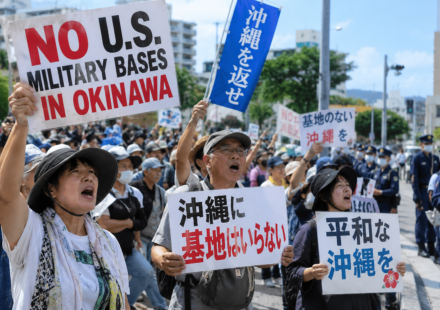
The incident has revived longstanding concerns in Okinawa about the presence of U.S. military forces.
Okinawa hosts a large proportion of the U.S. military personnel stationed in Japan, including most of the approximately 18,000 U.S. Marines based in the country. The U.S. military presence has repeatedly generated controversy over crime, aircraft accidents, noise and other issues.
A 1995 rape case involving three U.S. servicemen sparked major protests across Okinawa and became a defining episode in opposition to the military presence.
The latest killing could further complicate discussions over the future of Marine Corps Air Station Futenma and plans to relocate its functions to Henoko, an issue that has remained politically contentious on the island.
Okinawa's strategic importance
Despite the controversy surrounding the U.S. military presence, Okinawa remains strategically important to both Tokyo and Washington.
The island chain lies close to Taiwan and is viewed as a key location for deterring potential military threats in East Asia, particularly amid growing tensions involving China.
That makes the relationship between U.S. forces and Okinawan communities an important issue not only for local politics but also for the broader U.S.-Japan security alliance.
The immediate focus, however, remains on the murder investigation and the military's response. Japanese authorities are continuing their investigation into the death of Yagi, while U.S. commanders have imposed the new restrictions as they seek to reinforce discipline and accountability among service members.