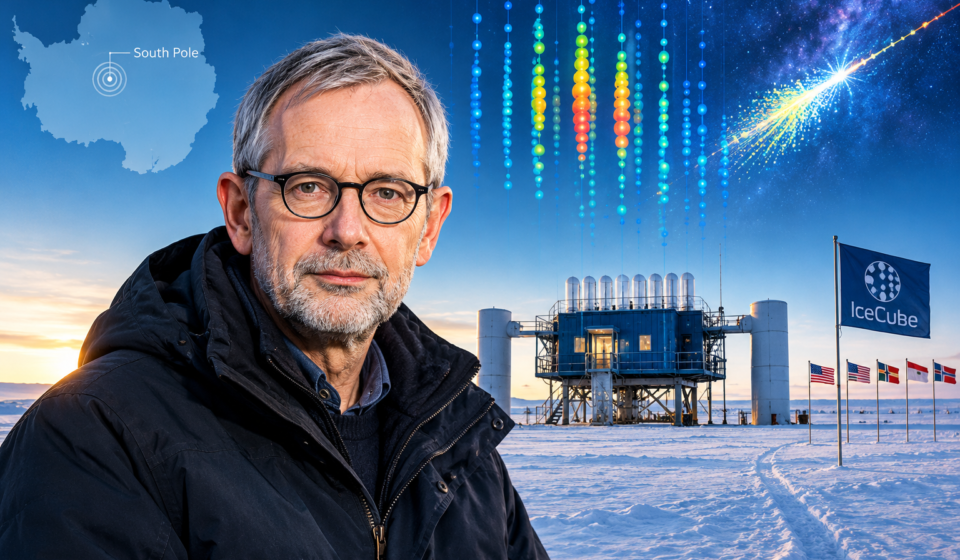

Belgian-American physicist Francis Halzen has won the 2026 Nobel Prize in Physics for his decisive contributions to the IceCube Neutrino Observatory and the discovery of high-energy neutrinos originating from astrophysical sources.
The Royal Swedish Academy of Sciences announced the award on October 6, recognising Halzen’s work in turning an unusual idea — using the enormous volume of Antarctic ice to detect elusive cosmic particles — into a powerful new tool for studying the universe.
Halzen’s Antarctic idea changed the way scientists study the universe
Neutrinos are electrically neutral subatomic particles that interact extremely weakly with matter. Because they can travel enormous distances without being significantly deflected or absorbed, they can carry information from some of the most violent environments in the universe.
Halzen recognised that the ice beneath the South Pole could be used as a giant detector for these difficult-to-observe particles.
That idea became the foundation of the IceCube Neutrino Observatory, an enormous scientific installation buried deep beneath the Antarctic ice. The observatory occupies roughly a cubic kilometre of ice and contains thousands of light sensors designed to detect flashes produced when neutrinos interact with matter.
IceCube opened a new window on distant cosmic events
The IceCube experiment has allowed researchers to identify high-energy neutrinos coming from outside the Solar System and investigate their possible astrophysical sources.
Unlike light, neutrinos are not electrically charged and therefore are not bent by magnetic fields. This means their arrival direction can provide scientists with a relatively direct indication of where they originated.
Researchers hope such observations can help explain powerful cosmic processes associated with phenomena such as exploding stars, black holes and other extremely energetic environments.
The Nobel Committee said the work has opened the way to a new form of astronomy, using neutrinos as messengers from the distant universe.
A huge detector buried beneath Antarctic ice
IceCube is located at the Amundsen-Scott South Pole Station in Antarctica. Its detection system extends deep into the ice, where sensors monitor the faint flashes of light created by particle interactions.
The project was completed in 2011 after years of development involving an international team of scientists and engineers. The first high-energy neutrinos were subsequently detected, helping establish that some of these particles originate from extremely distant cosmic sources.
The scale of the detector is essential because high-energy astrophysical neutrinos are extremely rare. A vast volume of ice gives researchers a greater chance of capturing the tiny signals produced by their interactions.
Halzen says the biggest discoveries may still be ahead
Halzen, who is 82 and is affiliated with the University of Wisconsin–Madison, said after the announcement that the full scientific potential of the method remains to be explored.
His work has already demonstrated that neutrinos can be used to investigate the universe in ways that conventional astronomical observations cannot. Researchers now hope that continued IceCube observations could reveal more about the sources of these high-energy particles and potentially uncover previously unknown cosmic phenomena.
The Nobel recognition therefore goes beyond a single particle discovery. It honours the development of an entirely different way of observing the cosmos.
Nobel Prize carries 12 million Swedish kronor
The 2026 Nobel Prize in Physics comes with a prize amount of 12 million Swedish kronor, according to the Royal Swedish Academy of Sciences.
Halzen’s award also highlights the importance of long-term scientific projects. IceCube required a huge international collaboration, complex engineering in one of the world’s harshest environments and years of observations before its scientific potential became clear.
The discovery of high-energy astrophysical neutrinos has now transformed Antarctic ice into one of the world’s most unusual astronomical instruments.
For scientists, the next challenge is to determine what other secrets can be revealed by these almost undetectable particles travelling across the universe.