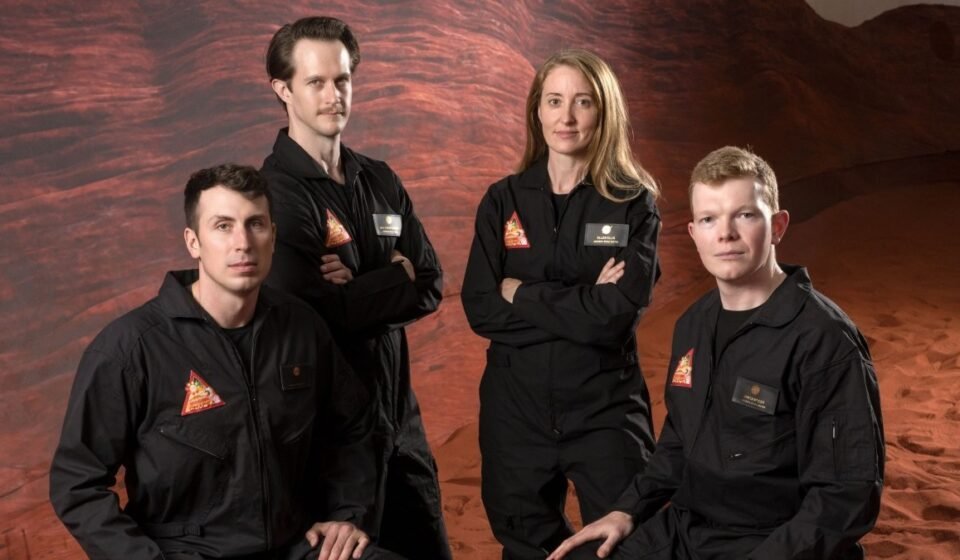

Four volunteers have emerged from a simulated Mars habitat after spending 378 days in isolation, completing a demanding experiment designed to help prepare humans for future missions to the Red Planet. The team lived and worked inside a specially designed facility at NASA’s Johnson Space Center in Houston, Texas, experiencing conditions intended to replicate several challenges of living on Mars.
The crew exited the habitat on October 31, 2026, bringing an end to the second mission under NASA’s Crew Health and Performance Exploration Analog (CHAPEA) programme. The experiment focused on how astronauts could maintain their physical health, mental well-being and ability to work together during an extended mission far from Earth.
Although the volunteers never travelled into space, their year inside the habitat offered researchers an opportunity to study some of the practical difficulties that a real Mars expedition could present.
Meet the Four Volunteers Who Completed the Mission
The four-member crew included:
• Ross Elder — Mission Commander
• Ellen Ellis — Medical Officer
• Matthew Montgomery — Science Officer
• James Spicer — Flight Engineer
The volunteers entered the habitat on October 19, 2025. Their assignment was to follow routines resembling those of astronauts living and working on Mars, including maintaining their living environment, conducting scientific activities and managing limited resources.
After more than a year in confinement, the crew members emerged on October 31, 2026, and were welcomed by representatives of the space agency. Their experiences will now be examined by researchers seeking practical lessons for future human spaceflight.
A Special Habitat Designed to Recreate Life on Mars
The experiment took place inside Mars Dune Alpha, a three-dimensional-printed habitat measuring approximately 1,700 square feet, or 158 square metres.
Located at the Johnson Space Center, the facility was designed to recreate selected aspects of a future Mars settlement. Its confined living space allowed researchers to observe how a small team managed daily responsibilities while operating under conditions that differed considerably from normal life on Earth.
The volunteers had to maintain the habitat, organise their work and make decisions while dealing with restricted resources. Their activities also included simulated surface operations, physical exercise and growing crops.
These tasks were important because astronauts on a real Mars mission would not be able to rely on the same immediate support available to people living on Earth. A damaged piece of equipment, a shortage of supplies or an unexpected medical problem could require the crew to find a solution using the resources already available to them.
The simulation provided an environment in which researchers could investigate how people respond to such demands before astronauts face them in space.
Growing Food and Managing Limited Resources
One of the experiment’s important elements was food production.
The crew grew crops under simulated Martian conditions, exploring how astronauts might supplement stored food during a long-duration mission. Growing food on Mars would be considerably more complicated than cultivating plants in an ordinary garden because future explorers would have to work within carefully controlled environmental conditions and limited supplies.
A real mission would also require astronauts to manage water, energy, equipment and other essential resources over an extended period.
The simulation did not mean the volunteers were growing food on the actual planet. Instead, researchers used the ground-based habitat to investigate routines and operational challenges that could inform future space exploration.
The information gathered could eventually help scientists determine how much food and equipment a crew might need, which tasks could be performed independently and where additional technology would be necessary.
Such knowledge could become increasingly important as space agencies consider missions lasting months or years rather than the comparatively shorter journeys that have defined much of human spaceflight.
Communication Delays Test Crew Independence
Communication was another major challenge built into the experiment.
Mars is millions of kilometres from Earth, and the distance between the two planets changes as they travel around the Sun. Depending on their relative positions, radio signals can take several minutes to travel in one direction.
NASA’s simulation incorporated communication delays of up to 22 minutes, requiring the crew to adapt to a system in which questions and responses could not always be exchanged immediately.
This is a significant difference from operations aboard the International Space Station, where astronauts can generally maintain much more immediate communication with mission control.
On a future Mars expedition, a crew could have to resolve technical difficulties, assess risks and make important decisions before receiving guidance from Earth.
The volunteers therefore had to work with greater independence, follow planned procedures and take responsibility for managing their activities.
The experiment’s findings could help mission planners determine how future astronauts should be trained to operate safely when immediate assistance from Earth is unavailable.
The Psychological Challenge of Spending a Year in Isolation
Living in a confined environment for 378 days presents challenges beyond equipment, food and scientific work.
Astronauts on a Mars mission would spend an extended period away from family, friends and familiar surroundings. They would also have limited opportunities for privacy and recreation, while sharing their living and working environment with the same small group of people.
Over time, these conditions could affect sleep, concentration, motivation and relationships among crew members.
NASA’s CHAPEA programme is intended to help researchers understand how people adapt to prolonged isolation and confinement. Information about crew health, daily performance and interactions can help scientists develop strategies to support astronauts during future missions.
The volunteers will undergo approximately two weeks of post-mission evaluations and discussions with researchers. These assessments will allow the team to reflect on its experiences and help scientists interpret the information collected during the experiment.
The results may also help researchers identify which routines, recreational activities, communication arrangements and team-management approaches are most useful in a restricted environment.
However, a ground-based simulation cannot reproduce every aspect of an actual Mars mission. The effects of microgravity, radiation and other hazards of deep space require separate investigation.
Why This Experiment Matters for Future Mars Missions
Sending humans to Mars would involve considerably more than building a spacecraft capable of reaching the planet.
Mission planners must also determine how astronauts will live, maintain equipment, manage emergencies, produce or conserve resources and protect their health over long periods.
Unlike astronauts travelling to the International Space Station, a crew on Mars would face substantial communication delays and could not depend on rapid resupply from Earth. These challenges make preparation on the ground particularly valuable.
The latest CHAPEA experiment provides another opportunity to examine how people behave under some of the pressures expected during a long-duration expedition.
Its findings could influence future training programmes, habitat design, food systems, medical planning and procedures for responding to equipment failures.
The research could also support preparations for extended lunar missions. NASA’s Artemis programme aims to return humans to the Moon and establish experience relevant to longer-term exploration beyond Earth. Lessons from lunar operations could, in turn, contribute to preparations for eventual human missions to Mars.
Could Humans Reach Mars in the 2030s?
Human exploration of Mars remains a major long-term ambition for NASA and other space programmes. The agency has discussed the possibility of sending astronauts to Mars as early as the 2030s, although such a mission would depend on technological progress, funding, safety assessments and broader programme decisions.
The successful completion of a simulation does not establish a launch date or demonstrate that every challenge of a real mission has been solved.
Instead, it contributes to a wider body of research intended to reduce risks before humans attempt such a journey.
The latest crew’s experience will be particularly useful when combined with data from previous simulations, spacecraft testing, robotic Mars missions and other studies of human health in space.
What Happens Next?
Following their exit, the four volunteers will participate in medical and performance evaluations, along with debriefings designed to capture their experiences.
Researchers will examine the information collected during the 378-day experiment to understand how the team managed its responsibilities, adapted to isolation and responded to simulated mission conditions.
The key takeaway is that preparing for Mars begins on Earth. Before astronauts can safely live millions of kilometres from home, scientists must understand not only how spacecraft travel through space but also how humans can remain healthy, capable and cooperative in an unfamiliar and isolated environment.
The experiment brings NASA another source of information for that effort, even though a real human journey to Mars remains a far more complex undertaking.