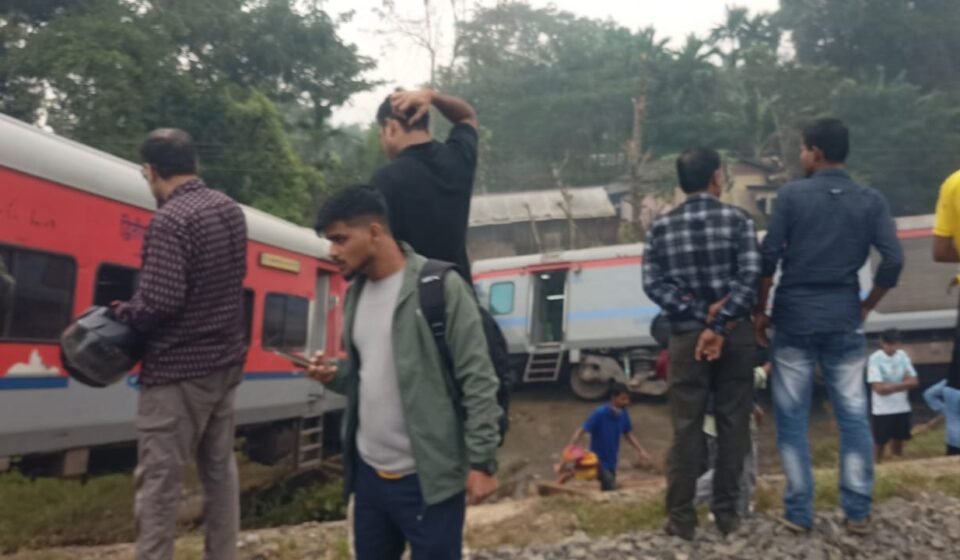
Train Derailment Near Guwahati Disrupts Northeast Rail Link as Engine and Five Coaches Leave Tracks

A major railway incident involving the Kolkata–Sairang Express disrupted train operations near Guwahati on Wednesday morning after its locomotive and five coaches derailed at Digaru railway station in Assam. The incident occurred while the train was being received at the station, prompting an immediate response from railway officials and the deployment of relief arrangements for passengers.
The derailment took place at approximately 6:54 a.m. in Digaru, located in Kamrup Metropolitan district, around 30 kilometres from Guwahati. The train involved was identified as Train No. 13125, the Kolkata–Sairang Express.
The incident brought attention to railway operating procedures at a station where trains may need to be regulated to allow another service to pass. The exact sequence of events is expected to be examined as railway authorities assess the damaged locomotive, coaches and track infrastructure.
What happened at Digaru railway station?
According to the preliminary explanation provided by Northeast Frontier Railway, the express train was being received at Digaru to give precedence to another train. During this movement, the locomotive and five passenger coaches went off the tracks.
The railway’s initial account indicated that the locomotive pilot could not control the train’s speed during the operation. This is a preliminary explanation and should not be treated as the final finding of an accident investigation.
The derailment involved six railway units in total: the locomotive and five coaches. Some early reports described the incident as involving six coaches in addition to the locomotive, while other reports counted the locomotive and five coaches as the affected units. The railway’s stated breakdown is therefore important when describing the scale of the accident.
The exact physical condition of every affected coach and the extent of damage to the railway track were not fully detailed in the initial information.
Conflicting early information about passenger injuries
Information about passenger safety varied in the first reports following the derailment.
Northeast Frontier Railway’s Chief Public Relations Officer, Kapinjal Kishore Sharma, initially said that no casualties had been reported. A subsequent railway account stated that all passengers were safe and that no injuries had been reported.
At the same time, some early media reports carried claims that several passengers had sustained injuries, with the number and seriousness of those injuries not immediately established.
These accounts were not consistent. The railway’s initial official position was that there were no casualties or reported injuries, while early reports of injuries remained unconfirmed in that information. A final verified injury figure should therefore not be assumed without an updated statement from the authorities.
The distinction matters because early information from an accident site can change as rescue teams reach passengers, assess medical needs and complete checks.
Railway officials reach the accident site
Following the incident, senior officials of Northeast Frontier Railway moved towards Digaru to supervise the response. The General Manager and other railway personnel were reported to be heading to the location.
The immediate priorities included checking the condition of passengers, assessing the derailed train and arranging the movement of people whose journey had been interrupted.
Railway authorities also began relief and restoration work. Such operations require teams to inspect the affected coaches, secure the site and determine whether the track and signalling equipment can safely support train movement again.
The derailment’s location at a railway station is significant because station operations involve controlled movements, points, signals and coordination between train crews and operating staff. Investigators will need to establish how the train was moving, what speed restrictions applied and whether the relevant operating instructions were followed.
Alternative transport arranged for passengers
Passengers travelling on the affected service were being shifted to an alternative train so that they could continue towards their destinations.
This arrangement was intended to reduce the inconvenience caused by the derailment rather than requiring passengers to wait until the damaged train was restored. The railway administration also initiated assistance and relief measures at the site.
However, details about the total number of passengers, the exact departure arrangements for the alternative service and the final travel schedules were not fully available in the initial updates.
Passengers travelling through the affected section may need to check official railway announcements for revised timings, possible delays and any changes to connecting services.
Why this rail connection matters
The Kolkata–Sairang Express is an important long-distance connection linking eastern India with Mizoram. Sairang, near Aizawl, is part of the railway network that has improved access to the northeastern state.
Rail connectivity is particularly important for the region because it supports passenger travel, the movement of goods and links with other parts of the country. Disruption to a long-distance service can affect passengers well beyond the location of the accident, especially when they depend on connecting trains.
The incident also highlights the operational demands placed on railway networks in the Northeast, where trains run through a combination of urban approaches, hills, bridges and geographically challenging sections.
The scale of disruption will depend on how quickly the affected track and equipment can be inspected and restored. No complete schedule for the resumption of normal operations was available in the initial reports.
Investigation and restoration remain key priorities
The immediate cause of the derailment has not been established through a completed inquiry. The preliminary explanation concerning speed control during the station movement will need to be tested against operational records and physical evidence.
Investigators may examine train movement data, signalling records, the condition of the locomotive and coaches, track components and statements from railway personnel. These checks can help determine whether the incident involved a speed-control issue, a technical fault, an operational error or a combination of factors.
The railway administration will also need to assess the condition of the affected section before normal train movements can safely resume.
For now, the confirmed central development is that the Kolkata–Sairang Express locomotive and five coaches derailed at Digaru at around 6:54 a.m. on Wednesday. Railway officials have launched relief and restoration arrangements, and passengers are being moved through an alternative service.
The final assessment of injuries, damage and responsibility will depend on further verified information from railway authorities.