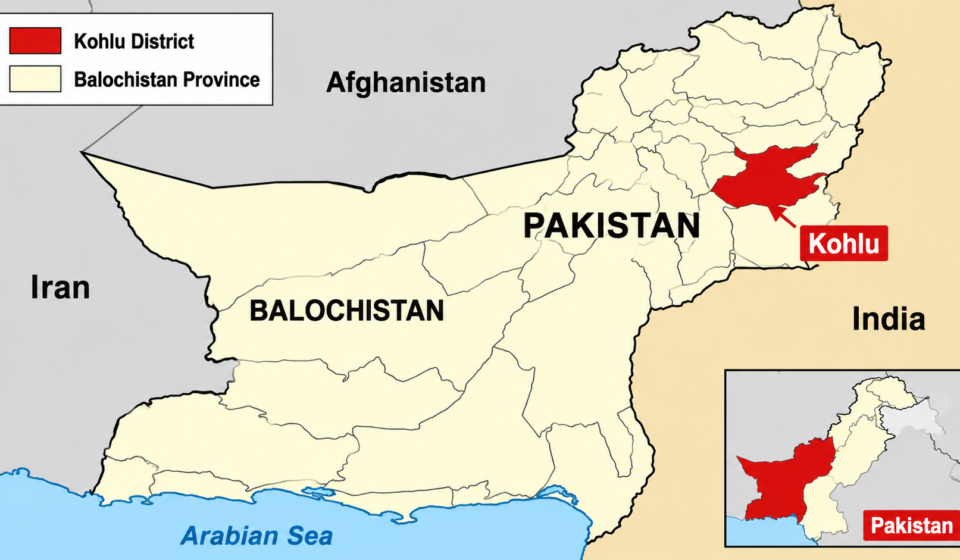

Balochistan coal miners attack killed at least 11 people on Sunday, November 29, when gunmen ambushed two vehicles carrying workers in southwestern Pakistan, officials said. The attack took place in Kohlu district, in Balochistan province, where police launched a search operation to identify and arrest the assailants. No group immediately claimed responsibility.
Key Highlights
• Gunmen ambushed two vehicles carrying coal miners in Kohlu district, killing 11 people, officials said.
• Police launched a search operation to trace and arrest those responsible.
• Pakistan’s Interior Minister Mohsin Naqvi condemned the killings and expressed condolences to the victims’ families.
• No group immediately claimed responsibility; authorities have previously blamed the outlawed Balochistan Liberation Army for similar attacks.
Attack in Kohlu District
The attack occurred in Kohlu, a district in Balochistan, a province that has experienced a rise in militant violence in recent months. Senior police official Tayyab Iqbal said the gunmen struck two vehicles carrying coal miners and fled after the killings. Police were working to trace the attackers and make arrests.
Local reporting said the workers were employed at the Chamalang coal mines and were travelling in two pickup vehicles toward Duki district. According to that account, armed men intercepted the vehicles in the Housri area of Jandran tehsil, forced the workers out and took them to a nearby mountainous area, where they were shot. These details have been reported locally; authorities’ initial public account confirmed the ambush and death toll but did not provide a full reconstruction of the attack.
Police reached the area and began searching for the assailants. Officials also worked to identify the victims. Local reports said identification was still underway for some of those killed.
Government Condemns the Killings
Pakistan’s Interior Minister Mohsin Naqvi condemned the attack and offered condolences to the families of the victims. His statement came as authorities faced renewed pressure to protect civilians and workers travelling through violence-affected parts of Balochistan.
The immediate official response focused on the investigation and search for those responsible. Police had not publicly identified the attackers or established a motive in the initial reports. No organisation had claimed responsibility by the time the reports were published.
Balochistan’s Long-running Insurgency
Balochistan is Pakistan’s largest province by area and is rich in oil, minerals and other natural resources. It has experienced a long-running separatist insurgency, with armed groups carrying out attacks against security forces, government targets and civilians. The province is also affected by violence from other militant organisations.
The outlawed Balochistan Liberation Army has been blamed by Pakistani authorities for previous attacks in the province. However, officials had not confirmed responsibility for Sunday’s killings, and no group had claimed the attack. Any attribution remains unconfirmed until investigators establish who carried it out.
The region’s security challenges are complicated by its geography and the presence of remote communities, mining sites and transport routes. Workers travelling between coal fields and nearby districts may have to pass through areas where security forces are stretched and armed groups operate. The latest attack has renewed concern about the safety of labourers moving through the province.
Workers and Mining Communities at Risk
Coal mining provides livelihoods for workers and their families in parts of Balochistan. Attacks on miners can have consequences well beyond the immediate loss of life, leaving families without income and creating fear among people who depend on travel to and from mining areas.
Sunday’s victims were travelling in vehicles when they were attacked, according to officials. The available initial reports do not establish whether they were specifically targeted because of their employment, their place of origin or another motive. Investigators will need to determine whether the attack was connected to the wider insurgency or involved a separate dispute.
The incident also raises questions about security on routes used by workers. Local reports described the miners as travelling from the Chamalang coal mines toward Duki. Authorities have not publicly announced new protective measures for workers or a change to transport arrangements following the killings.
Investigation and Unanswered Questions
Police launched a search operation to locate the gunmen, but the initial reports did not say whether suspects had been detained. The motive, the identity of the attackers and whether the victims were selected for a particular reason remained unclear.
Some local accounts provided additional details about the route and the circumstances in which the miners were taken away. Those accounts have not all been confirmed in the initial official description. The number of victims, however, was consistently reported as 11. Further information from investigators may clarify the sequence of events and whether anyone else was abducted or remains missing.
Strategic & Future Implications
The killing of 11 coal miners highlights the continuing danger faced by civilians in Balochistan, where separatist violence and other militant activity have persisted for years. The attack has again placed the security of workers and transport routes under scrutiny. While authorities have launched a search operation, the absence of a confirmed claim of responsibility or publicly established motive means the incident’s full context remains uncertain.
The investigation will be important not only for identifying those responsible but also for determining whether the miners were targeted as part of a wider campaign or for another reason. For mining communities, the immediate concern is whether workers can travel safely between work sites and home. Until authorities provide further findings and announce any security response, the attack leaves families grieving and raises fresh concerns about civilian safety in the province.