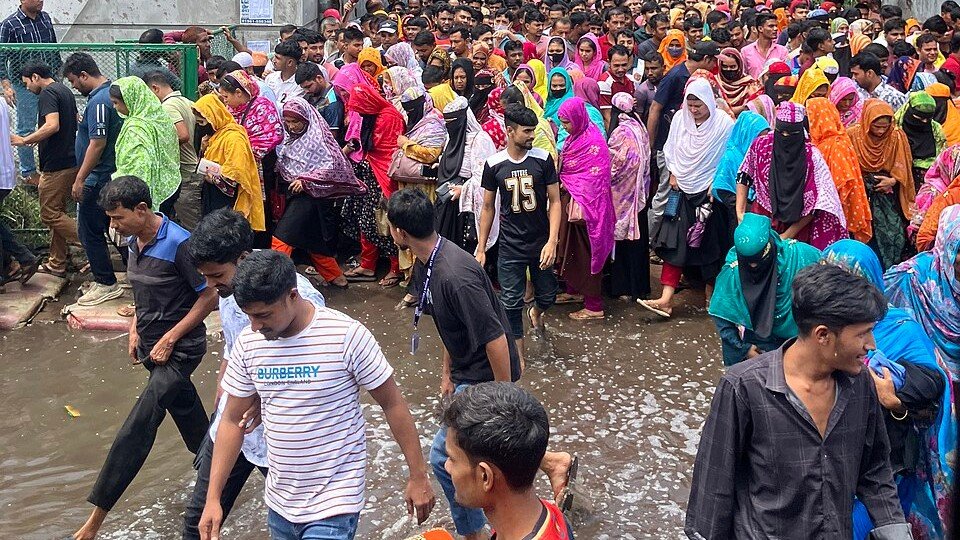

Bangladesh has established a new wage board to review minimum salaries in its garment industry, but the government’s move has yet to end protests by workers demanding higher pay amid rising living costs. Demonstrations across Dhaka and surrounding industrial areas have disrupted transport and factory operations, creating fresh uncertainty for one of the country’s most important export industries.
The six-member wage board was formed on November 1 following discussions involving the government, labour representatives and garment manufacturers. Its primary responsibility is to determine a revised minimum wage structure for workers in the ready-made garment sector.
Workers are demanding a minimum monthly salary of 30,000 Bangladeshi taka, more than double the existing minimum of 12,500 taka. They argue that increasing expenses for food, housing, transportation and healthcare have reduced the purchasing power of their current wages.
Wage Board Formed as Protests Continue
The government’s decision represents an important step towards addressing the wage dispute. However, workers continued demonstrating after the announcement, indicating that establishing a board alone may not be sufficient to restore confidence among employees.
Protests were reported in several industrial locations, including parts of Dhaka, Ashulia and Gazipur. Some demonstrations involved road blockades and confrontations with police. Authorities used tear gas and water cannon in efforts to disperse crowds, while reports also described damage to property and injuries during clashes.
The wage board includes representatives of employers and workers, alongside government and independent representation. Its task is to examine the wage structure and determine an appropriate minimum salary under Bangladesh’s labour law.
The central question now is how quickly the board can begin its work and whether its eventual recommendation will address workers’ concerns about the rising cost of living.
Why Workers Want a 30,000-Taka Minimum Wage
For many garment workers, wages must cover basic household expenses, including food, rent, transportation, education and medical care. When these costs rise faster than salaries, workers can find it increasingly difficult to meet essential needs.
Workers say the existing minimum wage no longer adequately reflects their financial pressures. Their demand for 30,000 taka per month is intended to provide greater purchasing power and improve their ability to manage everyday expenses.
However, the proposed increase would represent a substantial rise in labour costs for manufacturers. Factory owners must consider wages alongside spending on electricity, gas, raw materials, transportation and production facilities.
This creates a difficult balancing act for policymakers. A higher minimum wage could improve workers’ living standards, but the implementation process must also account for the financial position of factories competing in international markets.
A credible wage settlement will therefore depend on negotiations that consider both the needs of workers and the industry’s ability to sustain employment.
Why the Dispute Matters Beyond Bangladesh
Bangladesh’s garment industry is a major source of employment and foreign exchange. The sector employs approximately four million people and accounts for more than 80% of the country’s export earnings, making stable factory operations important to the wider economy.
The industry supplies clothing to international retailers and brands. When factories stop production, even temporarily, manufacturers may struggle to meet delivery schedules and buyers may face uncertainty over the arrival of orders.
Prolonged disruption could affect export revenue, factory cash flow and workers’ income. If manufacturers experience delays in receiving payments from international buyers, their ability to cover operating expenses and pay salaries could also come under pressure.
The timing of the unrest is particularly important because garment manufacturers are seeking orders in a competitive global market. Higher production costs, energy supply difficulties and uncertainty in international markets are already presenting challenges for businesses.
However, the extent of any lasting economic damage will depend on how quickly normal production resumes and whether the wage dispute can be resolved through negotiations.
What Happens Next?
The wage board’s next steps will be closely watched by workers, factory owners and international buyers. A transparent process, clear communication and a credible timetable could help reduce uncertainty and encourage a return to normal operations.
The government has urged workers to resume work, while warning that prolonged factory closures could delay shipments and payments. But the continued demonstrations suggest that many workers are still waiting for a concrete outcome on their wage demands.
The board must now move beyond its formation and undertake the work needed to establish a revised wage structure. Its recommendation will need to balance workers’ purchasing power with the financial realities facing manufacturers.
For Bangladesh, the challenge is not simply to end the protests. It is to find a wage settlement that improves workers’ livelihoods while protecting jobs, export competitiveness and long-term stability in the garment industry.