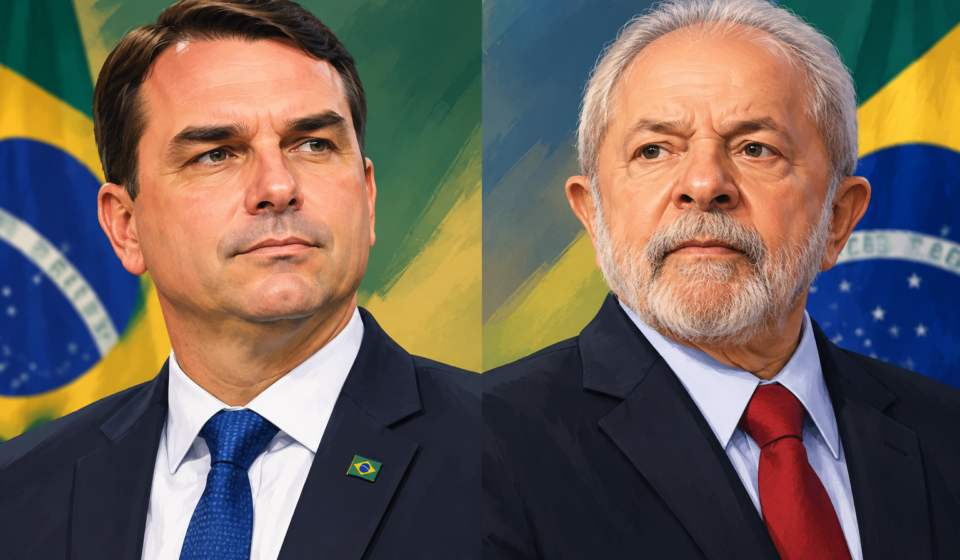

Brazil’s presidential election is heading to a second round after right-wing Senator Flávio Bolsonaro finished ahead of incumbent President Luiz Inácio Lula da Silva in the first round, but failed to secure the majority required for an outright victory.
With almost all ballots counted, Flávio Bolsonaro received 47.03% of valid votes, while Lula secured 45.16%, according to Brazil’s Superior Electoral Court (TSE). Neither candidate crossed the 50% threshold, setting up a decisive runoff on October 25.
Flávio Bolsonaro takes narrow first-round lead
The result gives Flávio Bolsonaro a narrow but significant advantage heading into the second round.
The senator, 45, is the eldest son of former Brazilian President Jair Bolsonaro and is running for the presidency for the first time. His first-round performance exceeded expectations, as several pre-election polls had shown Lula either leading or in a very close race.
Flávio received more than 56 million votes, compared with roughly 53.9 million for Lula, according to the official election count.
The result represents a major challenge for Lula, who is seeking another term after returning to the presidency in 2023.
Lula forced into another high-stakes battle
Lula, 80, entered the election seeking a fourth non-consecutive presidential term.
His campaign focused heavily on social programmes, economic relief and defending democratic institutions. However, the government has faced criticism over the cost of living, household debt, crime and economic concerns.
Despite those challenges, Lula remains a powerful political figure with a strong electoral base, particularly in Brazil’s Northeast.
The runoff now gives him another opportunity to rebuild support among voters who backed other candidates in the first round.
Other candidates could decide the runoff
Neither Flávio nor Lula can rely only on their first-round support.
Several million voters supported other presidential candidates, meaning the two finalists will now compete aggressively for those voters.
The campaign is expected to become more intense as both sides attempt to broaden their coalitions beyond their traditional political bases.
The central issues are likely to include the economy, public security, government spending, corruption, social programmes and Brazil’s position in international affairs.
Bolsonaro seeks to turn first-round lead into victory
Flávio Bolsonaro is expected to use his first-round victory as evidence that Brazilian voters want political change.
His campaign has emphasized public security, a tougher approach to crime and a more conservative political agenda. He has also benefited from the continuing strength of the Bolsonaro political movement.
His family remains a major force in Brazilian politics despite the legal troubles facing his father, Jair Bolsonaro.
The former president was convicted over an attempt to overturn the result of the 2022 election and remains imprisoned, making the 2026 contest closely connected to Brazil’s wider political divide.
Lula faces difficult path to another term
For Lula, the challenge will be to convince voters who supported other candidates that his government offers greater economic and political stability.
The president is expected to portray the runoff as a choice between his progressive agenda and the more conservative programme represented by Flávio Bolsonaro.
Lula has also sought to emphasize his record on reducing inequality and protecting social programmes.
The narrow first-round gap means the contest remains highly competitive, with neither candidate holding a decisive advantage going into the final weeks.
October 25 vote will decide Brazil’s next president
Brazilian voters will return to the polls on October 25 for the decisive second round.
The candidate who receives the majority of valid votes will become Brazil’s next president.
The election is being closely watched across Latin America and internationally because of Brazil’s economic importance, its role in global climate policy and its relations with the United States, China and other major powers.
The runoff between Flávio Bolsonaro and Lula is also expected to deepen an already highly polarized political environment.
For Flávio, the task is to convert his unexpected first-round lead into a national majority. For Lula, the immediate challenge is to close the gap and persuade voters outside his traditional support base.
The final result will determine whether Brazil remains under Lula’s leadership or moves toward a new conservative administration led by Flávio Bolsonaro.
Source attribution: Brazil’s Superior Electoral Court (TSE), Reuters, Associated Press and Agência Brasil.