Brazil Investigates Amazon Wildfires as Toxic Smoke Disrupts Daily Life and Fuels Election Tensions

Brazilian authorities are investigating a sharp rise in wildfires across the Amazon region after thick smoke disrupted everyday life and intensified political tensions ahead of the country’s presidential runoff election.
The state of Amazonas has experienced a significant increase in fire activity during October. The smoke has affected Manaus, the state capital and a major urban centre in the Brazilian Amazon, prompting authorities to suspend in-person school classes and municipal activities as air quality deteriorated.
The federal government suspects that some fires may have been deliberately set. Environment Minister João Paulo Capobianco has said that officials observed fire outbreaks in protected forest areas, raising concerns about possible criminal activity linked to forest degradation and illegal land occupation. Investigators are examining whether the incidents are isolated acts or part of a coordinated operation.
The investigation comes at a politically sensitive time, following Brazil’s October 4 first-round election. The country is preparing for a presidential runoff on October 25 between President Luiz Inácio Lula da Silva and Senator Flávio Bolsonaro.
The fires have become part of the wider political debate over environmental protection, enforcement against illegal land clearing and the government’s handling of the crisis. However, investigators have not established that all the fires are politically motivated.
Smoke Disrupts Life in Manaus
The impact of the fires has extended beyond remote forest areas to the daily lives of residents in Manaus.
Smoke carried from burning areas has reduced air quality and raised health concerns, particularly for children, older people and those with respiratory conditions. Municipal authorities have suspended in-person classes and some public activities while advising residents to take precautions.
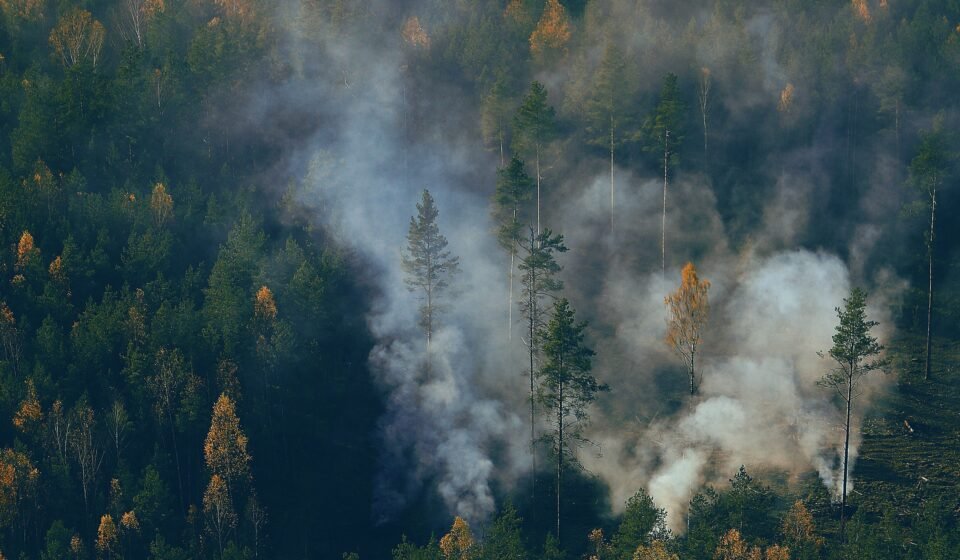
Satellite observations have also documented extensive smoke across parts of the Amazon. NASA reported that an image captured on October 12 showed smoke streaming from fires on both sides of the Amazon River, with heavy pollution affecting Manaus. Reported fine-particle pollution levels in the city reached hazardous levels during the episode.
Fine particulate matter, commonly known as PM2.5, consists of tiny airborne particles that can penetrate deep into the lungs. Exposure can aggravate asthma and other respiratory illnesses and can pose risks even to otherwise healthy people when pollution levels are very high.
The disruption highlights how forest fires can affect millions of people indirectly, even when the flames are far from urban neighbourhoods. Smoke can travel considerable distances, making air pollution a regional problem rather than one confined to the immediate fire zone.
Authorities Suspect Deliberate Burning
Brazil’s Environment Ministry has pointed to human activity as a major factor behind the fires in Amazonas.
According to Agência Brasil, officials reported 540 new fire hotspots over a 48-hour period in the state earlier this week. The environment minister said that fires in difficult-to-reach forested areas raised concerns about intentional burning intended to damage protected vegetation or prepare land for future occupation.
Brazilian authorities have opened investigative proceedings to examine suspected criminal conduct. Federal and state police agencies are involved, alongside environmental and other government bodies.
Investigators are expected to examine the locations of fire outbreaks, possible links between separate incidents and whether land clearing or illegal occupation was involved.
The government has also warned that people responsible for deliberately starting forest fires could face administrative penalties and criminal prosecution. The final responsibility for individual incidents will depend on the evidence gathered through investigations.
El Niño and Drier Conditions Add to the Risk
Although authorities suspect that many fires have human origins, environmental conditions can help flames spread more quickly and make them harder to control.
The Amazon’s dry season normally brings increased fire risk in several areas. Delayed rainfall, high temperatures and dry vegetation can make forests and recently cleared land more vulnerable to burning.
The El Niño climate phenomenon can alter rainfall patterns and contribute to hotter, drier conditions in parts of the region. Climate change can further intensify extreme heat and drought risks, although the contribution of each factor varies by location and event.
Many Amazon fires are associated with human activities, including land clearing and agricultural burning. When fires escape their intended boundaries, they can spread into surrounding vegetation and threaten forest ecosystems.
Researchers and environmental authorities therefore distinguish between the immediate ignition of a fire and the conditions that determine how widely it spreads. Both human decisions and environmental factors can contribute to the scale of a wildfire emergency.
Firefighting Teams Step Up Their Response
Brazilian authorities have deployed additional personnel and equipment to tackle the fires and limit the effects of smoke.
Agência Brasil reported that the response included aircraft used for firefighting, helicopters and hundreds of firefighters. Public health services have also been mobilised in municipalities affected by worsening air quality.
The response is intended to contain active fires, prevent further outbreaks and support communities facing the effects of smoke. Authorities have also called for stronger enforcement against people suspected of starting fires illegally.
The scale of the challenge remains substantial because fire outbreaks can occur across large, remote areas that are difficult for ground teams to reach. A reduction in new hotspots does not necessarily mean that air quality has returned to safe levels or that the wider emergency has ended.
Wildfires Become a Political Flashpoint
The crisis has intensified debate over Brazil’s environmental policies as the presidential runoff approaches.
Lula’s administration has emphasised federal action against the fires and the need to identify those responsible. Political opponents have used the situation to question the government’s environmental response and its ability to protect the Amazon.
The allegations of deliberate burning have added another dimension to the debate. Officials are examining whether any incidents may be connected to illegal land occupation or broader organised activity, but those suspicions should not be treated as proof of a political conspiracy.
The competing political narratives make transparent investigations especially important. Establishing the causes of individual fires will require evidence rather than assumptions based on the election campaign or the identities of political actors.
Why the Amazon Fires Matter Beyond Brazil
The Amazon rainforest plays an important role in biodiversity, carbon storage and the movement of moisture through South America’s climate system. Large-scale forest degradation can affect wildlife habitats, local livelihoods and the region’s ability to store carbon.
The consequences also extend to Indigenous communities and people whose food, water, transport and income depend on forest ecosystems and rivers.
The immediate priority is to protect residents from smoke, control active fires and establish who is responsible for illegal burning. Over the longer term, preventing deforestation, improving fire monitoring and enforcing environmental laws will be important to reducing the risk of recurring emergencies.
As investigations continue, the key questions are whether the surge in fires reflects coordinated criminal activity, how much is attributable to land-clearing practices and how effectively authorities can prevent further damage.