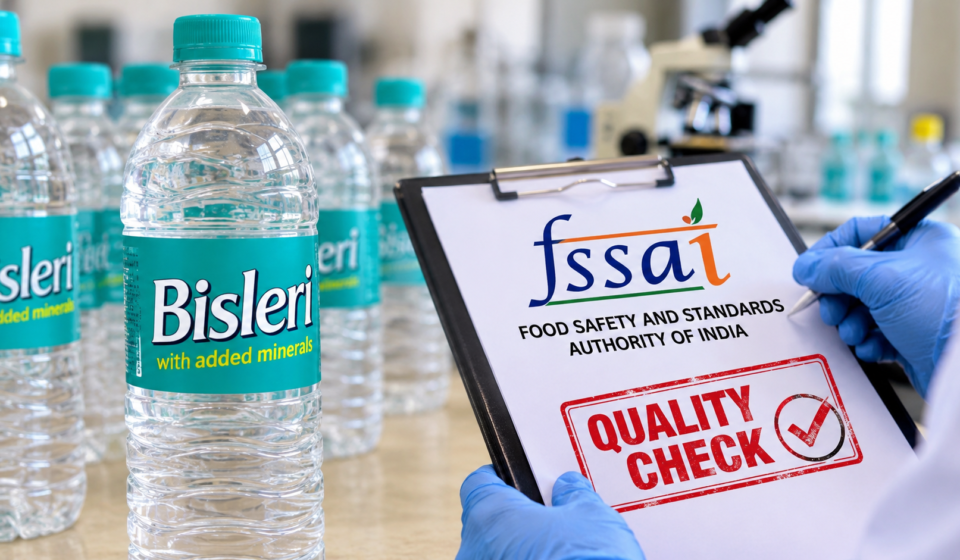
FSSAI Begins Nationwide Packaged Water Checks After Bisleri Row; Results Expected in 1–2 Months

India’s food safety regulator has begun a nationwide drive to test packaged drinking water, with laboratory results expected within one to two months, according to Food Safety and Standards Authority of India (FSSAI) Chief Executive Officer Rajit Punhani.
The exercise follows regulatory action involving a sample of Bisleri International’s packaged drinking water from its Goa facility. FSSAI has sanctioned prosecution against the company after the sample was declared unsafe following laboratory examination. Bisleri has maintained that its water is safe for consumption and said it will cooperate with the regulator.
Punhani said the nationwide checks are part of FSSAI’s ongoing surveillance of food categories and are not being undertaken because of one particular incident. The regulator has been examining different products in stages, with packaged drinking water now included in that process.
Key Highlights
• FSSAI has started collecting packaged drinking water samples across India.
• Laboratory results are expected in one to two months.
• The regulator says the drive is part of its wider food-safety monitoring programme.
• The Bisleri action relates to a specific sample and batch from its Goa facility.
• FSSAI is also preparing to inspect food packaging materials for compliance with food-grade standards.
Nationwide Sampling Underway
Punhani said the sampling process has started across the country and that the scale of the exercise means results will take time. He indicated that completing the testing could require at least a month or two.
The regulator has not publicly provided a final number of samples, the full list of companies being tested or a detailed schedule for releasing results. Earlier reports said officials had inspected premises of major packaged-water businesses and collected samples for laboratory analysis.
The drive will help the regulator assess whether products meet prescribed safety standards. Companies whose samples fail testing and are found to have violated applicable rules may face legal action.
The results will be important for determining whether any concerns extend beyond the sample that led to the Bisleri case. Until the testing is complete, the nationwide exercise does not establish that packaged water from other brands is unsafe.
FSSAI Says Water Checks Are Part of Routine Surveillance
Punhani said the regulator has been taking up food categories one by one. Previous surveillance efforts included dairy products, meat, eggs, cereals, energy drinks and sugary drinks. Packaged drinking water is the latest category to receive wider scrutiny.
His remarks place the water-testing exercise within FSSAI’s broader consumer-protection work. The agency’s role includes monitoring food safety, checking compliance with standards and taking action when products are found to violate the law.
The regulator has also said it will soon begin inspecting packaging materials used for food products to ensure they meet food-grade requirements. That work could cover materials that come into contact with food and beverages, although details of the inspection plan have not yet been announced.
What Triggered the Bisleri Case?
The current controversy concerns a regulatory sample of packaged drinking water collected from Bisleri International’s premises in Goa. FSSAI said the sample initially failed to meet the prescribed limit for bromate and was declared unsafe under the Food Safety and Standards Act, 2006.
After the company appealed, the sample was sent to a referral food laboratory for further examination. FSSAI said the referral laboratory also declared it unsafe after detecting polynuclear aromatic hydrocarbons, commonly known as PAHs.
The regulator subsequently sanctioned prosecution against Bisleri International. The action relates to the specific sample examined by the authorities, rather than a finding that every product manufactured by the company is unsafe.
FSSAI also prohibited the sale of the concerned batch. The batch was identified as GO 270 and was manufactured at the company’s Verna facility in South Goa on September 27, 2025.
Bisleri’s Response
Bisleri International has said its packaged drinking water is safe for consumption and that it maintains quality-control procedures. The company said it would cooperate with the regulator to address the matter.
The company also stated that the restriction applied to the specific batch identified by FSSAI and that it had no stocks of that batch available in the market. Bisleri said it produces more than 50,000 batches annually and referred to its own testing, which it said found bromate levels below the prescribed limit.
The regulator’s findings and the company’s response are distinct positions. The legal process will determine the consequences of the sample results and any alleged violation. The wider nationwide testing programme will provide additional information about packaged water products across the market.
What Consumers Should Understand
The announcement of nationwide checks is a monitoring measure; it is not a declaration that all packaged drinking water is unsafe. The regulator has not yet published the results of the current exercise, and consumers should avoid drawing conclusions about brands or batches that have not been identified in official findings.
For consumers, the most relevant information will be the final laboratory results, any product or batch-specific advisories, and instructions issued by food-safety authorities. A finding involving one sample should not automatically be applied to every batch produced by the same company.
The distinction also matters for businesses. Regulatory action can concern a particular product, batch or sample, while broader surveillance is designed to assess compliance across a category. The two processes serve different purposes.
Strategic & Future Implications
The nationwide exercise could give FSSAI a broader picture of packaged drinking water quality and help identify whether compliance problems are isolated or more widespread. Its value will depend on the coverage of sampling, the laboratory methods used and how clearly the findings are communicated to the public. The planned inspection of food packaging materials also signals that the regulator’s attention may extend beyond the contents of products to the materials used to package them.
For the packaged-water industry, the immediate focus will be on the test results and any follow-up enforcement. Companies may face increased scrutiny of quality controls, batch records and compliance documentation. For consumers, the most useful outcome will be transparent, batch-specific information that distinguishes confirmed safety findings from general concern. FSSAI has said the results are expected in one to two months; until then, the nationwide drive remains an ongoing inspection and testing process.