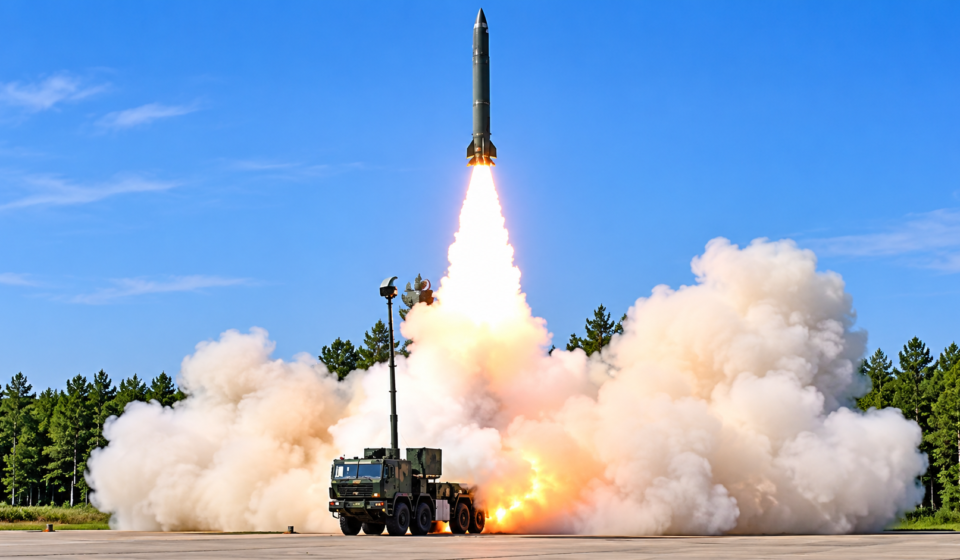

India has taken another significant step in strengthening its indigenous defence capabilities after the Defence Research and Development Organisation (DRDO) successfully flight-tested the Pralay quasi-ballistic missile off the Odisha coast. The latest trial, conducted on November 5, 2026, was part of user evaluation trials and is expected to bring the missile system closer to its induction into the armed forces.
According to the Ministry of Defence, the missile was launched from Dr APJ Abdul Kalam Island at approximately 11:10 am. Data recorded by various range instruments deployed by the Integrated Test Range (ITR), Chandipur, confirmed that all stipulated objectives of the test had been achieved.
The successful flight test was witnessed by senior DRDO officials, representatives from the defence industry and members of the armed forces. Defence Minister Rajnath Singh congratulated the scientists, defence personnel and industry partners involved in the programme, describing the achievement as another milestone in strengthening India’s domestic defence technology.
The ministry said that the missile’s induction into the armed forces had become imminent following the successful trial. However, the government has not announced a specific date for its formal deployment.
What makes the Pralay missile important?
Pralay is an indigenously developed, short-range, surface-to-surface quasi-ballistic missile designed to engage a range of ground-based targets. Unlike conventional ballistic missiles that generally follow a predictable trajectory after launch, a quasi-ballistic missile can make adjustments to its flight path during different stages of its journey.
This ability to alter its trajectory can make the missile’s movement more difficult for an opposing air-defence system to predict. Its design is intended to provide the armed forces with another conventional strike option in situations where speed, accuracy and operational flexibility are important.
Published technical details describe Pralay as having a strike range of approximately 150 to 500 kilometres and the capacity to carry a payload of around 500 to 1,000 kilograms. It uses a solid-propellant propulsion system and incorporates advanced guidance and navigation technologies intended to improve accuracy.
The missile is designed to carry different types of conventional warheads, allowing it to be used against various categories of targets. Its role is primarily tactical, meaning it is intended to support military operations at the battlefield and operational level rather than serve as a strategic nuclear delivery system.
The Defence Ministry’s announcement about the November 5 trial did not disclose the missile’s exact flight distance, payload configuration or detailed performance measurements during that particular test. The published range and payload figures should therefore be understood as reported specifications of the missile system, not as measurements confirmed for this individual flight.
DRDO and Indian industry behind the programme
The Pralay missile has been developed by Research Centre Imarat in Hyderabad, working with other laboratories of the DRDO. The project reflects India’s continuing effort to build important defence systems through domestic research, engineering and manufacturing.
Bharat Dynamics Limited (BDL), one of the programme’s development-cum-production partners, has manufactured the missile system. The involvement of Indian defence companies is important because the development of a modern weapon involves more than designing and testing a prototype. It also requires manufacturing capacity, quality control, maintenance arrangements and the ability to supply equipment to military units.
The partnership between DRDO and domestic industry is intended to strengthen the country’s defence manufacturing ecosystem. It can also help develop technical expertise and supply chains that may be useful for future missile and defence programmes.
The latest trial was conducted in the presence of representatives from these participating organisations, highlighting the role of collaboration between research institutions, manufacturers and the armed forces.
What are user evaluation trials?
User evaluation trials are an important stage in the process of bringing a newly developed weapon system into military service. While development trials examine whether a system meets its technical and design requirements, user evaluation involves assessing its performance against requirements set by the intended military users.
Such trials help determine whether the equipment is suitable for operational needs. They can involve checks of performance, reliability, handling and other parameters relevant to its intended use.
The Ministry of Defence said that the Pralay test met all stipulated objectives, with the results validated through data collected by range instruments. The statement that induction has become imminent suggests that the programme is approaching a significant stage, although formal induction, operational deployment and large-scale availability are separate milestones.
The armed forces will require suitable launch infrastructure, trained personnel, maintenance support and operational procedures before the system can become part of regular military capability.
Strengthening India’s indigenous defence capabilities
The successful test comes amid India’s broader effort to reduce dependence on imported military equipment and expand domestic defence manufacturing. Over recent years, the country has invested in indigenous missile programmes, aircraft, radar systems, naval platforms and other defence technologies.
Developing systems within the country can provide greater control over design changes, production schedules, maintenance and future upgrades. It can also support the development of specialised skills among Indian scientists, engineers and manufacturers.
For the armed forces, the addition of a domestically developed missile such as Pralay could provide another option for conventional precision strikes. Its reported range and payload capacity place it within the category of tactical missile systems intended to address battlefield requirements.
However, the effectiveness of any missile system depends on several factors, including its integration with surveillance and targeting networks, the availability of trained operators, logistics and the ability to maintain equipment under operational conditions.
A new milestone, with induction still ahead
The November 5 flight test represents an important development for the Pralay programme. The successful completion of user evaluation objectives has moved the system closer to its intended military role, according to the Defence Ministry.
The next phase will involve the remaining steps required for formal induction and operational readiness. The government has not yet provided a public timeline detailing when the missile will enter regular service or how many units may eventually be acquired.
For India’s defence research and manufacturing sector, the trial also demonstrates the growing role of domestic organisations in developing advanced military systems. As the Pralay programme moves towards its next stage, attention will focus on formal induction decisions, production plans and the missile’s eventual integration into the armed forces.