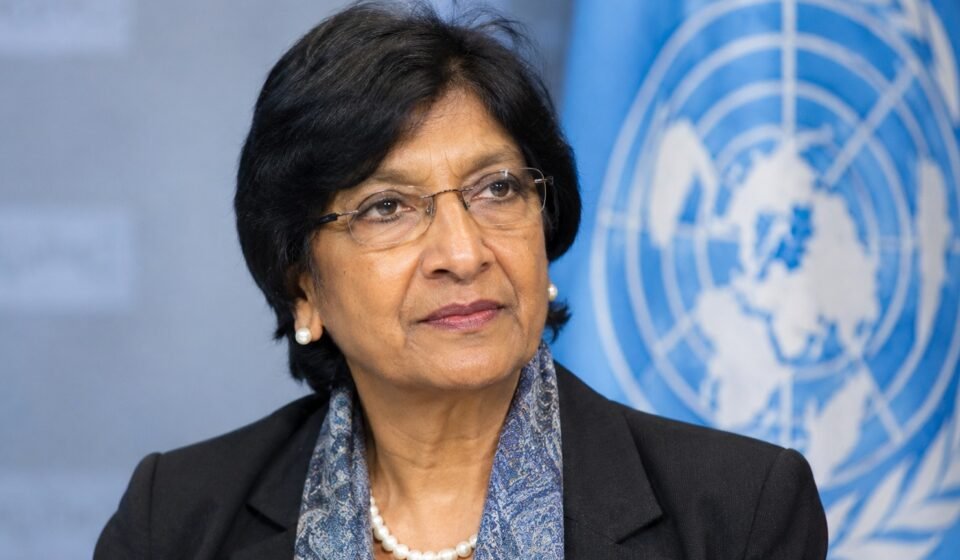

South African jurist Navi Pillay has won the 2026 Nobel Peace Prize in recognition of her efforts to strengthen international law, promote human rights and advance accountability for serious international crimes.
The Norwegian Nobel Committee announced the award on Friday, October 9, highlighting Pillay’s role in advancing a global legal framework capable of addressing war crimes, crimes against humanity and genocide.
Pillay, whose full name is Navanethem Pillay, has held several prominent positions in international justice. Her career includes serving as a judge at the International Criminal Tribunal for Rwanda, working at the International Criminal Court (ICC) and leading the United Nations as High Commissioner for Human Rights.
Nobel Committee Recognises International Law
The Nobel Peace Prize recognises Pillay’s long-standing commitment to the principle that international law should apply to all people, regardless of political power or national identity.
According to the committee, her work has helped strengthen efforts to investigate and prosecute some of the gravest crimes under international law. The recognition also draws attention to the importance of international institutions in resolving conflicts and protecting vulnerable communities.
The award comes at a time when international courts and human rights bodies face intense political scrutiny over their investigations and decisions. Pillay’s career has placed her at the centre of several highly sensitive international legal debates.
From Apartheid-Era South Africa to International Courts
Born in Durban, South Africa, to a family of Indian Tamil origin, Pillay grew up under apartheid, a system of racial segregation and discrimination that denied basic rights to the country’s Black majority and other non-white communities.
She became a lawyer and challenged discrimination through legal advocacy. Her early career included defending people involved in the struggle against apartheid, including opponents of the system associated with Nelson Mandela’s movement.
Her experience in South Africa helped shape her commitment to equality before the law and the protection of fundamental rights. She later took those principles into international legal institutions, where she worked on cases involving mass violence and alleged atrocities.
Pillay’s career has spanned domestic courts, international criminal tribunals and the United Nations, making her one of the most prominent figures in the development of modern international justice.
Roles at the ICC and United Nations
Pillay served as a judge at the International Criminal Court, which prosecutes individuals accused of genocide, war crimes, crimes against humanity and the crime of aggression when the court has jurisdiction.
She also served as the United Nations High Commissioner for Human Rights, a position in which she advocated for the protection of civil liberties, accountability for abuses and stronger international responses to human rights violations.
Her work has involved difficult questions about the responsibilities of governments, the rights of victims and the ability of international institutions to hold powerful actors accountable.
Pillay has also been associated with United Nations investigations concerning the occupied Palestinian territory. A commission she chaired concluded in 2025 that Israel had committed genocide in Gaza, a finding Israel strongly rejected. Such findings and the responses to them have remained politically contentious.
The Nobel recognition does not itself resolve those disputes. Rather, it highlights the committee’s assessment of Pillay’s broader contribution to international law and human rights.
Why the Award Matters
The 2026 award places renewed focus on whether international law can provide meaningful protection during conflicts and whether those responsible for serious crimes can be held accountable.
Supporters of international justice argue that independent courts and investigations can help victims seek recognition and reduce impunity. Critics, however, have sometimes questioned the impartiality, jurisdiction or political impact of international institutions.
Pillay’s Nobel Peace Prize is likely to intensify that debate. Her career reflects both the ambition of international justice—to apply legal principles across borders—and the political resistance that can arise when powerful governments or officials are scrutinised.
The committee’s decision sends a message about the importance it attaches to legal accountability as part of the pursuit of peace.
A Career Spanning Decades
From challenging apartheid in South Africa to serving in international courts and leading the UN human rights office, Pillay has spent decades working on questions of discrimination, justice and state responsibility.
Her 2026 Nobel Peace Prize recognises that career and brings international attention to the institutions and legal principles she has championed. It also places the protection of human rights and accountability for serious crimes back at the centre of the global discussion on peace.