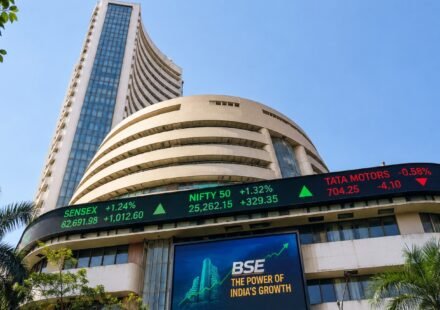
Dalal Street Braces for Monday Moves as Global Cues, Oil and Jobs Data Shape Market Mood

Indian equity markets are set to resume regular trading on Monday after a strong weekly rally and a relatively quiet Diwali Muhurat session. Investors will be watching global market signals, movements in crude oil, the latest US employment figures and foreign investment flows to assess the direction of the Sensex and Nifty 50.
The previous regular trading session on Friday, November 6, saw the Nifty 50 close at 25,030.35, while the Sensex settled at 81,028.02. During Sunday's special Muhurat trading session, both benchmarks ended slightly lower. The Nifty slipped 0.18 per cent to 24,986.40, while the Sensex declined 0.04 per cent to 80,999.40.
The market now faces the task of determining whether the recent recovery can continue or whether investors will book profits after several sessions of strong gains.
Here are five important factors that could influence Dalal Street on November 9.
1. GIFT Nifty: First indication of market sentiment
GIFT Nifty will be among the first indicators investors monitor before the domestic market opens at 9:15 am.
The index futures contract provides an indication of how overseas trading activity is influencing expectations for Indian equities. Its movement can reflect changes in global risk appetite, currency trends and developments in international markets while Indian exchanges are closed.
Investors will compare the latest GIFT Nifty level with the previous Nifty 50 closing mark of 25,030.35 to assess the possible opening direction.
However, the futures signal should not be treated as a guarantee of how the market will actually open. Sentiment can change during the pre-opening session as institutional orders and individual stock movements influence prices.
After the recent rally, the ability of the Nifty to sustain buying interest around its previous closing range will be closely watched.
2. US Nonfarm Payrolls: Strong jobs data changes interest-rate expectations
The latest US employment report is another major factor influencing global financial markets.
American employers added 165,000 jobs in October, considerably higher than the market expectation of approximately 65,000. The unemployment rate also declined from 4.2 per cent to 4.1 per cent.
The stronger employment figures indicate that the US labour market remains relatively resilient. However, they have also increased expectations that the Federal Reserve may maintain a tighter monetary policy for longer or consider another interest-rate increase.
Higher US interest rates can strengthen the dollar and make American fixed-income investments more attractive relative to emerging-market assets.
For India, this creates a potential challenge because foreign investors may reconsider their allocation to equities if global borrowing costs remain elevated.
The employment report has already been released, so Monday's focus will be on how investors continue to interpret its implications for US monetary policy.
3. Crude Oil Prices: A key factor for India's economy
International crude oil prices remain particularly important for the Indian stock market because India depends heavily on imported energy.
Brent crude was trading around $97.49 per barrel in early Monday trading, keeping energy costs firmly on investors' radar.
A sustained decline in oil prices can benefit India by reducing the country's import bill, easing pressure on the rupee and potentially improving the cost structure of several industries.
Lower crude prices may also support sectors such as aviation, paints, chemicals, logistics and other businesses that depend on petroleum-based inputs.
On the other hand, a renewed increase in oil prices could raise concerns about inflation, corporate expenses and the country's external balance.
Investors will therefore monitor whether crude continues to ease or begins recovering from its recent decline.
4. Global Markets and Technology Stocks
International market performance will provide another important signal for Indian equities.
Asian markets began Monday on a firmer footing, with Japan's Nikkei gaining around 2.5 per cent and broader regional shares also moving higher. US equity futures edged upward after a volatile period in technology stocks.
The recent global technology-sector correction has been driven partly by concerns about the cost of artificial intelligence investments, future profitability and possible regulatory changes.
This matters for Indian markets because global investment flows can influence technology shares, financial stocks and other heavyweight companies in the Nifty 50 and Sensex.
A recovery in international equities could support investor confidence, although uncertainty around technology valuations and interest rates may continue to create sudden price movements.
Market participants will also track the performance of Asian semiconductor and technology companies for clues about the strength of the global recovery.
5. FII-DII Activity and Domestic Inflation Expectations
Institutional investment activity will be another important factor determining whether the recent market rally can maintain its strength.
Foreign portfolio investors purchased approximately Rs 45,961 crore worth of Indian equities over five sessions in November, indicating a substantial return of overseas buying interest.
The buying has helped support domestic benchmarks after a period of uncertainty. However, investors will want to see whether these inflows continue rather than treating a short period of purchases as a permanent change in sentiment.
Domestic institutional investors have also been active in the market, and their buying or selling activity can influence the balance between demand and supply.
Meanwhile, India's October retail inflation data, scheduled for November 12, will be an important upcoming domestic event.
The inflation reading could influence expectations about monetary policy and interest rates. A higher-than-expected figure may create concerns about borrowing costs, while a softer reading could improve expectations for economic and market conditions.
Important trading calendar update
Indian equity markets will remain open for normal trading on Monday, November 9, from 9:15 am to 3:30 pm.
However, Tuesday, November 10, will be a trading holiday on account of Diwali-Balipratipada. Investors should account for the holiday while planning short-term positions and settlement requirements.
The shorter trading week may also influence trading volumes and the timing of portfolio adjustments.
What investors should watch today
The market enters Monday with a combination of supportive and challenging signals. Lower oil prices, renewed foreign buying and stronger global equity sentiment may provide support, while higher US interest-rate expectations and uncertainty around technology valuations could limit enthusiasm.
The Nifty 50's ability to hold its recent gains and the Sensex's movement around the 81,000 level will remain important reference points.
Rather than relying on one indicator, investors will need to assess GIFT Nifty, crude oil, international markets and institutional flows together.
After a sharp recovery, the next phase for Indian equities may depend on whether buying interest broadens across sectors and whether global conditions remain supportive.
For November 9, the focus is therefore not just on the opening direction but on the strength and sustainability of market participation throughout the trading session.

Stock Market Today: Sensex and Nifty Set for a Bullish Opening as Global Rally Lifts Investor Sentiment
The Indian stock market is expected to open sharply higher on Thursday, November 5, 2026, as strong signals from GIFT Nifty, falling crude oil prices and a rally on Wall Street improve investor sentiment. The benchmark Sensex and Nifty 50 are likely to extend their recent winning streak, although volatility in Asian markets could influence trading during the session.
GIFT Nifty was trading around 24,300–24,315 in early morning trade, indicating a premium of approximately 340–355 points over the previous Nifty futures closing level. The positive indication comes after Indian equity benchmarks ended Wednesday's session in the green for the fifth consecutive trading day.
However, investors will need to monitor developments in global markets. South Korea's Kospi declined more than 3%, while Japan and Taiwan also witnessed weakness in early trading. In contrast, US markets closed with substantial gains after the latest US midterm election results.
The decline in international crude prices is another important factor supporting Indian equities, as lower oil prices can ease pressure on India's import bill and inflation.
1. GIFT Nifty signals a strong opening
GIFT Nifty provided one of the strongest positive signals for the Indian market before Thursday's opening bell.
The index was trading near 24,300 in early trade, suggesting that the Nifty 50 could begin the session considerably higher than its previous close.
A strong opening could help the domestic market extend its recovery, particularly in heavyweight banking, automobile, financial and consumer stocks.
However, a gap-up opening does not guarantee that the market will maintain its gains throughout the day. Traders will watch whether buying interest continues after the initial opening moves.
Market participants may also book profits after five consecutive sessions of gains, particularly if the indices approach important technical resistance levels.
2. Sensex and Nifty 50: Previous session performance
Indian benchmark indices continued their positive momentum on Wednesday, November 4.
The BSE Sensex gained 383.55 points, or 0.50%, to close at 77,301.40. During the session, it touched an intraday high of 77,396.04.
The NSE Nifty 50 advanced 149.75 points, or 0.63%, to settle at 23,960.60.
The gains were supported by buying in financial, automobile, FMCG and other heavyweight stocks. Improving foreign investor participation and falling crude oil prices also helped market sentiment.
The Nifty's close near the 24,000 mark has made this level particularly important for Thursday's trading session.
3. Wall Street rallies after US midterm election results
US stock markets ended Wednesday with strong gains following the Democratic Party's victory in the US midterm elections.
The Dow Jones Industrial Average surged 1,569.40 points, or approximately 3%, to close at 53,356.12. It was one of the strongest single-day advances for the index in recent months.
The S&P 500 climbed 119.70 points, or 1.6%, to finish at 7,688.62.
The Nasdaq Composite also advanced 364.50 points, or 1.4%, to settle at 25,736.51.
Investors reacted positively to the election outcome and a decline in crude oil prices. Political developments also influenced expectations surrounding US economic and foreign policy.
The rally on Wall Street provided an important positive signal for Asian markets and Indian equities. However, technology-related stocks faced pressure in parts of Asia despite the broader improvement in US market sentiment.
4. South Korea's Kospi slides more than 3%
Asian markets presented a mixed picture on Thursday morning.
South Korea's Kospi was among the biggest regional laggards, falling more than 3% during early trading. The index briefly dropped over 4%, triggering a temporary market mechanism designed to control certain types of program-driven selling.
The weakness was concentrated in technology and semiconductor-related stocks.
Samsung Electronics and SK Hynix faced selling pressure as investors reassessed valuations of companies linked to artificial intelligence and data-centre investment.
The Kosdaq index also declined sharply.
The weakness in South Korean technology shares is important for global investors because semiconductor companies play a major role in the international AI and electronics supply chain.
Japan's Nikkei 225 also moved lower after an initially positive start, while Taiwan's Taiex traded in negative territory.
The contrasting performance of Asian markets indicates that investors are not responding uniformly to the positive Wall Street session.
5. Crude oil prices remain an important market trigger
Crude oil prices are another major factor that Indian investors will monitor.
Brent crude fell sharply in the previous session, losing more than 8% amid changing expectations about the geopolitical situation involving the United States and Iran.
On Thursday morning, Brent crude was trading around the $93–95 per barrel range in early market reports, while US West Texas Intermediate crude was near $88 per barrel.
Lower oil prices are generally positive for India because the country imports a substantial portion of its crude oil requirements.
A sustained decline can reduce pressure on the import bill, support the rupee and improve the operating environment for sectors such as aviation, paints, chemicals and oil-consuming industries.
However, any fresh escalation in geopolitical tensions could quickly change the direction of crude prices.
6. Foreign and domestic institutional investor activity
Institutional investment flows will remain an important factor for Dalal Street.
Foreign institutional investors continued their buying activity for the fourth consecutive session on Wednesday. They purchased Indian equities worth approximately Rs 7,284 crore.
Domestic institutional investors, meanwhile, sold shares worth around Rs 3,712 crore.
The continued participation of foreign investors has helped support the recent market recovery.
Investors will watch whether this buying trend continues on Thursday, particularly in large-cap financial and consumer companies.
7. Gold and silver prices in focus
Precious metals also attracted attention after the decline in the US dollar and Treasury yields.
Spot gold rose around 3.3% in the previous session, marking its strongest single-day advance since August. It was trading near $4,070 per ounce in early Thursday reports.
Silver also gained, moving towards $52.36 per ounce after a strong previous session.
The movement in gold and silver prices will be watched alongside currency fluctuations and changing expectations about US monetary and economic policy.
8. Stocks likely to remain in focus
Several companies could attract attention following their latest earnings announcements and business updates.
BSE: The exchange operator reported a 45% rise in second-quarter profit, making its shares important to watch.
Apollo Hospitals: The healthcare company reported a substantial increase in quarterly profit, with earnings rising by nearly one-third.
Lenskart: The eyewear retailer also reported strong earnings growth, with quarterly profit more than doubling.
Apart from these companies, banking, automobile, FMCG, technology and aviation stocks may remain active depending on the strength of buying after the opening bell.
9. Sensex and Nifty 50: Important technical levels
Technical analysts are watching important support and resistance levels as the market approaches the psychological 24,000 mark.
For the Nifty 50, immediate support is placed around 23,700. On the upside, 24,000 remains an important resistance level, followed by 24,200.
A sustained move above 24,000 could improve the short-term technical outlook, while a failure to hold higher levels may lead to consolidation or profit booking.
For the Sensex, immediate support is seen around 76,500–76,900, while resistance is placed in the 77,700–78,000 zone.
These are analyst-provided technical reference levels, not guaranteed market targets.
What should investors watch today?
The November 5 trading session will be influenced by several interconnected developments: GIFT Nifty's strong indication, the Wall Street rally, weakness in South Korean technology stocks, falling crude oil prices and institutional fund flows.
The initial opening could be positive, but the market's ability to sustain gains will be more important than the opening gap itself.
Investors should also monitor global geopolitical developments, currency movements and company-specific earnings announcements.
With the Nifty approaching the 24,000 level and the Sensex trading above 77,000, Thursday could be an important session for determining whether the recent recovery has further room to continue or whether traders begin booking profits.